Indian Rupee strengthens on lower oil prices, AI unwinding
- The Indian Rupee gains significantly against the US Dollar due to multiple tailwinds.
- Lower oil prices and AI unwinding have underpinned the Indian currency.
- The Fed is expected to deliver three back-to-back interest rate hikes.


The Indian Rupee (INR) opens sharply higher against the US Dollar (USD) on Tuesday, with the USD/INR pair revisiting the six-month low of 93.62. The pair is under pressure as the Indian currency strengthens due to lower oil prices, a consistent inflows of foreign funds due to the unwinding of Artificial Intelligence (AI) trade globally.
Why are oil prices falling?
Rising exports of energy products from the Middle East despite attacks on tankers in the region have improved hopes of supply surplus. The International Energy Agency (IEA) said last week that the global oil market will return to a surplus in the fourth quarter of this year, as Middle East exports recover faster than global oil demand despite attacks on shipping, Reuters reported.
In the opening trade, the MCX Crude Oil contract expiring on November 19 is down 1.53% to near Rs. 7,955. The oil price is close to its almost 11-week low of Rs. 7,861. Lower oil prices bode well for currencies from economies, such as India, which rely heavily on oil imports to meet their energy needs.
FIIs continue to pour money into the Indian stock market
Indian stock markets continue to attract investment from Foreign Institutional Investors (FIIs), with the entire world is facing the rapid unwinding of AI trade, following the victory of United States (US) Democrats in midterm elections and the resignation of Nvidia CEO Jensen Huang
India’s Chief Economic Advisor (CEA) V Anantha Nageswaran also said in an interview with Indian Express newspaper published on Monday, “India’s status as a non-AI play is definitely weighing positively on the Indian market sentiment and also drawing in foreign institutional investors in the near term.”
So far in November, FIIs have remained net buyers on all trading days, except for the Diwali Muhurat trading session, and bought stake worth Rs. 84,167.40 crore.
US Dollar outperforms on hawkish Fed rhetoric
The US Dollar Index (DXY) retreats after posting a fresh 19-month high at 103.70 in the early trade on Tuesday, but is likely to regain strength again as market experts bet on consecutive interest rate hikes from the Federal Reserve (Fed).
Analysts at MUFG/BTMU highlight that the sharp hawkish repricing of Fed policy has filtered directly into the US rates market, which is now "assigning a higher probability to three consecutive hikes in December, January and March, which would lift the effective Fed funds rate towards 4.6%."
USD/INR Technical Analysis
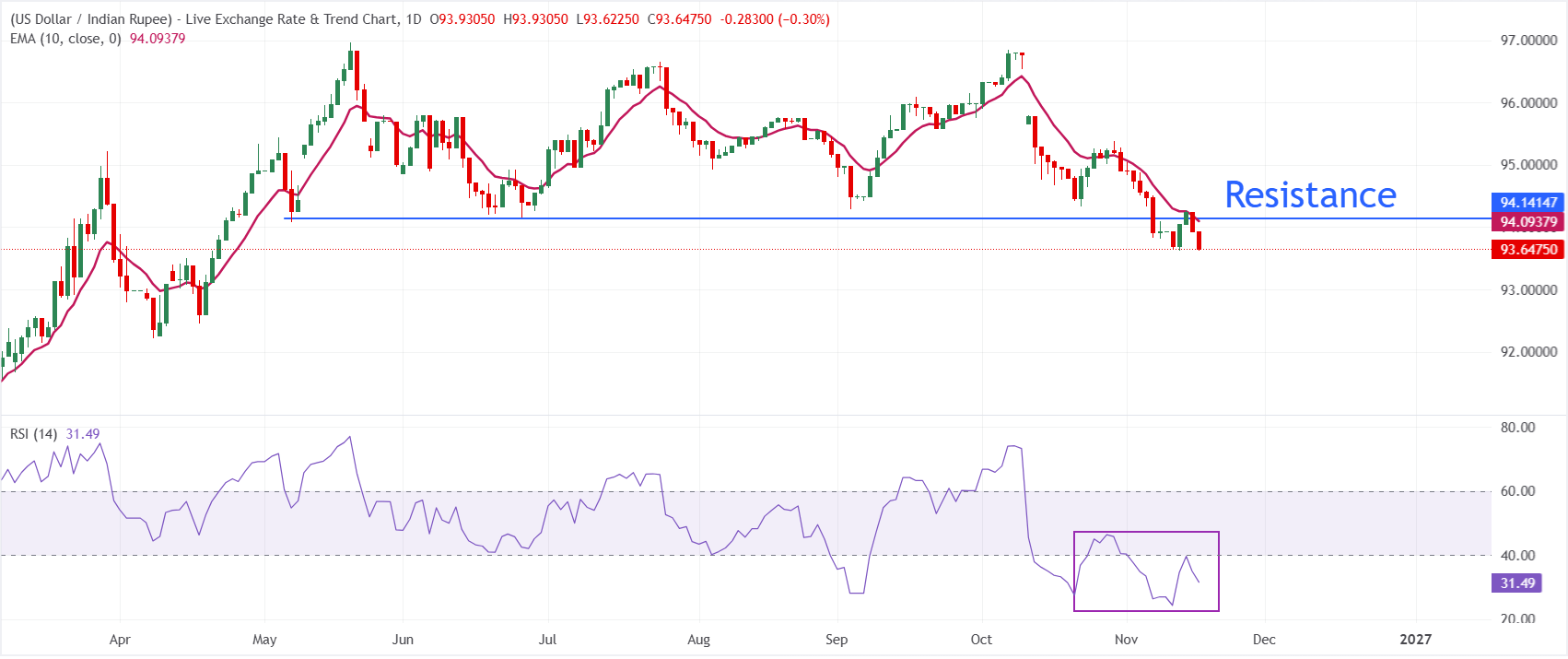
In the daily chart, USD/INR trades at 93.65, maintaining a bearish near-term bias as spot holds beneath the 10-day exponential moving average (EMA) at 94.09. The pair’s slide below this short-term average suggests that rallies are being capped by immediate overhead supply, while the Relative Strength Index (RSI) at 31.58 hovers just above oversold territory, hinting at persistent but not yet exhausted downside pressure.
On the topside, initial resistance is located at the 10-day EMA around 94.10, and a sustained recovery above this barrier would be needed to ease the current bearish tone and open the way for a broader corrective bounce. Looking down, the 93.00 level would act as key support for the pair.
(The technical analysis of this story was written with the help of an AI tool. Know more.)
Indian Rupee FAQs
The Indian Rupee (INR) is one of the most sensitive currencies to external factors. The price of Crude Oil (the country is highly dependent on imported Oil), the value of the US Dollar – most trade is conducted in USD – and the level of foreign investment, are all influential. Direct intervention by the Reserve Bank of India (RBI) in FX markets to keep the exchange rate stable, as well as the level of interest rates set by the RBI, are further major influencing factors on the Rupee.
The Reserve Bank of India (RBI) actively intervenes in forex markets to maintain a stable exchange rate, to help facilitate trade. In addition, the RBI tries to maintain the inflation rate at its 4% target by adjusting interest rates. Higher interest rates usually strengthen the Rupee. This is due to the role of the ‘carry trade’ in which investors borrow in countries with lower interest rates so as to place their money in countries’ offering relatively higher interest rates and profit from the difference.
Macroeconomic factors that influence the value of the Rupee include inflation, interest rates, the economic growth rate (GDP), the balance of trade, and inflows from foreign investment. A higher growth rate can lead to more overseas investment, pushing up demand for the Rupee. A less negative balance of trade will eventually lead to a stronger Rupee. Higher interest rates, especially real rates (interest rates less inflation) are also positive for the Rupee. A risk-on environment can lead to greater inflows of Foreign Direct and Indirect Investment (FDI and FII), which also benefit the Rupee.
Higher inflation, particularly, if it is comparatively higher than India’s peers, is generally negative for the currency as it reflects devaluation through oversupply. Inflation also increases the cost of exports, leading to more Rupees being sold to purchase foreign imports, which is Rupee-negative. At the same time, higher inflation usually leads to the Reserve Bank of India (RBI) raising interest rates and this can be positive for the Rupee, due to increased demand from international investors. The opposite effect is true of lower inflation.
Author
Sagar Dua
FXStreet
Sagar Dua is associated with the financial markets from his college days. Along with pursuing post-graduation in Commerce in 2014, he started his markets training with chart analysis.

















