Indian Rupee inches lower as US Dollar rises on safe-haven demand
- USD/INR rises as the US Dollar strengthens amid rising Middle East geopolitical tensions.
- Declining crude offers relief to INR, but pending US sanctions on Iran threaten to push prices up.
- Robust capital inflows have helped limit the Indian Rupee's losses.

The Indian Rupee (INR) loses ground on Monday as the US Dollar (USD) gains on rising safe-haven demand driven by escalating geopolitical tensions in the Middle East. Friction intensified after Iranian Foreign Minister Abbas Araghchi dismissed upcoming US sanctions as an act of desperation, while Iranian Security Chief Mohsen Rezaei warned of "earthquake-like" retaliation if US President Donald Trump takes further action, reinforcing a risk-off mood across global markets.
However, the Rupee attempted to maintain its position for a quiet start to the week. Strong capital inflows have supported the local currency, though traders remain attentive to fluctuating oil prices and potential Reserve Bank of India (RBI) interventions designed to maintain stability. Pressure on the Rupee temporarily eased alongside a dip in crude oil prices as investors took profits ahead of expected US announcements regarding stricter sanctions on Iran.
The Indian Rupee may further face challenges as Crude oil prices threaten to rebound following a statement from US Treasury Secretary Scott Bessent regarding Washington's plans to impose unprecedented sanctions on Iran. This potential policy shift, combined with severe disruptions to Iranian oil shipments, reduced offers to Chinese buyers, and an ongoing US naval blockade, risks further constraining global energy markets. Geopolitical tensions around the critical Strait of Hormuz remain high, with vessel transit continuing significantly below historical averages, a major concern for India, the third-largest global crude importer, which experienced record foreign investor equity outflows earlier this year due to elevated oil costs.
Oil curve signals markets bracing for extended Strait of Hormuz disruption
Analysts at Deutsche Bank highlight that the structure of the Brent futures market is increasingly reflecting geopolitical risk, noting that “if we look at the oil futures curve, it’s clear that markets are starting to price in a longer closure of the Strait of Hormuz again.” This shift along the curve underscores how traders are reassessing the duration and severity of potential supply disruptions, reinforcing the recent resilience in crude prices and keeping inflation and yield concerns firmly in focus.
Despite ongoing geopolitical uncertainty that may suppress broader risk appetite, pressure on the Rupee is expected to be cushioned by active Reserve Bank of India (RBI) interventions. Over the weekend, the central bank reported accumulating nearly $73 billion under initiatives launched in June to reinforce India's balance of payments, pushing foreign exchange reserves near record levels.
Analysts at MUFG/BTMU point out that the latest policy communication from the Reserve Bank of India marks a notable shift in tone. They highlight that “the August MPC minutes were more hawkish than the actual policy meeting and also what markets expected,” adding that the minutes “also suggest the RBI has reached the end of its easing cycle with the next move higher rather than lower.” This reinforces MUFG’s view that the central bank is now poised to pivot away from accommodation and toward rate hikes in the coming months.
Strategists at Scotiabank argue that the US Dollar (USD) remains the primary shock absorber for mounting US fiscal concerns. With policymakers focused on keeping long-term yields in check, they contend that “efforts to suppress long-term yields mean that the USD will bear a greater—negative—burden from US fiscal policy concerns,” reinforcing their view that the Dollar is likely to stay under pressure as these issues persist.
Technical Analysis: USD/INR rises amid prevailing bullish bias
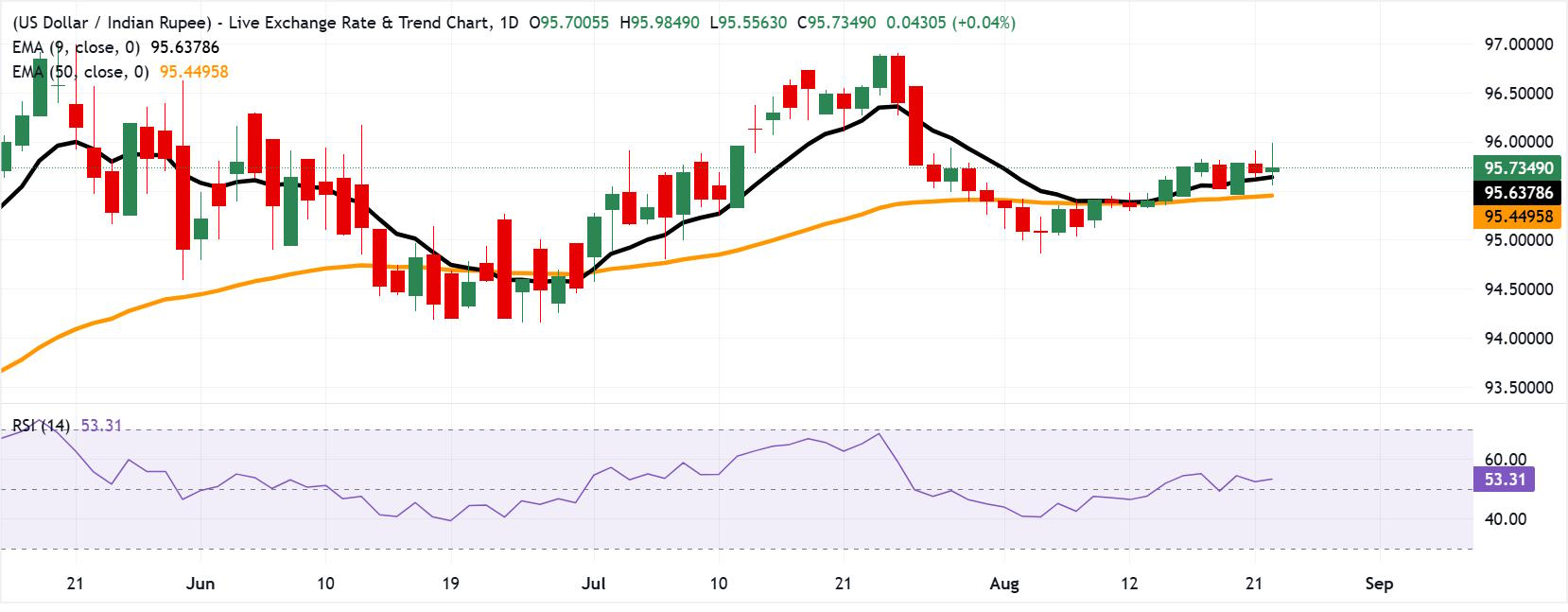
USD/INR trades around 95.70, holding above both the nine-period and 50-period Exponential Moving Averages (EMAs), which keeps the near-term bias mildly bullish. The short-term nine-period EMA at 95.64 sits just below spot, reinforcing a constructive tone, while the 50-period EMA at 95.45 underpins the broader uptrend. The 14-day Relative Strength Index (RSI) near 53 suggests neutral-to-firm momentum rather than overbought conditions, allowing room for further upside as long as price stays above these averages.
On the downside, initial support is seen at the nine-period EMA, with a deeper structural floor at the 50-period EMA. As long as USD/INR defends this support cluster, pullbacks are likely to be limited, and buyers could retain control, with the lack of nearby overhead levels hinting that any fresh advance would need new resistance to be established higher up the chart.
(The technical analysis of this story was written with the help of an AI tool. Know more.)
Indian Rupee FAQs
The Indian Rupee (INR) is one of the most sensitive currencies to external factors. The price of Crude Oil (the country is highly dependent on imported Oil), the value of the US Dollar – most trade is conducted in USD – and the level of foreign investment, are all influential. Direct intervention by the Reserve Bank of India (RBI) in FX markets to keep the exchange rate stable, as well as the level of interest rates set by the RBI, are further major influencing factors on the Rupee.
The Reserve Bank of India (RBI) actively intervenes in forex markets to maintain a stable exchange rate, to help facilitate trade. In addition, the RBI tries to maintain the inflation rate at its 4% target by adjusting interest rates. Higher interest rates usually strengthen the Rupee. This is due to the role of the ‘carry trade’ in which investors borrow in countries with lower interest rates so as to place their money in countries’ offering relatively higher interest rates and profit from the difference.
Macroeconomic factors that influence the value of the Rupee include inflation, interest rates, the economic growth rate (GDP), the balance of trade, and inflows from foreign investment. A higher growth rate can lead to more overseas investment, pushing up demand for the Rupee. A less negative balance of trade will eventually lead to a stronger Rupee. Higher interest rates, especially real rates (interest rates less inflation) are also positive for the Rupee. A risk-on environment can lead to greater inflows of Foreign Direct and Indirect Investment (FDI and FII), which also benefit the Rupee.
Higher inflation, particularly, if it is comparatively higher than India’s peers, is generally negative for the currency as it reflects devaluation through oversupply. Inflation also increases the cost of exports, leading to more Rupees being sold to purchase foreign imports, which is Rupee-negative. At the same time, higher inflation usually leads to the Reserve Bank of India (RBI) raising interest rates and this can be positive for the Rupee, due to increased demand from international investors. The opposite effect is true of lower inflation.
Author

Akhtar Faruqui
FXStreet
Akhtar Faruqui is a Forex Analyst based in New Delhi, India. With a keen eye for market trends and a passion for dissecting complex financial dynamics, he is dedicated to delivering accurate and insightful Forex news and analysis.