USD/INR rises as US Dollar gains after fresh Iran threats over Hormuz
- USD/INR rises as traders assess progress in US–Iran talks amid lingering geopolitical uncertainty.
- India HSBC Manufacturing PMI was 54.7 in April, revised from 55.9, but above the prior 53.9.
- Indian Rupee faces pressure as WTI oil rises amid fresh Iran threats over Strait of Hormuz tensions.

USD/INR gains ground for the second successive day, trading around 95.00 during the Asian hours on Monday, following the release of India’s HSBC Manufacturing Purchasing Managers' Index (PMI). The index came in at 54.7 in April, revised down from the preliminary 55.9 but higher than 53.9 in the prior month. Both output and new orders continued to expand, though growth remained subdued relative to levels seen over the past three-and-a-half years.
The risk-sensitive USD/INR pair gains ground as the US Dollar (USD) has recovered its daily losses and is extending its gains amid uncertainty surrounding the United States (US)–Iran peace negotiations. Iran’s armed forces said the country will “respond harshly” and warned the US against entering the Strait of Hormuz.
The Iranian army also said all commercial ships and oil tankers must refrain from movement through the Strait of Hormuz without coordination with the Iranian military. Aggressive actions by the US would only “complicate the current situation” and further endanger the security of vessels. An Iranian official also warned earlier that US interference in Hormuz would be considered a violation of the ceasefire, adding that the Strait of Hormuz and the Persian Gulf are not a place for rhetoric.
President Donald Trump said on Sunday that the United States will begin guiding neutral ships stranded in the Persian Gulf out through the Strait of Hormuz starting Monday. The initiative is aimed at helping civilian vessels from non-aligned countries exit the contested waterway and resume normal operations.
The Indian Rupee (INR) may find some support as mediation efforts to end the war have continued, as the conflict in Iran enters its third month. Iran said it is reviewing Washington’s response to its latest 14-point proposal, boosting optimism for a diplomatic resolution to the conflict. Trump suggested that Tehran’s latest peace proposal may fall short of expectations, Bloomberg reported Sunday.
The INR faces challenges as West Texas Intermediate (WTI) oil price gains ground, trading around $100.00 per barrel at the time of writing. It is important to note that India is a major oil importer, and higher oil increases US Dollar demand by oil companies.
The Rupee remains under sustained pressure, caught in a feedback loop of high oil prices that have dented sentiment, driven heavier importer hedging, and sustained dollar demand from refiners.
Elevated crude has also sidelined foreign investors from Indian equities. Portfolio outflows neared about $6.5 billion in April, taking cumulative 2026 withdrawals to about $20.6 billion, exceeding all of 2025 and adding to dollar demand, according to Reuters.
Indian equities opened higher on Monday, aided by softer oil prices, while key state election results remain in focus. Vote counting began across four major states, with Prime Minister Narendra Modi’s party projected to win two, boosting his standing midway through his third term.
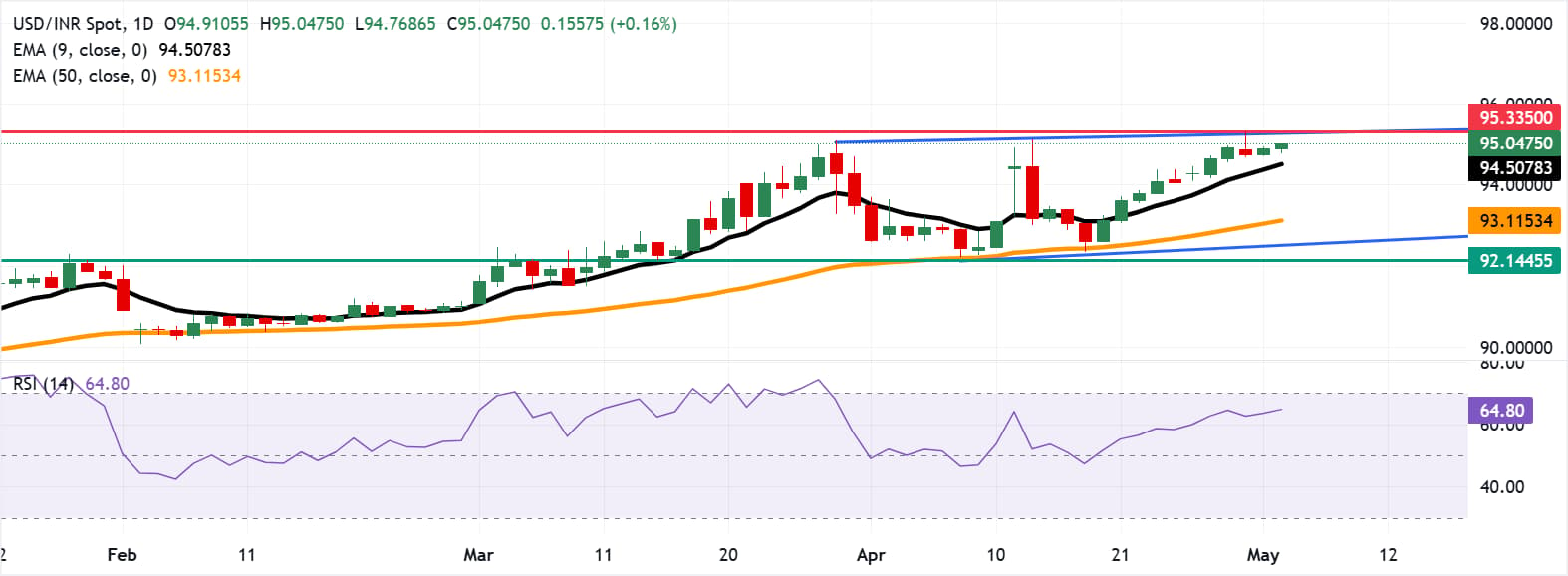
Technical Analysis: USD/INR hovers around 95.00 near fresh record highs
USD/INR trades around 95.00 at the time of writing on Monday. The technical analysis of the daily chart indicates an ongoing neutral bias as the pair remains within the rectangular channel.
However, the USD/INR pair holds above both the nine-day and 50-day Exponential Moving Averages (EMAs), indicating a bullish near-term bias. The alignment of shorter- over longer-dated EMAs hints at sustained upside pressure, while the 14-day Relative Strength Index (RSI) near 64 stays in bullish territory without yet signaling extreme overbought conditions.
The USD/INR pair may retest the upper boundary of the rectangle, aligned with the all-time high of 95.33, which was recorded on April 30. On the downside, the initial support lies at the nine-day EMA of 94.50. A break below the short-term average would lead the pair to test the 50-day EMA at 93.11, followed by the lower rectangle boundary around 92.50 and a seven-week low of 92.14.
US Dollar Price Today
The table below shows the percentage change of US Dollar (USD) against listed major currencies today. US Dollar was the strongest against the Indian Rupee.
| USD | EUR | GBP | JPY | CAD | AUD | NZD | INR | |
|---|---|---|---|---|---|---|---|---|
| USD | -0.02% | 0.05% | -0.11% | 0.10% | 0.13% | -0.04% | 0.16% | |
| EUR | 0.02% | 0.03% | -0.07% | 0.12% | 0.15% | -0.01% | 0.08% | |
| GBP | -0.05% | -0.03% | -0.13% | 0.09% | 0.12% | -0.07% | 0.17% | |
| JPY | 0.11% | 0.07% | 0.13% | 0.18% | 0.18% | 0.02% | 0.14% | |
| CAD | -0.10% | -0.12% | -0.09% | -0.18% | 0.00% | -0.16% | -0.05% | |
| AUD | -0.13% | -0.15% | -0.12% | -0.18% | -0.01% | -0.20% | -0.08% | |
| NZD | 0.04% | 0.01% | 0.07% | -0.02% | 0.16% | 0.20% | 0.21% | |
| INR | -0.16% | -0.08% | -0.17% | -0.14% | 0.05% | 0.08% | -0.21% |
The heat map shows percentage changes of major currencies against each other. The base currency is picked from the left column, while the quote currency is picked from the top row. For example, if you pick the US Dollar from the left column and move along the horizontal line to the Japanese Yen, the percentage change displayed in the box will represent USD (base)/JPY (quote).
Indian Rupee FAQs
The Indian Rupee (INR) is one of the most sensitive currencies to external factors. The price of Crude Oil (the country is highly dependent on imported Oil), the value of the US Dollar – most trade is conducted in USD – and the level of foreign investment, are all influential. Direct intervention by the Reserve Bank of India (RBI) in FX markets to keep the exchange rate stable, as well as the level of interest rates set by the RBI, are further major influencing factors on the Rupee.
The Reserve Bank of India (RBI) actively intervenes in forex markets to maintain a stable exchange rate, to help facilitate trade. In addition, the RBI tries to maintain the inflation rate at its 4% target by adjusting interest rates. Higher interest rates usually strengthen the Rupee. This is due to the role of the ‘carry trade’ in which investors borrow in countries with lower interest rates so as to place their money in countries’ offering relatively higher interest rates and profit from the difference.
Macroeconomic factors that influence the value of the Rupee include inflation, interest rates, the economic growth rate (GDP), the balance of trade, and inflows from foreign investment. A higher growth rate can lead to more overseas investment, pushing up demand for the Rupee. A less negative balance of trade will eventually lead to a stronger Rupee. Higher interest rates, especially real rates (interest rates less inflation) are also positive for the Rupee. A risk-on environment can lead to greater inflows of Foreign Direct and Indirect Investment (FDI and FII), which also benefit the Rupee.
Higher inflation, particularly, if it is comparatively higher than India’s peers, is generally negative for the currency as it reflects devaluation through oversupply. Inflation also increases the cost of exports, leading to more Rupees being sold to purchase foreign imports, which is Rupee-negative. At the same time, higher inflation usually leads to the Reserve Bank of India (RBI) raising interest rates and this can be positive for the Rupee, due to increased demand from international investors. The opposite effect is true of lower inflation.
Author

Akhtar Faruqui
FXStreet
Akhtar Faruqui is a Forex Analyst based in New Delhi, India. With a keen eye for market trends and a passion for dissecting complex financial dynamics, he is dedicated to delivering accurate and insightful Forex news and analysis.
















