Indian Rupee trades firmly on Wednesday despite hawkish Fed bets
- The Indian Rupee opens flat against the US Dollar on Wednesday after a strong Tuesday.
- Hawkish Fed bets could act as a headwind for the Indian currency.
- India’s growth outlook improves on expectations of strong festive demand.

The Indian Rupee (INR) holds onto Tuesday's gains at around 94.80 against the US Dollar (USD) on Wednesday. However, the Indian currency is expected to face selling pressure against the US Dollar, as the latter has strengthened due to increasing expectations that the Federal Reserve (Fed) will tighten its monetary policy at the policy meeting this month.
As of writing, the US Dollar Index (DXY), which gauges the Greenback’s value against six major currencies, trades 0.15% higher to near 99.85, the highest level seen in over two weeks.
US Dollar Price Today
The table below shows the percentage change of US Dollar (USD) against listed major currencies today. US Dollar was the strongest against the Canadian Dollar.
| USD | EUR | GBP | JPY | CAD | AUD | INR | CHF | |
|---|---|---|---|---|---|---|---|---|
| USD | 0.14% | 0.05% | -0.38% | 0.20% | -0.03% | -0.11% | 0.16% | |
| EUR | -0.14% | -0.09% | -0.52% | 0.06% | -0.16% | -0.20% | 0.02% | |
| GBP | -0.05% | 0.09% | -0.41% | 0.15% | -0.08% | -0.15% | 0.11% | |
| JPY | 0.38% | 0.52% | 0.41% | 0.57% | 0.34% | 0.29% | 0.52% | |
| CAD | -0.20% | -0.06% | -0.15% | -0.57% | -0.23% | -0.27% | -0.04% | |
| AUD | 0.03% | 0.16% | 0.08% | -0.34% | 0.23% | -0.05% | 0.20% | |
| INR | 0.11% | 0.20% | 0.15% | -0.29% | 0.27% | 0.05% | 0.23% | |
| CHF | -0.16% | -0.02% | -0.11% | -0.52% | 0.04% | -0.20% | -0.23% |
The heat map shows percentage changes of major currencies against each other. The base currency is picked from the left column, while the quote currency is picked from the top row. For example, if you pick the US Dollar from the left column and move along the horizontal line to the Japanese Yen, the percentage change displayed in the box will represent USD (base)/JPY (quote).
Strategists at Brown Brothers Harriman (BBH) said that Fed funds futures now “price in 67% odds of a 25bps hike on September 16 and imply 60bps of tightening over the next twelve months.”
De-anchored inflation expectations fuel hawkish Fed bets
Rising global inflation projections due to continuously surging oil prices amid fears of prolonged global energy supply disruption on the back of ongoing tensions between the United States (US) and Iran have boosted Fed interest rate hike expectations.
According to Kpler’s data, only five vessels passed through the vital waterway, well below the 10-day average of about 14 vessels, Al Jazeera reported.
Continuous exchange of attacks between the US and Iran near the Strait of Hormuz, a key passage to almost one-fifth of global energy supply, has forced ship sailors to avoid the route.
On Tuesday, US President Donald Trump said in a post on Truth Social that Washington is striking Iranian targets near the Strait of Hormuz in retaliation for Iran’s "failed attempt" to add sea mines in the Strait, which currently “has no mines.” Trump added that the US base at Jordan successfully knocked down all eight missiles launched by Tehran.
US data awaited
Financial markets keenly await the US Nonfarm Payrolls (NFP) data for August, which will be released on Friday. The official employment is expected to have a significant impact on the Fed’s interest rate projections.
In Wednesday’s session, investors will focus on the US ADP Employment Change data for August, which will be published at 12:15 GMT. According to estimates, the US private sector created 48K fresh jobs, slightly higher than 44K in July.
Experts lift India’s growth outlook on stronger data and festive tailwinds
Strategists at Standard Chartered have raised their outlook for India’s economy, saying they now “revise our FY27 (year ending March 2027) GDP growth forecast to 7.2% from 6.6%.” They note that they had “previously highlighted upside risks amid reasonably strong economic activity despite the oil supply and price shock,” and the latest data have reinforced that view.
According to the bank, the upgrade “reflects stronger-than-expected Q1-FY27 (quarter ended June 2026) GDP growth of 7.8%, versus consensus – including us – of 7.3%; continued momentum in July, as indicated by our composite economic indicator; and the likelihood that activity and sentiment remain supportive into the festival season.” In line with the more upbeat tone of recent high-frequency data, Standard Chartered adds that “given the strength of high-frequency indicators so far, we now expect Q2-FY27 GDP growth of 7.4%, versus 6.6% previously.”
The bank still anticipates some moderation later in the fiscal year, cautioning that “we still expect growth to slow in H2-FY27, reflecting the adverse impact of El Niño on agricultural output and rural demand, higher inflation, and fading tailwinds from GST cuts delivered from September 2025.” Even so, they emphasise that “momentum should be stronger than previously expected,” and now “forecast H2-FY27 GDP growth of 6.7%, versus 6.5% previously.”
Technical Analysis: USD/INR holds remains below 20-day EMA
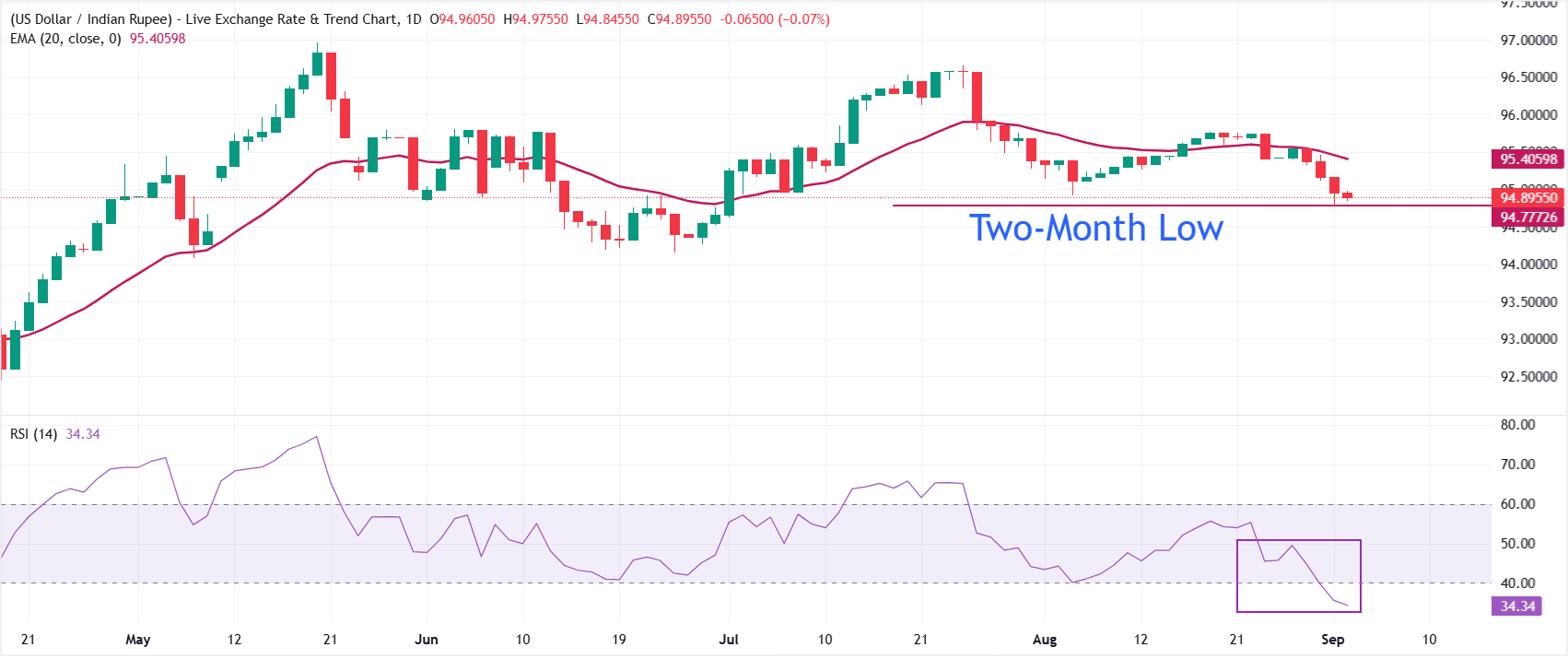
In the daily chart, USD/INR trades at 94.90, maintaining a bearish near-term tone as spot holds below the 20-period Exponential Moving Average (EMA) at 95.41. The pair is sliding away from this dynamic cap, while the Relative Strength Index (RSI) around 35 suggests persistent downside momentum, hinting that buyers remain on the defensive despite intermittent pauses.
On the downside, the two-month low at 94.80 is the key support level; a decisive move below it could expose the pair to the June low at 94.15. Looking up, the 20-day EMA will act as a dynamic barrier for the pair.
(The technical analysis of this story was written with the help of an AI tool. Know more.)
Economic Indicator
ADP Employment Change
The ADP Employment Change is a gauge of employment in the private sector released by the largest payroll processor in the US, Automatic Data Processing Inc. It measures the change in the number of people privately employed in the US. Generally speaking, a rise in the indicator has positive implications for consumer spending and is stimulative of economic growth. So a high reading is traditionally seen as bullish for the US Dollar (USD), while a low reading is seen as bearish.
Read more.Next release: Wed Sep 02, 2026 12:15
Frequency: Monthly
Consensus: 47K
Previous: 44K
Source: ADP Research Institute
Traders often consider employment figures from ADP, America’s largest payrolls provider, report as the harbinger of the Bureau of Labor Statistics release on Nonfarm Payrolls (usually published two days later), because of the correlation between the two. The overlaying of both series is quite high, but on individual months, the discrepancy can be substantial. Another reason FX traders follow this report is the same as with the NFP – a persistent vigorous growth in employment figures increases inflationary pressures, and with it, the likelihood that the Fed will raise interest rates. Actual figures beating consensus tend to be USD bullish.
Author

Sagar Dua
FXStreet
Sagar Dua is associated with the financial markets from his college days. Along with pursuing post-graduation in Commerce in 2014, he started his markets training with chart analysis.
















