Indian Rupee surrenders some gains, RBI maintain status quo again
- The Indian Rupee gives back some of its early gains against the US Dollar after the RBI's policy decision.
- The RBI leaves the Repo Rate steady at 5.25% for the fourth time in a row.
- Oil prices fall sharply on US-Iran deal hopes.

The Indian Rupee (INR) surrenders some gains after a strong opening against the US Dollar (USD), following the Reserve Bank of India’s (RBI) monetary policy decision. The USD/INR opened sharply lower near the monthly low at around 94.80 due to lower oil prices, but it has clawed back some of its early losses and has rebounded to near 95.12.
The RBI has left its Repo Rate steady at 5.25%, as expected, for the fourth time in a row, and has maintained a "neutral" stance on the monetary policy.
The Indian central bank was expected to maintain the status quo as the retail Consumer Price Index (CPI) has remained well within the RBI’s tolerance band of 2%-6%, despite arriving higher at 4.4% Year-on-Year (YoY) in June.
RBI Governor Sanjay Malhotra has warned that the West Asia conflict continues to challenge the global economy, with crude oil prices, currencies, and financial markets remaining volatile. Regarding inflation, Malhotra has said that higher fuel and food prices have started showing little signs of generalization of price pressures so far. He added that core inflation is expected to accelerate towards 5.9% YoY in the third quarter, but will peak from there and start cooling down to 5.5% YoY in the fourth quarter.
On the economic outlook, RBI Governor Malhotra has assured that economic activity remained robust, stating, "Indian economy performed better than expected in Q1 FY27."
US-Iran deal hopes push oil prices lower further
Oil prices extend their decline on Wednesday amid hopes that the US and Iran will reach a deal soon. On Tuesday, US Treasury Secretary Scott Bessent said in an interview with CNBC that Washington could reach a deal with Iran on reopening the Strait of Hormuz, a vital passage for almost 20% of global energy supply, within the next two days.
In the opening session, the MCX Crude Oil contract expiring on August 19 trades 1.6% lower to near Rs. 7,100.
Meanwhile, Qatar also confirmed on Tuesday that mediators including Qatar, Pakistan and Oman are coordinating closely to facilitate negotiations and exchange drafts between both sides.
However, financial markets remain uncertain regarding whether the US-Iran deal on Hormuz will restore freedom of movement through the passage.
US ADP Employment data in focus
In the US, investors await key US ADP Employment Change data for July, which will be published at 12:15 GMT.
Economists at Deutsche Bank anticipate a slightly firmer US labor market print on Wednesday, projecting private payrolls to rise by +65k after +49k previously. The private sector employment data is expected to influence the Federal Reserve's (Fed) interest rate expectations.
Technical Analysis: USD/INR sees fresh downside below 94.80
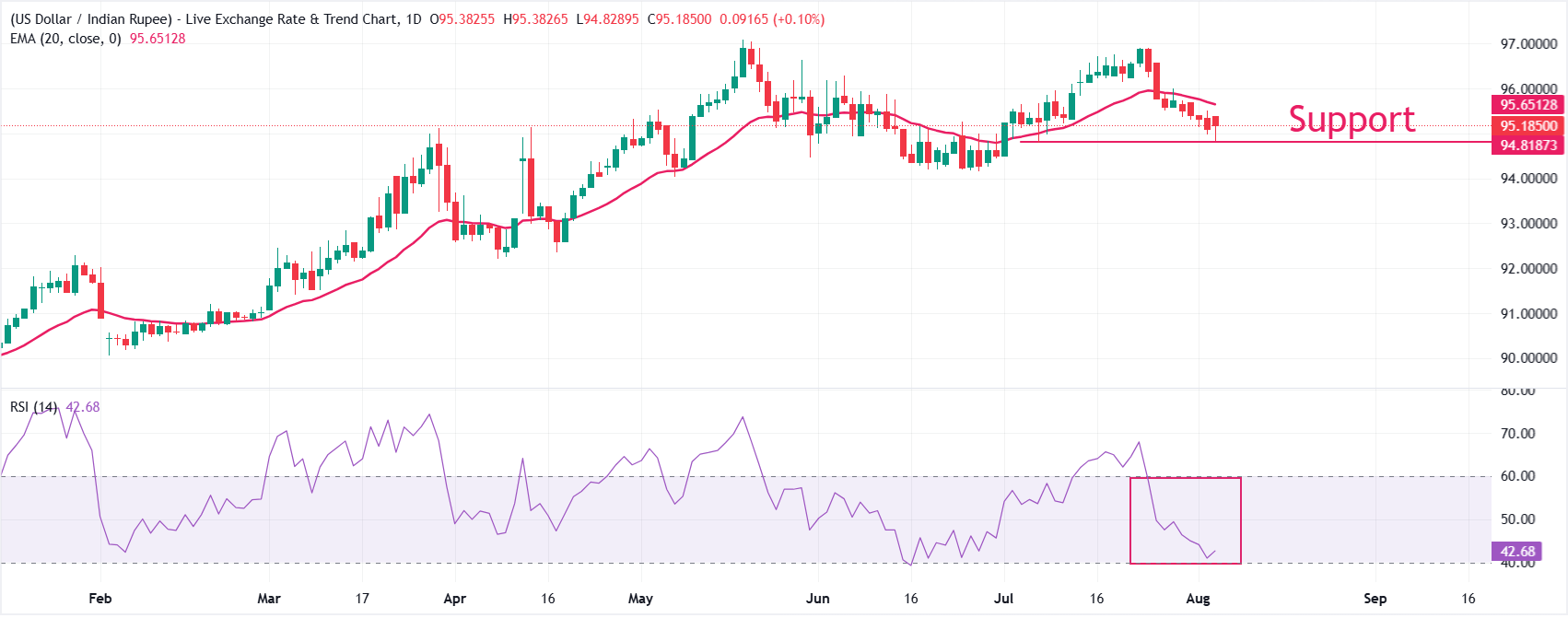
USD/INR trades lower at around 95.12 at press time. The pair remains under pressure in the near term, holding below the 20-period exponential moving average (EMA) at 95.6394, which suggests that recent rebounds are still being sold into.
The Relative Strength Index (RSI) near 42.00 stays in bearish territory but above oversold, hinting at persistent downside bias while leaving room for further weakness before stretched conditions emerge.
On the topside, initial resistance is located at the 20-day EMA near 95.64, which needs to be reclaimed to ease the immediate bearish tone and open the way for a more meaningful recovery toward 96.00. Looking down, the pair could decline toward the June low at 94.15 if it fails to hold the intraday low at around 94.80.
(The technical analysis of this story was written with the help of an AI tool. Know more.)
Economic Indicator
ADP Employment Change
The ADP Employment Change is a gauge of employment in the private sector released by the largest payroll processor in the US, Automatic Data Processing Inc. It measures the change in the number of people privately employed in the US. Generally speaking, a rise in the indicator has positive implications for consumer spending and is stimulative of economic growth. So a high reading is traditionally seen as bullish for the US Dollar (USD), while a low reading is seen as bearish.
Read more.Next release: Wed Aug 05, 2026 12:15
Frequency: Monthly
Consensus: 70K
Previous: 98K
Source: ADP Research Institute
Traders often consider employment figures from ADP, America’s largest payrolls provider, report as the harbinger of the Bureau of Labor Statistics release on Nonfarm Payrolls (usually published two days later), because of the correlation between the two. The overlaying of both series is quite high, but on individual months, the discrepancy can be substantial. Another reason FX traders follow this report is the same as with the NFP – a persistent vigorous growth in employment figures increases inflationary pressures, and with it, the likelihood that the Fed will raise interest rates. Actual figures beating consensus tend to be USD bullish.
Author

Sagar Dua
FXStreet
Sagar Dua is associated with the financial markets from his college days. Along with pursuing post-graduation in Commerce in 2014, he started his markets training with chart analysis.














