Indian Rupee gets relief from pullback in US bond yields
- The Indian Rupee rebounds against the US Dollar as US bond yields cool down.
- US President Trump pushes back fears of military aggression against Iran before Midterm elections.
- Investors shift their focus to the India’s CPI data.
The Indian Rupee (INR) opens slightly higher against the US Dollar (USD) on Friday. The USD/INR pair ticks lower to near 96.55, but is still close to its all-time high of 97.00. The Indian currency gets a much-needed reprieve from a corrective move in United States (US) Treasury Yields.
At press time, 10-year US Treasury Yields are down 0.23% to near 5.22%. Yields on US-backed securities started correcting after failing to extend the rally above the two-decade-high at 5.36%.
Theoretically, the scenario of a pause in US bond yields improves the appeal of riskier assets, such as the Indian Rupee, unless the broader trend resumes.
Meanwhile, the Reserve Bank of India (RBI) is also expected to have intervened at the open. According to a Reuters report, the Indian central bank likely sold US Dollars to support rupee near record-low levels.
What led to sharp correction in US Treasury Yields?
US bond Yields came under pressure on Thursday after oil prices cut some advance, following remarks from President Donald Trump pointing to optimism on US-Iran diplomacy.
We [US] will not be attacking Iran at any time prior to the Midterm Elections to be held in the United States on November 3rd,” US President Trump said through a post on Truth Social, adding, “We are having productive discussions with the Islamic Republic of Iran.”
Is rally in US bond yields over?
A pause in the ongoing rally in US bond Yields has brought some relief for risk-sensitive assets. However, the broader trend in the US Treasury Yields will likely last long, as significant investment from hyperscalers remain intact and the Federal Reserve is highly anticipated to deliver more interest rate hikes in the near term.
Analysts at Danske Bank said in a note this week that US bond yields are in a longer-term uptrend not only because of the supply of Treasuries, but also from higher bond issuance by hyperscalers. Against this setting, the bank cautions that “we do see the risk of 10Y and 30Y Treasuries hitting 6% as investors demand a higher premium for the long end,” underscoring concerns that term premia may need to rise further to clear upcoming issuance.
On the domestic front, the RBI hiked its key policy rate by 25 basis points (bps) this week, and changed its monetary policy stance from “neutral” to “calibrated tightening”, signaling that rate cuts are off the table in the near term. Meanwhile, investors await India’s Consumer Price Index (CPI) data for September, which will be released on Monday.
What to expect from India’s CPI report?
According to Societe Generale, India’s inflation backdrop is set to deteriorate markedly in September 2026, with the bank projecting that “headline CPI inflation [will] rise sharply to 5.6% yoy, from 4.8% in August, led by food inflation which likely rose to around 7.5% yoy.” Societe Generale adds that the move is not confined to volatile components, noting that “we also expect core CPI inflation to approach 4.5% yoy, indicating that underlying price pressures are strengthening despite relatively subdued mass-market demand.”
USD/INR Technical Analysis
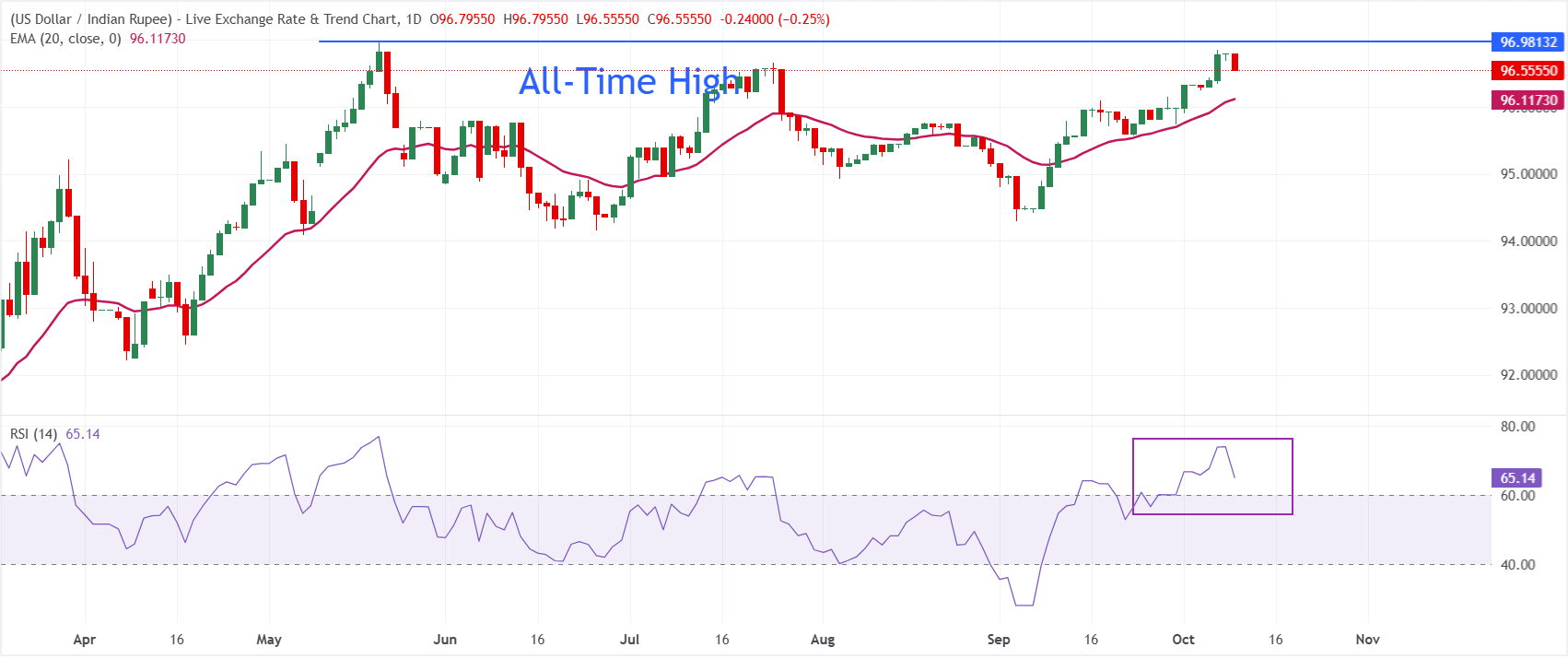
In the daily chart, USD/INR trades at 96.55, maintaining a bullish near-term bias as spot holds above the 20-day exponential moving average (EMA) at 96.12.
The positioning over this short-term trend gauge suggests underlying demand remains in place, while the Relative Strength Index (14) at 65.14 stays in positive territory but shy of overbought, hinting that bullish momentum is constructive yet not extreme.
On the downside, immediate support is seen at the 20-day EMA at 96.12, where a daily close below would signal fading upside pressure and expose a deeper corrective phase. On the upside, the all-time high near 97.00 would remain the major barrier.
(The technical analysis of this story was written with the help of an AI tool. Know more.)
Indian Rupee FAQs
The Indian Rupee (INR) is one of the most sensitive currencies to external factors. The price of Crude Oil (the country is highly dependent on imported Oil), the value of the US Dollar – most trade is conducted in USD – and the level of foreign investment, are all influential. Direct intervention by the Reserve Bank of India (RBI) in FX markets to keep the exchange rate stable, as well as the level of interest rates set by the RBI, are further major influencing factors on the Rupee.
The Reserve Bank of India (RBI) actively intervenes in forex markets to maintain a stable exchange rate, to help facilitate trade. In addition, the RBI tries to maintain the inflation rate at its 4% target by adjusting interest rates. Higher interest rates usually strengthen the Rupee. This is due to the role of the ‘carry trade’ in which investors borrow in countries with lower interest rates so as to place their money in countries’ offering relatively higher interest rates and profit from the difference.
Macroeconomic factors that influence the value of the Rupee include inflation, interest rates, the economic growth rate (GDP), the balance of trade, and inflows from foreign investment. A higher growth rate can lead to more overseas investment, pushing up demand for the Rupee. A less negative balance of trade will eventually lead to a stronger Rupee. Higher interest rates, especially real rates (interest rates less inflation) are also positive for the Rupee. A risk-on environment can lead to greater inflows of Foreign Direct and Indirect Investment (FDI and FII), which also benefit the Rupee.
Higher inflation, particularly, if it is comparatively higher than India’s peers, is generally negative for the currency as it reflects devaluation through oversupply. Inflation also increases the cost of exports, leading to more Rupees being sold to purchase foreign imports, which is Rupee-negative. At the same time, higher inflation usually leads to the Reserve Bank of India (RBI) raising interest rates and this can be positive for the Rupee, due to increased demand from international investors. The opposite effect is true of lower inflation.
Author

Sagar Dua
FXStreet
Sagar Dua is associated with the financial markets from his college days. Along with pursuing post-graduation in Commerce in 2014, he started his markets training with chart analysis.