|

Indian Rupee gains further as US Dollar extends decline

  • The Indian Rupee recovers further against the US Dollar as the latter underperforms.
  • Signs of US-Iran war de-escalation have diminished the US Dollar’s safe-haven demand.
  • FIIs’ buying streak in the Indian stock market comes to an end.
The Indian Rupee (INR) extends Thursday’s recovery against the US Dollar (USD) in the opening session on Friday. The USD/INR pair falls further to near 95.22 as the US Dollar weakens as the restart of the war in the Middle East between the United States (US) and Iran won’t be prolonged. However, the Indian Rupee could show signs of weakness as oil prices remain higher.

As of writing, the US Dollar Index (DXY), which tracks the Greenback’s value against six major currencies, trades 0.3% lower to near its three-week low of 100.60. The DXY extends its losing streak for the third trading day on Friday.

US confirms technical talks with Iran are still on

According to The Times of Israel, a US official has confirmed that technical talks with Iran remain ongoing, even as President Donald Trump has declared that the Memorandum of Understanding (MoU) with Tehran is over.

Also, US President Trump said late Wednesday that Iran still wants a deal badly, but he does not know whether it will “honor the deal”, CNBC reported.

Though the continuation of US-Iran technical talks signals signs of de-escalation between the two, investors will remain fearful of increasing aggression amid ongoing exchange of attacks.

Late Thursday, the Iranian state media confirmed that US forces struk several more locations in coastal Iran.

Fears of energy supply disruption remain elevated amid US-Iran tensions

Oil prices rebound strongly on Friday after a steep correction the previous day. The WTI Crude Oil contract expiring on July 20 is up over 1.1% to near Rs. 6,930 amid fears that Middle East conflicts could disrupt the overall energy supply.

Currencies from economies, such as India, which rely heavily on oil imports to meet their energy needs, tend to underperform in a high-oil-price environment.

FIIs turned net sellers on Thursday

After remaining net buyers in all trading days of July 3-8, Foreign Institutional Investors (FIIs) turned out to be net sellers on Thursday, offloading their stake worth Rs. 532.86 crore in the Indian stock market.

Moving forward, investors should be prepared for mixed sentiment from overseas investors toward the Indian equity market, as the earnings season of the first quarter of the financial year (FY) 2026-27 has kicked off, with quarterly results from India’s tech giant Tata Consultancy Services (TCS) on Thursday.

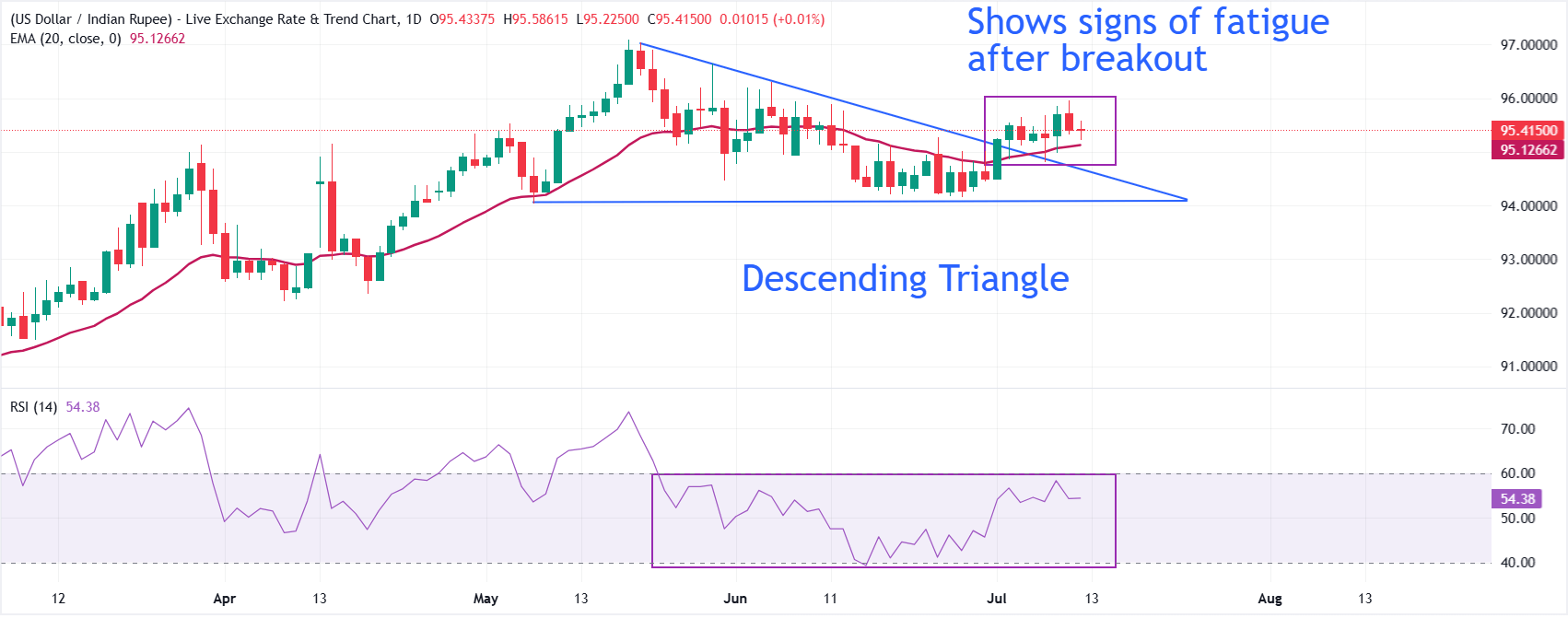
Technical Analysis: USD/INR slides toward 20-day EMA

USD/INR trades lower at around 95.222. Still, the pair holds a mild bullish bias as it trades above the 20-day exponential moving average (EMA) at 95.11.

The Relative Strength Index (RSI) staying inside the 40.00-60.00 zone for a long period, with signs of fatigue after a descending triangle breakout, suggests a likely corrective move ahead.

On the downside, immediate support is seen at the 20-day EMA near 95.11, ahead of the former descending trendline break around 94.69, followed by the May 7 low at 94.03. On the topside, a more meaningful resistance reference remains the original descending trendline anchor near 97.02, and only a sustained break above that area would open the door to a stronger bullish extension.

(The technical analysis of this story was written with the help of an AI tool. Know more.)

Indian Rupee FAQs

The Indian Rupee (INR) is one of the most sensitive currencies to external factors. The price of Crude Oil (the country is highly dependent on imported Oil), the value of the US Dollar – most trade is conducted in USD – and the level of foreign investment, are all influential. Direct intervention by the Reserve Bank of India (RBI) in FX markets to keep the exchange rate stable, as well as the level of interest rates set by the RBI, are further major influencing factors on the Rupee.

The Reserve Bank of India (RBI) actively intervenes in forex markets to maintain a stable exchange rate, to help facilitate trade. In addition, the RBI tries to maintain the inflation rate at its 4% target by adjusting interest rates. Higher interest rates usually strengthen the Rupee. This is due to the role of the ‘carry trade’ in which investors borrow in countries with lower interest rates so as to place their money in countries’ offering relatively higher interest rates and profit from the difference.

Macroeconomic factors that influence the value of the Rupee include inflation, interest rates, the economic growth rate (GDP), the balance of trade, and inflows from foreign investment. A higher growth rate can lead to more overseas investment, pushing up demand for the Rupee. A less negative balance of trade will eventually lead to a stronger Rupee. Higher interest rates, especially real rates (interest rates less inflation) are also positive for the Rupee. A risk-on environment can lead to greater inflows of Foreign Direct and Indirect Investment (FDI and FII), which also benefit the Rupee.

Higher inflation, particularly, if it is comparatively higher than India’s peers, is generally negative for the currency as it reflects devaluation through oversupply. Inflation also increases the cost of exports, leading to more Rupees being sold to purchase foreign imports, which is Rupee-negative. At the same time, higher inflation usually leads to the Reserve Bank of India (RBI) raising interest rates and this can be positive for the Rupee, due to increased demand from international investors. The opposite effect is true of lower inflation.

Author

Sagar Dua

Sagar Dua

FXStreet

Sagar Dua is associated with the financial markets from his college days. Along with pursuing post-graduation in Commerce in 2014, he started his markets training with chart analysis.


More from Sagar Dua
Share:

Editor's Picks

GBP/USD holds gains below 1.3450 as markets bet on more BoE rate hikes

GBP/USD holds moderate gains but stays below 1.3450 in the European morning hours on Friday. The British Pound gains amid optimism on the UK government leadership transition and Bank of England rate hike bets. Meanwhile, the US Dollar loses ground on Middle East de-escalation and receding Fed rate hike expectations.

EUR/USD advances to 1.1450 on softer USD, ECB rate hike bets

EUR/USD advances to near 1.1450 in the early European hours on Friday, bolstered by a softer US Dollar. The European Central Bank is grappling with elevated core inflation, forcing traders to price in more aggressive tightening despite mixed guidance from ECB officials, lending support to the pair.


Gold flat lines above $4,100 amid weaker USD, Fed hike bets and Iran risks

Gold reverses a modest Asian session dip to the $4,109-$4,108 region, though it lacks bullish conviction. The US Dollar selling remains unabated for the third consecutive day in the wake of Wednesday's less hawkish FOMC Minutes and offers some support to the commodity. However, prospects of a Fed rate hike in 2026 remain active.

Zcash: Retail demand lifts ZEC price on new Ironwood shielded pool announcement

Zcash price shows mild recovery during early Asian hours, rising toward the $500 mark. Retail demand supports ZEC's recovery, with an 18% rise in its futures Open Interest, likely linked to the announcement of the Ironwood shielded pool. Technically, ZEC should clear a key Fibonacci resistance level near $520 to test its all-time high of $690.

Five sessions, one round trip: Why the whipsaw is exactly what Warsh ordered

Markets opened July with a December hike as the base case and spent five trading sessions unlearning and relearning it. A 57K payrolls print bled the tightening bets out of the strip; a re-shut Strait of Hormuz is pushing them back in. Wednesday's minutes from the June Federal Open Market Committee meeting landed mid-round-trip, describing a world that had already stopped existing.

Bye, forward guidance: How to trade when central banks choose silence

Central banks have spent years telling markets what might come next. Now, traders face the possibility that they say a lot less. From the Federal Reserve to the European Central Bank and the Bank of England, policymakers are pushing back against forward guidance.