ICE Elliott Wave: Wave ((4)) near 133 support

Triangle within Wave (B) suggests one more dip before bullish continuation
Intercontinental Exchange (ICE) continues to maintain a strong bullish Elliott Wave structure despite the recent consolidation. The stock has developed a clear impulsive advance over the last several years, supported by higher highs and higher lows across multiple time frames. The broader trend remains bullish, and the current pullback appears corrective rather than impulsive.
From the chart, ICE completed a strong five-wave rally into wave ((3)), which marked an important high within the larger bullish cycle. Following this advance, the stock entered a corrective phase labeled as wave ((4)). The correction currently appears to be unfolding as an A-B-C structure rather than a completed pattern. Within wave (B) of wave ((4)), the market has developed a contracting triangle formation labeled A-B-C-D-E. This overlapping structure reflects a period of consolidation and contracting volatility before the next directional move begins.
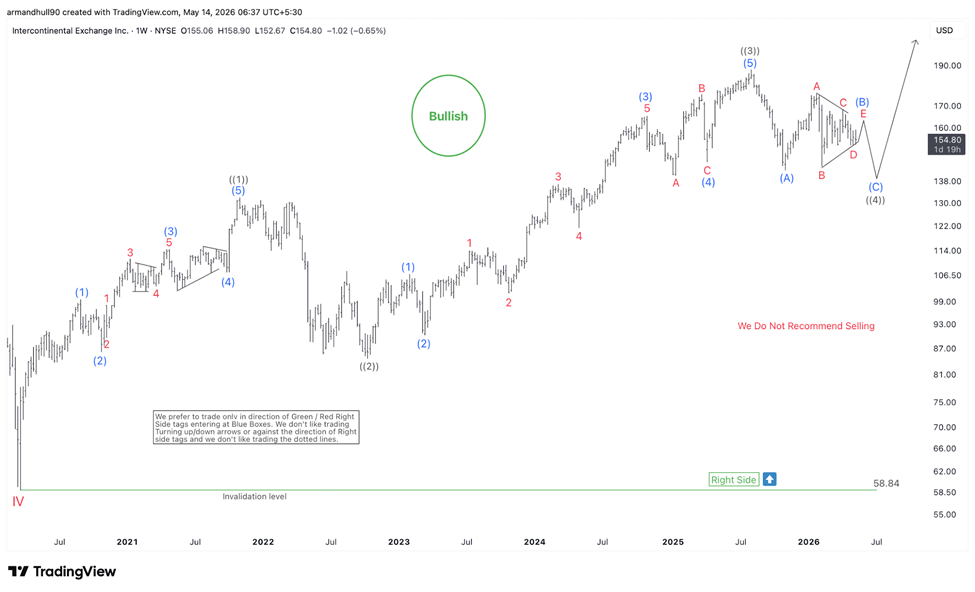
ICE Wave ((4)) outlook and bullish recovery potential
Once the triangle within wave (B) completes, ICE should decline again in wave (C) of ((4)) before ending the correction. Based on the projected structure from the chart, wave ((4)) could complete somewhere around the 133.36 area before the stock turns higher again. This region aligns with an important support zone and may provide the foundation for the next bullish phase. After wave ((4)) completes, ICE should resume higher in wave ((5)) and continue the larger bullish trend. This next impulsive leg could eventually push price toward fresh highs above the prior wave ((3)) peak.
In the short term, traders should continue monitoring the triangle boundaries closely as the final swings develop. However, the broader bullish trend remains intact as long as the stock stays above the major invalidation level near 58.84.
Summary:
Intercontinental Exchange remains in a long-term bullish Elliott Wave trend, with wave ((4)) correction unfolding at this moment. Once this consolidation completes, ICE should resume higher in wave ((5)) and target new highs. As long as price remains above 58.84, the bullish outlook stays intact.
Author

Elliott Wave Forecast Team
ElliottWave-Forecast.com
















