Gold tumbles below $5,100 on strong US Dollar, Treasury yields
- Gold drops 1.35% as DXY climbs above 99.20 and Treasury yields rise.
- Jobless claims steady at 213K; layoffs plunge to 48.3K, signaling resilient labor market.
- Fed easing bets trimmed to 35 bps ahead of Friday’s Nonfarm Payrolls report.

Gold price erased the previous day's gains on Thursday, hitting a two-day low as precious metals are pressured by high US Treasury yields and a strong US Dollar, underpinned by solid US jobs data. At the time of writing, XAU/USD trades at $5,069, down more than 1.35%.
Solid US jobs data offsets geopolitical tensions, pushing XAU/USD to a two-day low
Safe-haven flows are favoring the Greenback, which, according to the US Dollar Index (DXY), is rising over 0.50%. The DXY, which measures the American currency performance against other six, exchanges hands at 99.27.
Tensions in the Middle East remain high, as the war enters its sixth day. The campaign is set to continue as Israel is set to attack Iran’s underground missile sites. Attacks on ships continued Thursday, adding two to the previously attacked seven. Also, Iran threatened to retaliate after a US submarine torpedoed a warship, which killed more than 80 sailors.
Strong US jobs data may prompt the Fed to reconsider its policy
Given the backdrop, bullion prices are set to extend their gains, but solid economic data in the US outweighed geopolitics.
US Initial Jobless Claims for the week ending February 28 came at 213K, the Labor Department reported, coming in slightly below expectations of 215K and pointing to continued labor market resilience. Earlier, Challenger, Gray & Christmas data showed announced layoffs fell to 48.3K in February, down 55% from January.
On Wednesday, the Federal Reserve (Fed) revealed its Beige Book. Officials stated that “economic expectations were optimistic with most (Fed) districts expecting slight to moderate growth in the coming months.” Regarding employment conditions, policymakers revealed that conditions are “generally stable in recent weeks as seven of the twelve districts reported no change in hiring.”
Richmond Fed President Thomas Barkin added that recent inflation data raises questions about whether the central bank has fully subdued price pressures. He added that sticky inflation and solid jobs data could shift the risks outlook for the Fed.
The Trump administration submitted Kevin Warsh's nomination to succeed the Federal Reserve Chair Jerome Powell, whose period as Fed chief ends in mid-May.
Up next, the US economic docket will feature February’s Nonfarm Payrolls report with economists expecting the economy to add 59K people to the workforce and the Unemployment Rate to remain steady at 4.3%.
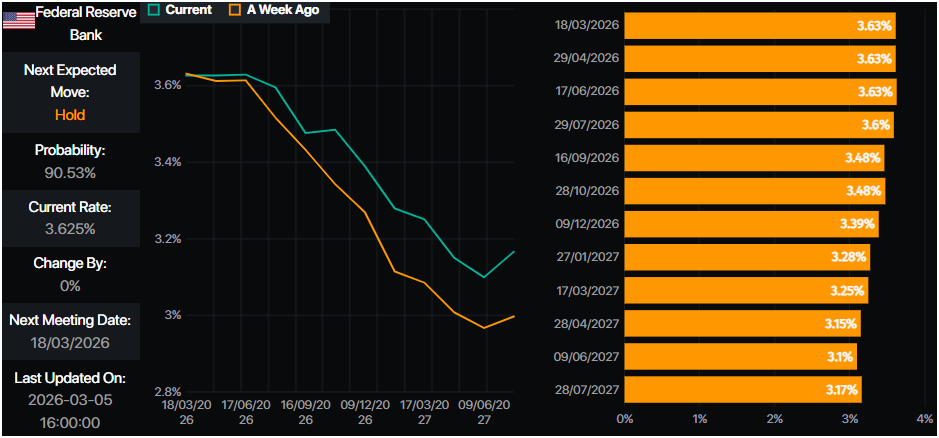
Investors pricing in a less dovish Fed
Money markets had priced in 35 basis points of Fed easing towards the year’s end, according to Prime Market Terminal data.
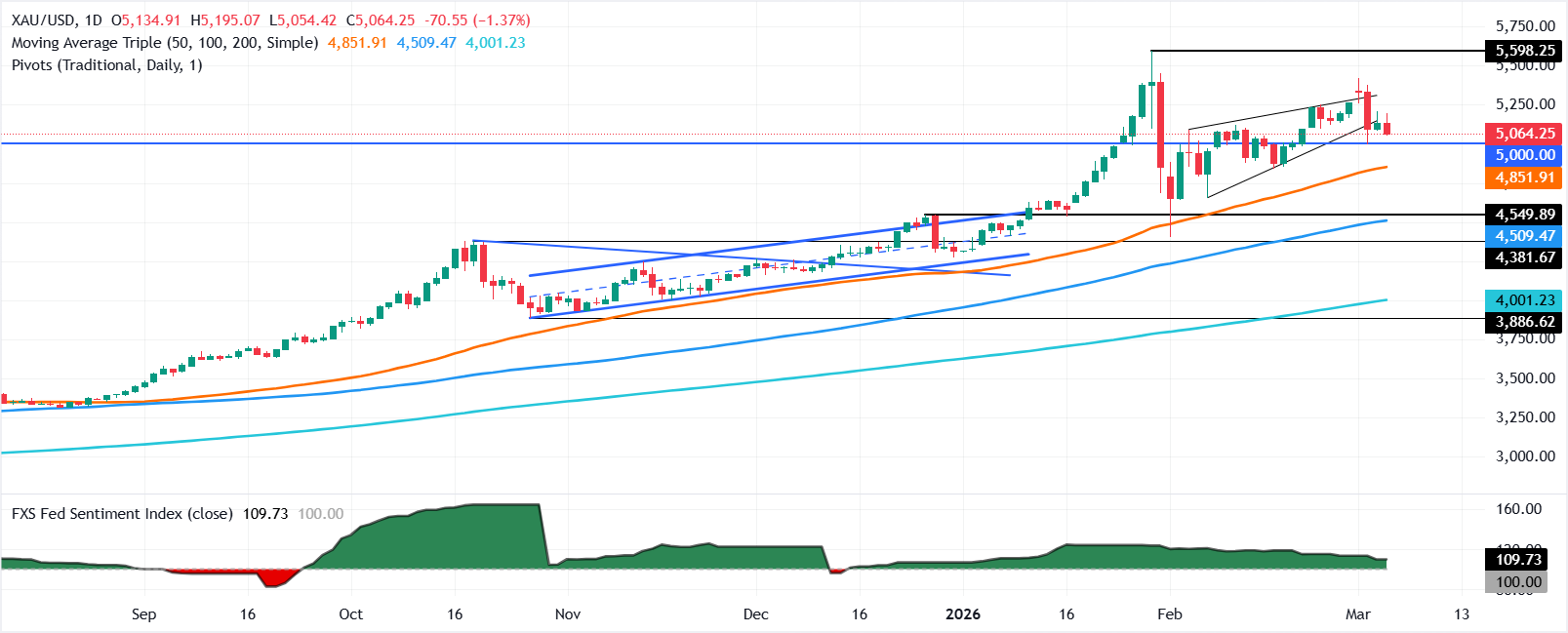
XAU/USD technical outlook: Gold consolidates within $5,000-$5,100
Price action remains constructive, but Gold could edge lower if it drops below the $5,000 figure. Momentum is turning negative as depicted in the Relative Strength Index (RSI). The RSI accelerates its fall towards its neutral level, an indication of buyers’ reluctance to push prices higher.
With that said, in the short-term, XAU/USD could re-test $5,000, but traders need to clear key support at $5,050. A breach below $5,000 exposes key support at $4,950, followed by the February 17 cycle low at $4,841 and the 50-day SMA near $4,810.
Conversely, if Gold surpasses $5,100, the first resistance is the March 4 peak at $5,206, ahead of the February 24 high at $5,249, and then $5,300.
Gold FAQs
Gold has played a key role in human’s history as it has been widely used as a store of value and medium of exchange. Currently, apart from its shine and usage for jewelry, the precious metal is widely seen as a safe-haven asset, meaning that it is considered a good investment during turbulent times. Gold is also widely seen as a hedge against inflation and against depreciating currencies as it doesn’t rely on any specific issuer or government.
Central banks are the biggest Gold holders. In their aim to support their currencies in turbulent times, central banks tend to diversify their reserves and buy Gold to improve the perceived strength of the economy and the currency. High Gold reserves can be a source of trust for a country’s solvency. Central banks added 1,136 tonnes of Gold worth around $70 billion to their reserves in 2022, according to data from the World Gold Council. This is the highest yearly purchase since records began. Central banks from emerging economies such as China, India and Turkey are quickly increasing their Gold reserves.
Gold has an inverse correlation with the US Dollar and US Treasuries, which are both major reserve and safe-haven assets. When the Dollar depreciates, Gold tends to rise, enabling investors and central banks to diversify their assets in turbulent times. Gold is also inversely correlated with risk assets. A rally in the stock market tends to weaken Gold price, while sell-offs in riskier markets tend to favor the precious metal.
The price can move due to a wide range of factors. Geopolitical instability or fears of a deep recession can quickly make Gold price escalate due to its safe-haven status. As a yield-less asset, Gold tends to rise with lower interest rates, while higher cost of money usually weighs down on the yellow metal. Still, most moves depend on how the US Dollar (USD) behaves as the asset is priced in dollars (XAU/USD). A strong Dollar tends to keep the price of Gold controlled, whereas a weaker Dollar is likely to push Gold prices up.
Author

Christian Borjon Valencia
FXStreet
Markets analyst, news editor, and trading instructor with over 14 years of experience across FX, commodities, US equity indices, and global macro markets.