Gold Price Forecast: XAU/USD rallies remain limited with bulls capped below $4,050
- Gold bulls struggle to extend gains beyond $4.050 following a sharp reversal from the $4,150 area on Tuesday.
- The US Dollar surges as hot US inflation figures boost hopes of further Fed tightening. and sent the US Dollar surging.
- The XAU/USD's bearish engulfing candle on the daily chart suggests that bears are taking control.

Gold (XAU/USD) is showing a shallow recovery attempt on Wednesday, with bulls struggling to consolidate above $4.050 during the European session, leaving bears in control after the impulsive reversal from the $4,150 resistance area on Tuesday. Precious metals remain vulnerable on Wednesday, as the US Dollar (USD) rallies across the board, boosted by rising hopes of a Federal Reserve (Fed) interest rate hike in December and with Oil prices picking up from lows.
Data from the US released on Tuesday revealed that consumer inflation grew beyond expectations in October, bolstering the case for another Fed tightening move in December and providing a fresh boost to a hitherto soft US Dollar.
Comments from the US central bank have endorsed that view earlier on Wednesday. The President of the Philadelphia Fed, Anna Paulson, called for a “further gradual tightening” to bring inflation to target, and somewhat later, Dallas Fed President Lorie Logan said that “it is clear that the Fed needs at least two more quarter-percentage-point increases,” fuelling the US Dollar further and weighing on precious metals.
Technical Analysis: Potential Double Top formation at the $4,150 area
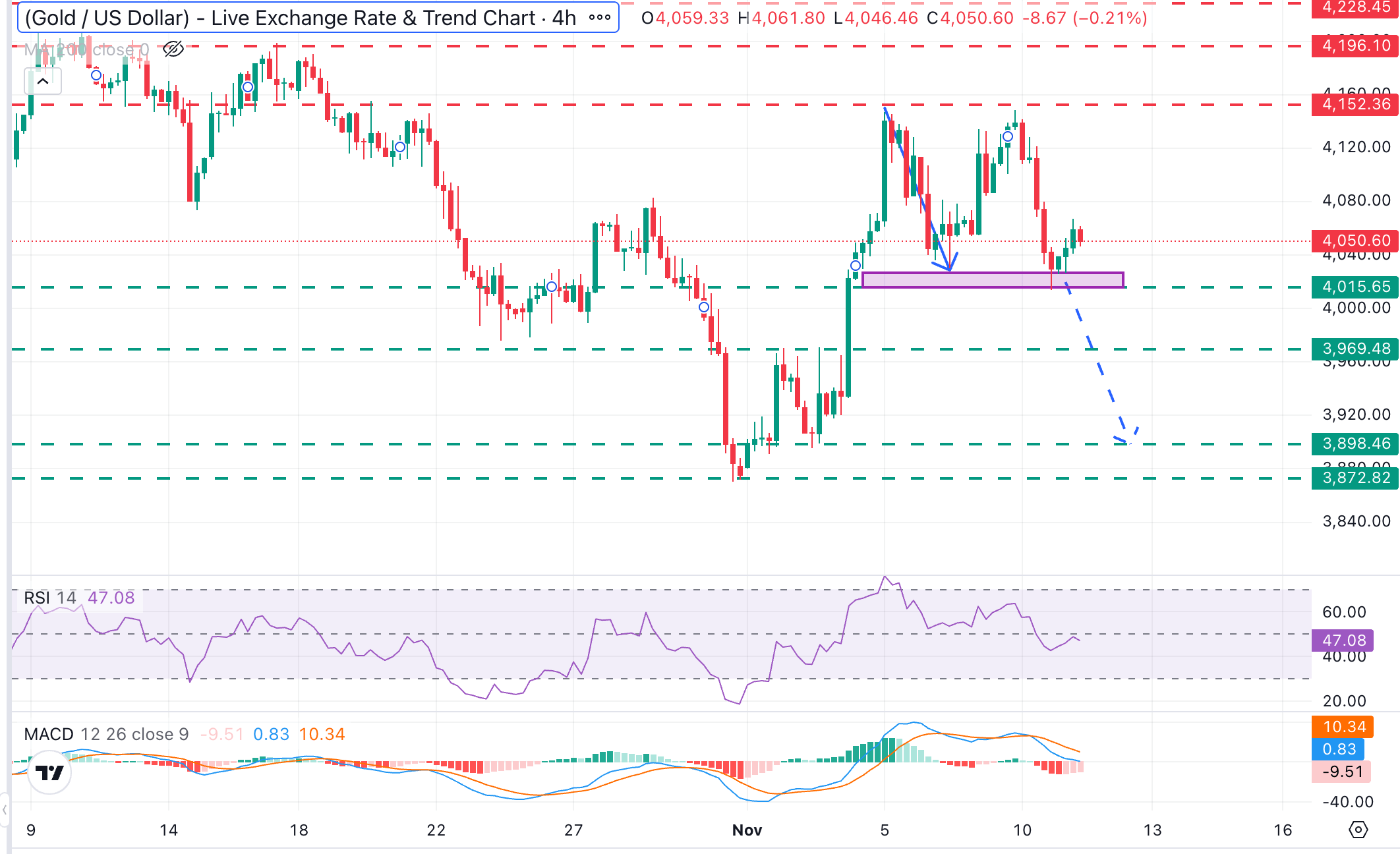
XAU/USD trades at $4,050, still holding a near-term constructive bias from late October lows, although the bearish engulfing candle in the daily chart and a potential Double Top (DT) formation around $4,150 suggest that buyers are giving up. The Relative Strength Index on the 4-hour chart remains capped below the key 50 level, and the Moving Average Convergence Divergence (MACD) indicator holds in negative territory at -9.51, supporting the bearish view.
Immediate support lies between the November 6 and 10 lows at $4,030 and $4,023, respectively. A clear break below here would confirm the mentioned DT, adding pressure towards the November 2 and 3 highs, around $3,970. The DT's measured target lies around the November 3 low of $3,911.
On the upside, the intra-day high at $4,066 is closing the path towards a key resistance at the mentioned $4,150 area (November 5 and 9 highs.
(The technical analysis of this story was written with the help of an AI tool. Know more.)
Gold FAQs
Gold has played a key role in human’s history as it has been widely used as a store of value and medium of exchange. Currently, apart from its shine and usage for jewelry, the precious metal is widely seen as a safe-haven asset, meaning that it is considered a good investment during turbulent times. Gold is also widely seen as a hedge against inflation and against depreciating currencies as it doesn’t rely on any specific issuer or government.
Central banks are the biggest Gold holders. In their aim to support their currencies in turbulent times, central banks tend to diversify their reserves and buy Gold to improve the perceived strength of the economy and the currency. High Gold reserves can be a source of trust for a country’s solvency. Central banks added 1,136 tonnes of Gold worth around $70 billion to their reserves in 2022, according to data from the World Gold Council. This is the highest yearly purchase since records began. Central banks from emerging economies such as China, India and Turkey are quickly increasing their Gold reserves.
Gold has an inverse correlation with the US Dollar and US Treasuries, which are both major reserve and safe-haven assets. When the Dollar depreciates, Gold tends to rise, enabling investors and central banks to diversify their assets in turbulent times. Gold is also inversely correlated with risk assets. A rally in the stock market tends to weaken Gold price, while sell-offs in riskier markets tend to favor the precious metal.
The price can move due to a wide range of factors. Geopolitical instability or fears of a deep recession can quickly make Gold price escalate due to its safe-haven status. As a yield-less asset, Gold tends to rise with lower interest rates, while higher cost of money usually weighs down on the yellow metal. Still, most moves depend on how the US Dollar (USD) behaves as the asset is priced in dollars (XAU/USD). A strong Dollar tends to keep the price of Gold controlled, whereas a weaker Dollar is likely to push Gold prices up.
Author

Guillermo Alcala
FXStreet
Graduated in Communication Sciences at the Universidad del Pais Vasco and Universiteit van Amsterdam, Guillermo has been working as financial news editor and copywriter in diverse Forex-related firms, like FXStreet and Kantox.