Gold tests $4,000 as energy-driven inflation fears keep Fed rate hike bets in play
- Gold struggles as higher energy prices keep inflation concerns alive despite soft US CPI and PPI data.
- Restrictive Fed policy and the possibility of a rate hike later this year limit demand for bullion.
- XAU/USD holds a bearish technical bias below key moving averages.

Gold (XAU/USD) edges lower on Thursday as traders look past back-to-back, softer-than-expected US inflation reports and remain focused on renewed Middle East tensions, which are fueling concerns that higher energy prices could reignite inflationary pressure.
At the time of writing, XAU/USD trades around $4,015, down 1.10% on the day after hitting $3,974 earlier in the American session.
Both the US Consumer Price Index (CPI) and Producer Price Index (PPI) reports for June came in below market expectations. However, Gold failed to benefit as the softer readings merely pushed back expectations of a near-term Federal Reserve (Fed) interest rate hike.
Meanwhile, the US Dollar (USD) and US Treasury yields are staging a modest rebound after two consecutive days of losses, adding to the pressure on Gold.
Fed officials continue to stress the need to bring inflation sustainably back to the 2% target while noting that the labor market appears to have stabilized. This suggests that the central bank could raise interest rates later this year if inflation proves more persistent.
Elevated borrowing costs reduce Gold's appeal as investors seek higher returns from interest-bearing assets. Against this backdrop, Gold retains a downside bias, with sellers eyeing a sustained break below the $4,000 mark.
Data released on Thursday showed US Retail Sales rose 0.2% MoM in June, in line with expectations. May's reading was revised up slightly to 1.0% from 0.9%.
The Retail Sales Control Group also came in as expected at 0.5%, although it was lower than May's 0.8% increase. Initial Jobless Claims fell to 208K from 216K, beating expectations of 217K.
On the geopolitical front, the US carried out a fifth consecutive night of strikes against Iranian targets, while Tehran responded by targeting US assets in Kuwait, Bahrain and Jordan. Reuters reported that Iran had instructed Yemen’s Houthis to close the Bab el-Mandeb gateway to the Red Sea if the US attacks its power network.
Oil prices extended their gains following the report, with West Texas Intermediate (WTI) trading around $80.00, up nearly 12% so far this week.
Technical analysis: Sellers retain control as XAU/USD struggles below $4,200
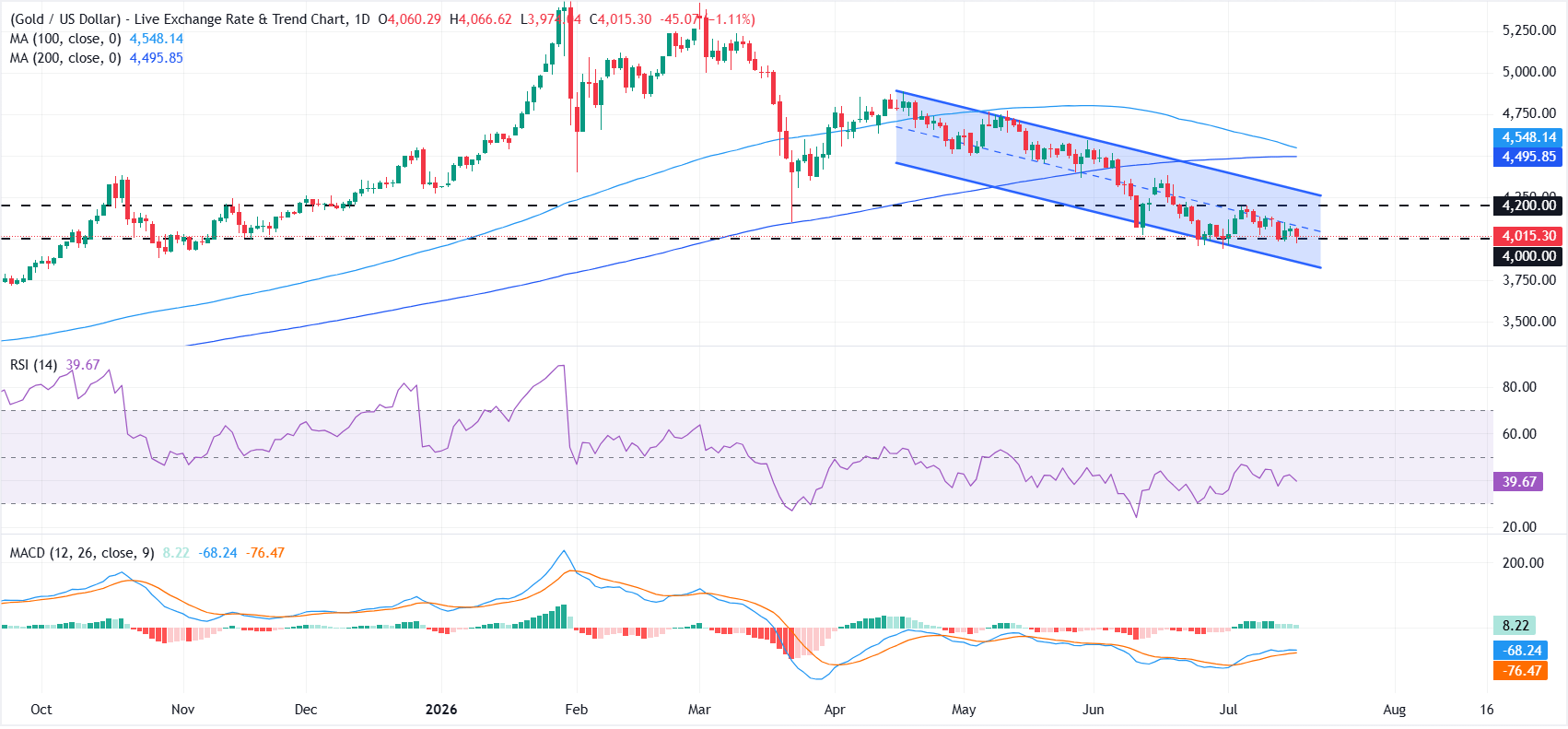
On the daily chart, XAU/USD keeps a bearish bias as it remains well below the 200-day Simple Moving Average (SMA) at $4,495 and the 100-day SMA at $4,547.
Price is holding within a downward parallel channel, trading beneath its upper boundary around $4,200, while momentum is mixed. The Relative Strength Index (RSI) near 37 leans bearish, while the Moving Average Convergence Divergence (MACD) remains positive, yet with declining histogram bars, hinting that any rebound would still face structural headwinds overhead.
On the topside, immediate resistance is clustered around $4,200, where the horizontal cap and the channel’s upper line converge, before the more significant barriers at the 200-day SMA near $4,495 and the 100-day SMA close to $4,547.
On the downside, initial support appears at the $4,000 horizontal level, with a deeper cushion at the channel floor around $3,800.
(The technical analysis of this story was written with the help of an AI tool. Know more.)
Inflation FAQs
Inflation measures the rise in the price of a representative basket of goods and services. Headline inflation is usually expressed as a percentage change on a month-on-month (MoM) and year-on-year (YoY) basis. Core inflation excludes more volatile elements such as food and fuel which can fluctuate because of geopolitical and seasonal factors. Core inflation is the figure economists focus on and is the level targeted by central banks, which are mandated to keep inflation at a manageable level, usually around 2%.
The Consumer Price Index (CPI) measures the change in prices of a basket of goods and services over a period of time. It is usually expressed as a percentage change on a month-on-month (MoM) and year-on-year (YoY) basis. Core CPI is the figure targeted by central banks as it excludes volatile food and fuel inputs. When Core CPI rises above 2% it usually results in higher interest rates and vice versa when it falls below 2%. Since higher interest rates are positive for a currency, higher inflation usually results in a stronger currency. The opposite is true when inflation falls.
Although it may seem counter-intuitive, high inflation in a country pushes up the value of its currency and vice versa for lower inflation. This is because the central bank will normally raise interest rates to combat the higher inflation, which attract more global capital inflows from investors looking for a lucrative place to park their money.
Formerly, Gold was the asset investors turned to in times of high inflation because it preserved its value, and whilst investors will often still buy Gold for its safe-haven properties in times of extreme market turmoil, this is not the case most of the time. This is because when inflation is high, central banks will put up interest rates to combat it. Higher interest rates are negative for Gold because they increase the opportunity-cost of holding Gold vis-a-vis an interest-bearing asset or placing the money in a cash deposit account. On the flipside, lower inflation tends to be positive for Gold as it brings interest rates down, making the bright metal a more viable investment alternative.
Author

Vishal Chaturvedi
FXStreet
I am a macro-focused research analyst with over four years of experience covering forex and commodities market. I enjoy breaking down complex economic trends and turning them into clear, actionable insights that help traders stay ahead of the curve.