Gold slides below $4,550 as Iran tensions lift Dollar, yields now
- Risk aversion lifted the Dollar as Iran tensions rattled global markets.
- Rising Treasury yields and strong Factory Orders pressured non-yielding Gold.
- Traders now await ISM Services PMI and Friday’s Nonfarm Payrolls.

Gold price tumbles more than 2% on Monday as tensions in the Middle East pushes the Greenback higher, while US Treasury yields soar sharply as investors discount no interest rate cuts by the Federal Reserve in 2026. At the time of writing, the XAU/USD trades at $4,521 after reaching a daily high of $4,639.
Bullion tumbles as Operation Freedom, Fed caution hit demand now
Risk aversion is taking over financial markets as the end of the ceasefire between the US and Iran looms. The US Navy began Trump’s Operation Freedom to escort commercial shipping vessels through the Strait of Hormuz. Tehran retaliated, launching attacks against the UAE and sending speedboats to halt sailing through the Strait of Hormuz.
US President Donald Trump revealed that the “we’ve shut down seven small boats” was aimed at disrupting vessel movement. In the meantime, CNN revealed that the US and Israel could resume attacks on Iran within the next 24 hours.
As market mood soured, US equities fell, oil prices rallied, and the US Dollar recovered, up over 0.25% on the US Dollar Index (DXY). The DXY, which measures the performance of the buck’s value against a basket of six currencies, bounced off daily lows of 97.97 and is now at 98.46.
Bullion is falling amid US Dollar strength and rising US Treasury yields. The US 10-year T-note is up six basis points at 4.432%, a headwind for the non-yielding metal.
Fed expected to hold rates in June
The New York Fed President, John Williams, stated that monetary policy is “well positioned” to address uncertainty generated by external shocks, such as the Middle East conflict. He said that the future is uncertain and that “the risks to both sides of our mandate have increased.” When asked about the future of monetary policy, he said that the Fed is in no “position to provide strong guidance about where interest rates are likely to be in the next several meetings.”
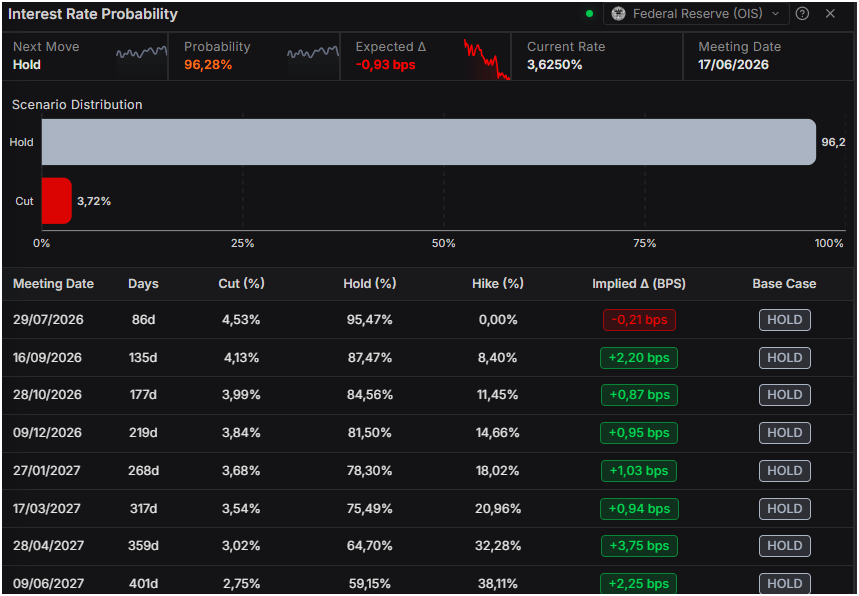
Expectations that the Federal Reserve will keep rates unchanged at the June 17 meeting are at 96%, according to Prime Terminal, which would be led by the newly appointed Federal Reserve Chair Kevin Warsh.
In terms of data, US Factory Orders rose by 1.5% MoM in March, surpassing the expected 0.5% increase and up from 0.3% in February.
Ahead, the US economic docket would feature the release of the ISM Services PMI on Tuesday, with eyes set on the US Nonfarm Payrolls data.
XAU/USD technical analysis: Gold remains sideways with buyers struggling at $4,600
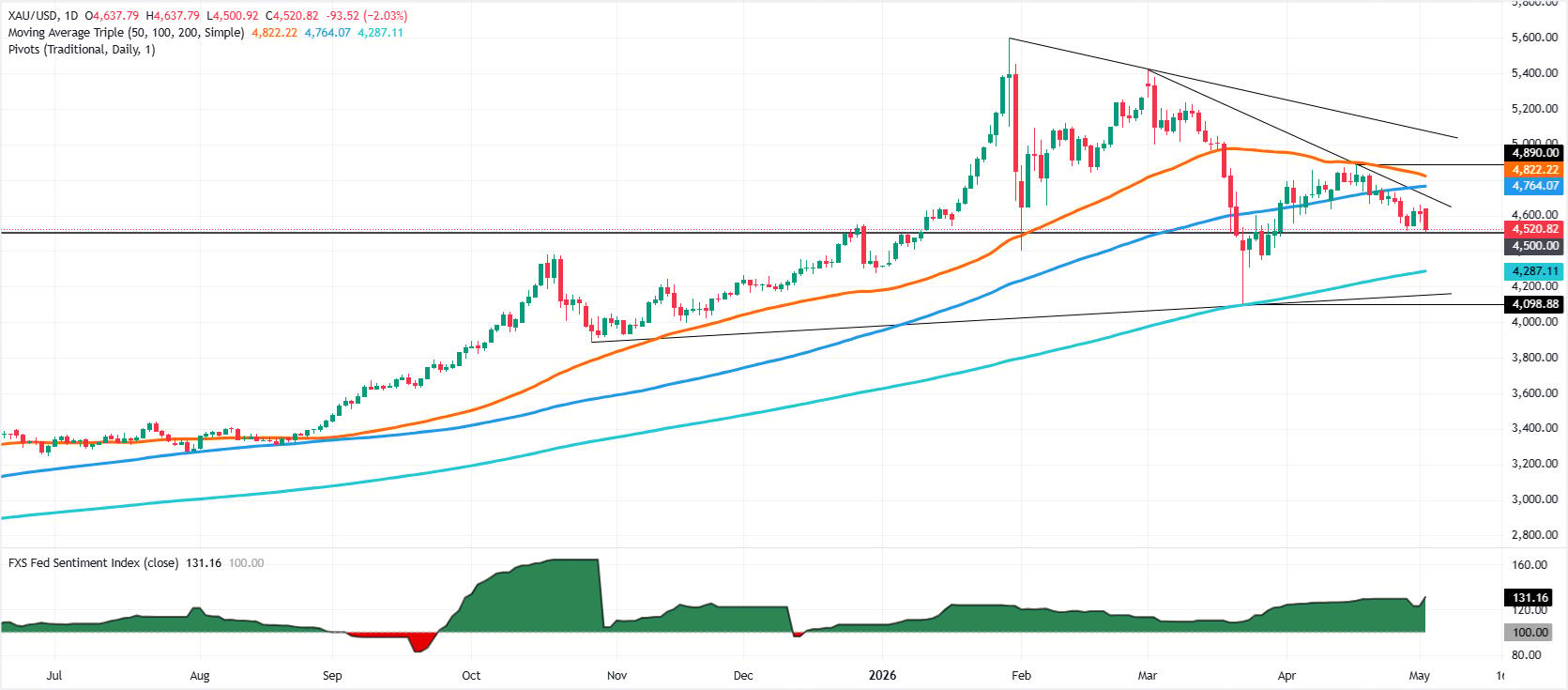
Gold remains neutrally biased, capped by key technical resistance and support levels, such as the 100-day Simple Moving Average (SMA) at $4,764 and the 200-day SMA at $4,287.
The Relative Strength Index (RSI) is aiming lower, an indication that sellers are gaining momentum.
If Gold drops below $4,500, the next support would be the March 26 daily low of $4,351, followed by the 200-day SMA. Down from there lies the March 23 swing low at $4,098, which, if breached, would change the trend to bearish, opening the door to a challenge of the $4,000 mark.
Conversely, if XAU/USD recovers above $4,550, buyers could test $4,600. On further strength, the next resistance is a downtrend line near the $4,700-$4,720 area, followed by the 100-day SMA at $4,764.
Gold FAQs
Gold has played a key role in human’s history as it has been widely used as a store of value and medium of exchange. Currently, apart from its shine and usage for jewelry, the precious metal is widely seen as a safe-haven asset, meaning that it is considered a good investment during turbulent times. Gold is also widely seen as a hedge against inflation and against depreciating currencies as it doesn’t rely on any specific issuer or government.
Central banks are the biggest Gold holders. In their aim to support their currencies in turbulent times, central banks tend to diversify their reserves and buy Gold to improve the perceived strength of the economy and the currency. High Gold reserves can be a source of trust for a country’s solvency. Central banks added 1,136 tonnes of Gold worth around $70 billion to their reserves in 2022, according to data from the World Gold Council. This is the highest yearly purchase since records began. Central banks from emerging economies such as China, India and Turkey are quickly increasing their Gold reserves.
Gold has an inverse correlation with the US Dollar and US Treasuries, which are both major reserve and safe-haven assets. When the Dollar depreciates, Gold tends to rise, enabling investors and central banks to diversify their assets in turbulent times. Gold is also inversely correlated with risk assets. A rally in the stock market tends to weaken Gold price, while sell-offs in riskier markets tend to favor the precious metal.
The price can move due to a wide range of factors. Geopolitical instability or fears of a deep recession can quickly make Gold price escalate due to its safe-haven status. As a yield-less asset, Gold tends to rise with lower interest rates, while higher cost of money usually weighs down on the yellow metal. Still, most moves depend on how the US Dollar (USD) behaves as the asset is priced in dollars (XAU/USD). A strong Dollar tends to keep the price of Gold controlled, whereas a weaker Dollar is likely to push Gold prices up.
Author

Christian Borjon Valencia
FXStreet
Markets analyst, news editor, and trading instructor with over 14 years of experience across FX, commodities, US equity indices, and global macro markets.
















