Gold clings to intraday gains as US-Iran ceasefire extension keep USD depressed
- Gold attracts some buyers as the US-Iran ceasefire extension undermines the USD.
- A standoff over the Strait of Hormuz could limit USD losses and cap the commodity.
- A less dovish Fed also supports the USD and warrants caution for the XAU/USD bulls.

Gold (XAU/USD) touches a fresh daily high heading into the European session on Wednesday and recovers further from a one-week low, around the $4,669-$4,668 region, touched the previous day. The US Dollar (USD) edges lower in reaction to a temporary extension of the US-Iran ceasefire, which, in turn, is seen as a key factor offering some support to the commodity. Investors, however, remain worried about prolonged disruptions in the Strait of Hormuz. Moreover, expectations for a less dovish US Federal Reserve (Fed) could limit deeper USD losses and cap the non-yielding yellow metal.
US President Donald Trump announced on Tuesday that he would indefinitely extend the ceasefire with Iran to allow the two countries to continue peace talks to end the war. That said, Tasnim News Agency, affiliated with Iran's Revolutionary Guards, reported that Iran had not asked for a ceasefire extension. Furthermore, signs of friction between the US and Iran remained due to the American naval blockade of Iranian ports. In fact, Trump said that he would keep up the pressure on Iran by maintaining the blockade. However, Iran wants the US to lift its blockade before peace talks can restart. This keeps geopolitical risks in play and might continue to benefit the USD's reserve currency status.
Meanwhile, comments from Fed Chair nominee Kevin Warsh at a Senate confirmation hearing on Tuesday were interpreted as slightly hawkish. Warsh tried to assure US senators that he would act independently of the White House while pursuing broad reforms and stated that he had made no promises to President Donald Trump over cutting interest rates. Adding to this, strong US Retail Sales data provided an upbeat view on the strength of the American economy and prompted economists to upgrade their growth estimates for the first quarter. This might further hold back the USD bears on the sidelines, warranting some caution before positioning for any further appreciating move for the Gold price.
Moving ahead, there isn't any relevant market-moving economic data due for release from the US on Wednesday, leaving the USD at the mercy of geopolitical headlines. Fresh developments surrounding the US-Iran saga might continue to infuse volatility in the financial markets and produce some trading opportunities around Gold. Nevertheless, the aforementioned fundamental backdrop suggests that some follow-through buying is needed to back the case for the resumption of the XAU/USD pair's move up witnessed over the past month or so.
XAU/USD 4-hour chart
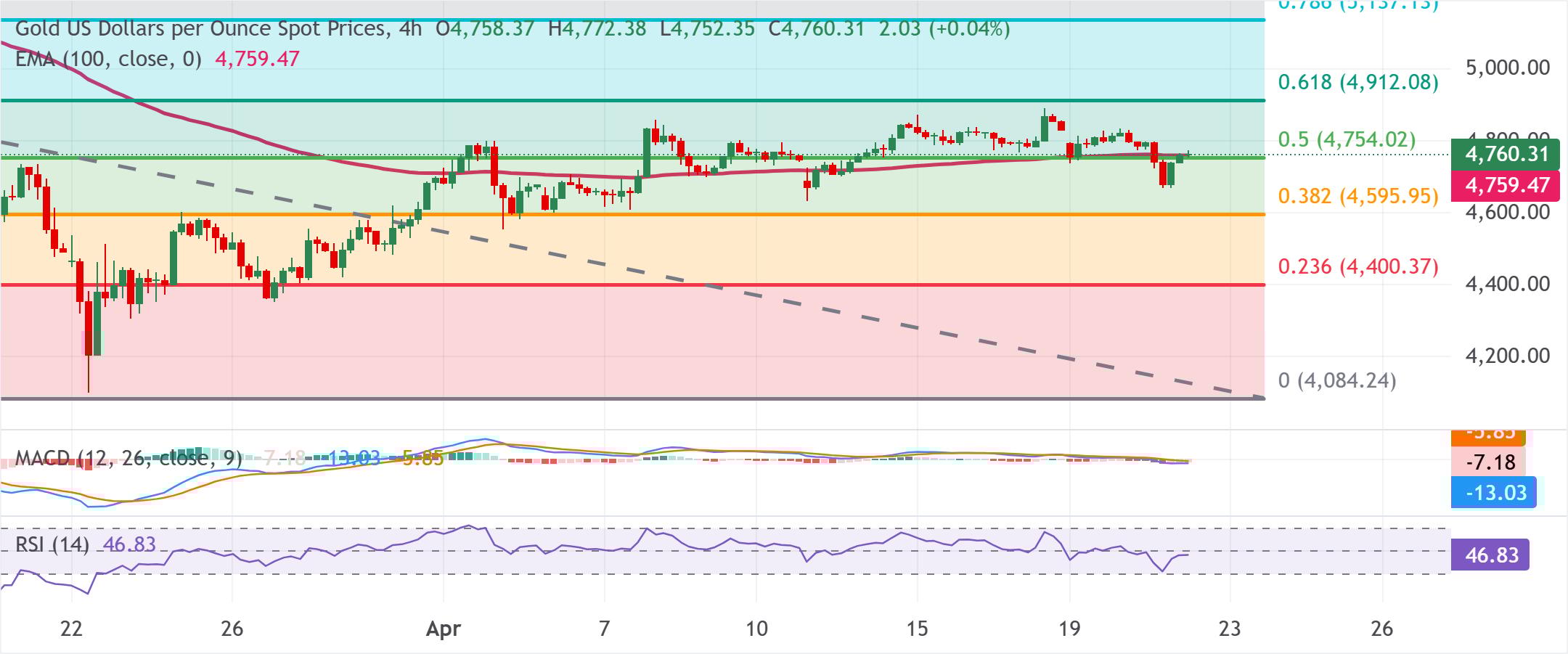
Gold bulls await sustained move beyond 50% Fibo./200-EMA confluence
From a technical perspective, last week's failure ahead of the $4,900 mark and the subsequent slide warrant caution for the XAU/USD bulls. Furthermore, the Relative Strength Index (RSI) is hovering near a neutral 46 and suggests lacklustre upside momentum. Adding to this, the Moving Average Convergence Divergence (MACD) indicator is in negative territory, suggesting that bullish attempts could remain gradual while corrective pressures linger.
The precious metal is currently pressing against a confluence hurdle – comprising the 100-period Exponential Moving Average (EMA) on the 4-hour chart and the 61.8% Fibonacci retracement of the March downfall. This configuration keeps the near-term bias cautiously bearish. Meanwhile, initial support is the 50.0% level at $4,754.02. A sustained break below this would expose the 38.2% Fibo. retracement floor at $4,595.95 and open a deeper corrective phase if bearish pressure persists.
On the flip side, momentum beyond the $4,760-$4,765 confluence is followed by a more meaningful hurdle at the 61.8% Fibo. retracement near $4,912.08, where sellers would likely reassert control if tested.
(The technical analysis of this story was written with the help of an AI tool.)
Interest rates FAQs
Interest rates are charged by financial institutions on loans to borrowers and are paid as interest to savers and depositors. They are influenced by base lending rates, which are set by central banks in response to changes in the economy. Central banks normally have a mandate to ensure price stability, which in most cases means targeting a core inflation rate of around 2%. If inflation falls below target the central bank may cut base lending rates, with a view to stimulating lending and boosting the economy. If inflation rises substantially above 2% it normally results in the central bank raising base lending rates in an attempt to lower inflation.
Higher interest rates generally help strengthen a country’s currency as they make it a more attractive place for global investors to park their money.
Higher interest rates overall weigh on the price of Gold because they increase the opportunity cost of holding Gold instead of investing in an interest-bearing asset or placing cash in the bank. If interest rates are high that usually pushes up the price of the US Dollar (USD), and since Gold is priced in Dollars, this has the effect of lowering the price of Gold.
The Fed funds rate is the overnight rate at which US banks lend to each other. It is the oft-quoted headline rate set by the Federal Reserve at its FOMC meetings. It is set as a range, for example 4.75%-5.00%, though the upper limit (in that case 5.00%) is the quoted figure. Market expectations for future Fed funds rate are tracked by the CME FedWatch tool, which shapes how many financial markets behave in anticipation of future Federal Reserve monetary policy decisions.
Author

Haresh Menghani
FXStreet
Haresh Menghani is a detail-oriented professional with 10+ years of extensive experience in analysing the global financial markets.















