Gold rises as lower US yields lift bullion demand anew
- Gold advances as falling Treasury yields offset broad US Dollar strength.
- Fed holding expectations support bullion despite rising oil and geopolitical stress.
- Traders now await JOLTS, Consumer Confidence and fresh Fed remarks.

Gold (XAU/USD) price clings to solid gains of almost 1% on Monday as the US Dollar (USD) remains strong, while US Treasury yields decline, despite expectations that the Federal Reserve (Fed) will keep interest rates on hold in 2026. At the time of writing, XAU/USD trades at $4,530, after bouncing off daily lows of $4,418.
Bullion gains as rate-cut bets grow despite firmer oil prices
The conflict in the Middle East continues to push energy prices higher, boosting traders' bets on higher interest rates. Nevertheless, speculation that the conflict could be prolonged would weigh on economic growth, exerting pressure on central banks to hold or reduce interest rates to prevent a deeper economic slowdown.
In the meantime, West Texas Intermediate (WTI) extended its gains for the fourth straight day, rising by more than 1.30% to $100.39 per barrel. Although this is positive for the US Dollar, it was also positive for Gold prices, which, despite this, is poised to post losses of more than 10% in March.
Fed Chair Jerome Powell crossed the wires at an interview at Harvard University. He said that tensions between the dual mandate's goals and reaffirmed the central bank's commitment to returning inflation to 2%. He said tariffs added a one-time 0.5% to 1% increase in inflation.
Powell called monetary policy well-positioned, acknowledged that Middle East events are impacting gas prices, and stated that long-term inflation expectations are stable. Officials may respond if conflicts affect inflation or expectations.
Contrarily, Fed Governor Stephen Miran said that Inflation expectations have not yet been affected by elevated oil prices, added that there is no evidence of a wage-price spiral, and said that such an outcome appears extremely unlikely.
Meanwhile, the US Dollar Index (DXY), which measures the American currency's performance against six others, is up 0.29% to 100.48. US Treasury yields, namely the 10-year T-note, drop nearly 9 basis points to 4.34% as money markets increase the chances of a rate cut by the Federal Reserve.
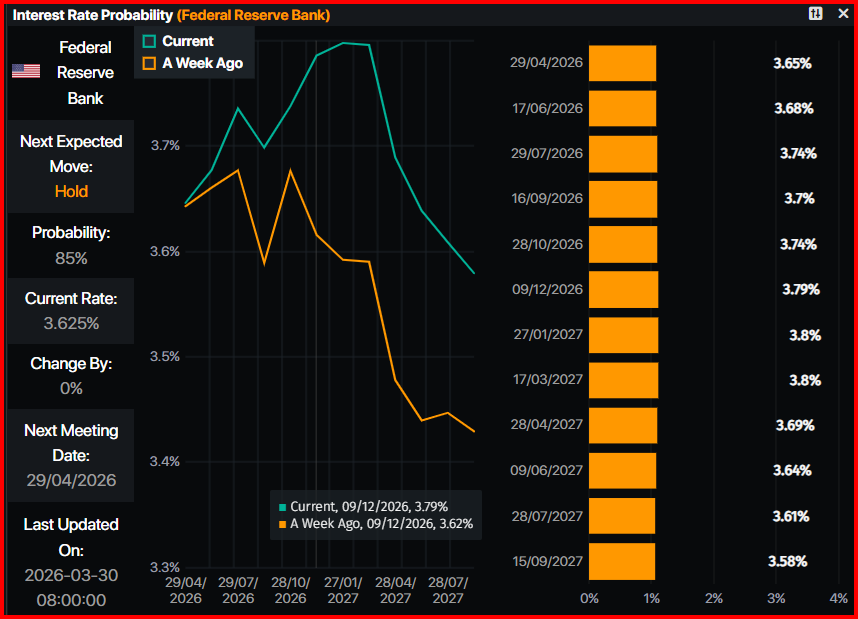
Money markets expect the Federal Reserve to hold rates in 2026, with the first cut seen in mid-2027
Fed Interest Rate Probabilities
Data-wise, the US economic docket will feature the Job Openings and Labor Turnover Survey (JOLTS) for February, Consumer Confidence and speeches by Fed policymakers.
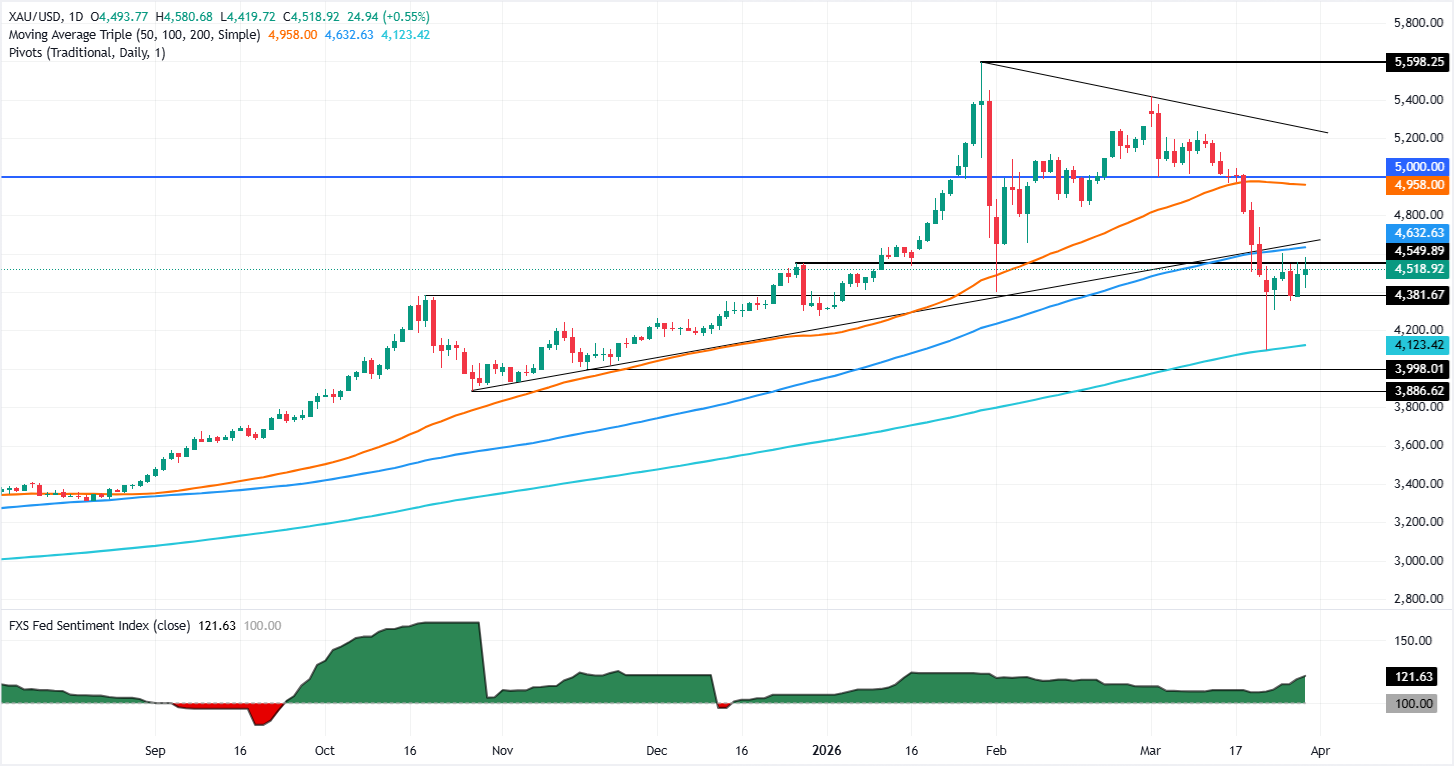
XAU/USD technical outlook: Gold to trade sideways below the 100-day SMA
The technical picture shows Gold trading sideways amid a lack of a clear catalyst, which could open the door to decisively clearing key resistance at the 100-day Simple Moving Average (SMA) at $4,610.
The Relative Strength Index (RSI) shows that sellers remain in charge, but buyers are beginning to emerge as the index approaches the 50-neutral level.
If XAU/USD clears the 100-day SMA, the next area of interest would be the March 20 high at $4,736, ahead of the 20-day SMA at $4,841. On further strength, the next area of supply would be the 50-day SMA at $4,951.
Conversely, if Gold tumbles below $4,500, the first support would be the February 2 swing low of $4,402, followed by the March 24 daily low of $4,305, ahead of the 200-day SMA at $4,100.
Gold FAQs
Gold has played a key role in human’s history as it has been widely used as a store of value and medium of exchange. Currently, apart from its shine and usage for jewelry, the precious metal is widely seen as a safe-haven asset, meaning that it is considered a good investment during turbulent times. Gold is also widely seen as a hedge against inflation and against depreciating currencies as it doesn’t rely on any specific issuer or government.
Central banks are the biggest Gold holders. In their aim to support their currencies in turbulent times, central banks tend to diversify their reserves and buy Gold to improve the perceived strength of the economy and the currency. High Gold reserves can be a source of trust for a country’s solvency. Central banks added 1,136 tonnes of Gold worth around $70 billion to their reserves in 2022, according to data from the World Gold Council. This is the highest yearly purchase since records began. Central banks from emerging economies such as China, India and Turkey are quickly increasing their Gold reserves.
Gold has an inverse correlation with the US Dollar and US Treasuries, which are both major reserve and safe-haven assets. When the Dollar depreciates, Gold tends to rise, enabling investors and central banks to diversify their assets in turbulent times. Gold is also inversely correlated with risk assets. A rally in the stock market tends to weaken Gold price, while sell-offs in riskier markets tend to favor the precious metal.
The price can move due to a wide range of factors. Geopolitical instability or fears of a deep recession can quickly make Gold price escalate due to its safe-haven status. As a yield-less asset, Gold tends to rise with lower interest rates, while higher cost of money usually weighs down on the yellow metal. Still, most moves depend on how the US Dollar (USD) behaves as the asset is priced in dollars (XAU/USD). A strong Dollar tends to keep the price of Gold controlled, whereas a weaker Dollar is likely to push Gold prices up.
Author

Christian Borjon Valencia
FXStreet
Markets analyst, news editor, and trading instructor with over 14 years of experience across FX, commodities, US equity indices, and global macro markets.