Gold slides as US-Iran tensions revive Fed rate hike bets, FOMC Minutes loom
- Gold retreats toward $4,000 as renewed US-Iran tensions weigh on sentiment.
- Higher Oil prices revive Fed rate hike bets, pressuring the non-yielding metal.
- Attention turns to the FOMC meeting minutes for guidance on the Fed's next move.

Gold (XAU/USD) sees a sharp move lower on Wednesday after US President Donald Trump declared that the ceasefire deal with Iran was “over” during the NATO Summit in Ankara, Turkey. However, Reuters later reported that Trump did not repeat those remarks, citing a source familiar with the talks.
At the time of writing, XAU/USD is trading around $4,040, retracing most of the gains recorded in the previous week.
Tensions escalated after renewed fighting between the United States and Iran overnight, following attacks on commercial vessels near the Strait of Hormuz. Trump warned that the US would “probably hit them again tonight” and added that “we may take over Kharg Island.”
The latest flare-up represents the most significant breach of the interim US-Iran agreement since it took effect on June 17, lifting the US Dollar (USD) and Crude Oil prices while dampening demand for the yellow metal.
West Texas Intermediate (WTI) crude Oil is trading around $74.50 per barrel, up more than 8% so far this week.
The rebound in Oil prices rekindled inflation concerns, with the CME FedWatch Tool showing the probability of a September Federal Reserve (Fed) interest rate hike rising to 68% from 58% a day earlier.
Higher borrowing costs tend to weigh on Gold as investors favor interest-bearing assets. US Treasury yields remained elevated, with the benchmark 10-year yield holding around 4.58% on Wednesday, its highest level since late May.
The June Federal Open Market Committee (FOMC) meeting minutes, due later in the American session at 18:00 GMT, will be closely watched for hints about the Fed's next move.
For now, Gold's price action remains driven by interest rate expectations, overshadowing its traditional role as an inflation hedge and safe-haven asset.
The precious metal is trading nearly 28% below its record high of around $5,600 reached in January and remains vulnerable to further losses amid an unfavorable macro backdrop.
Even so, the longer-term outlook remains underpinned by structural demand from central banks and institutional investors, which could help limit deeper declines.
Technical analysis: XAU/USD slides toward $4,000 support
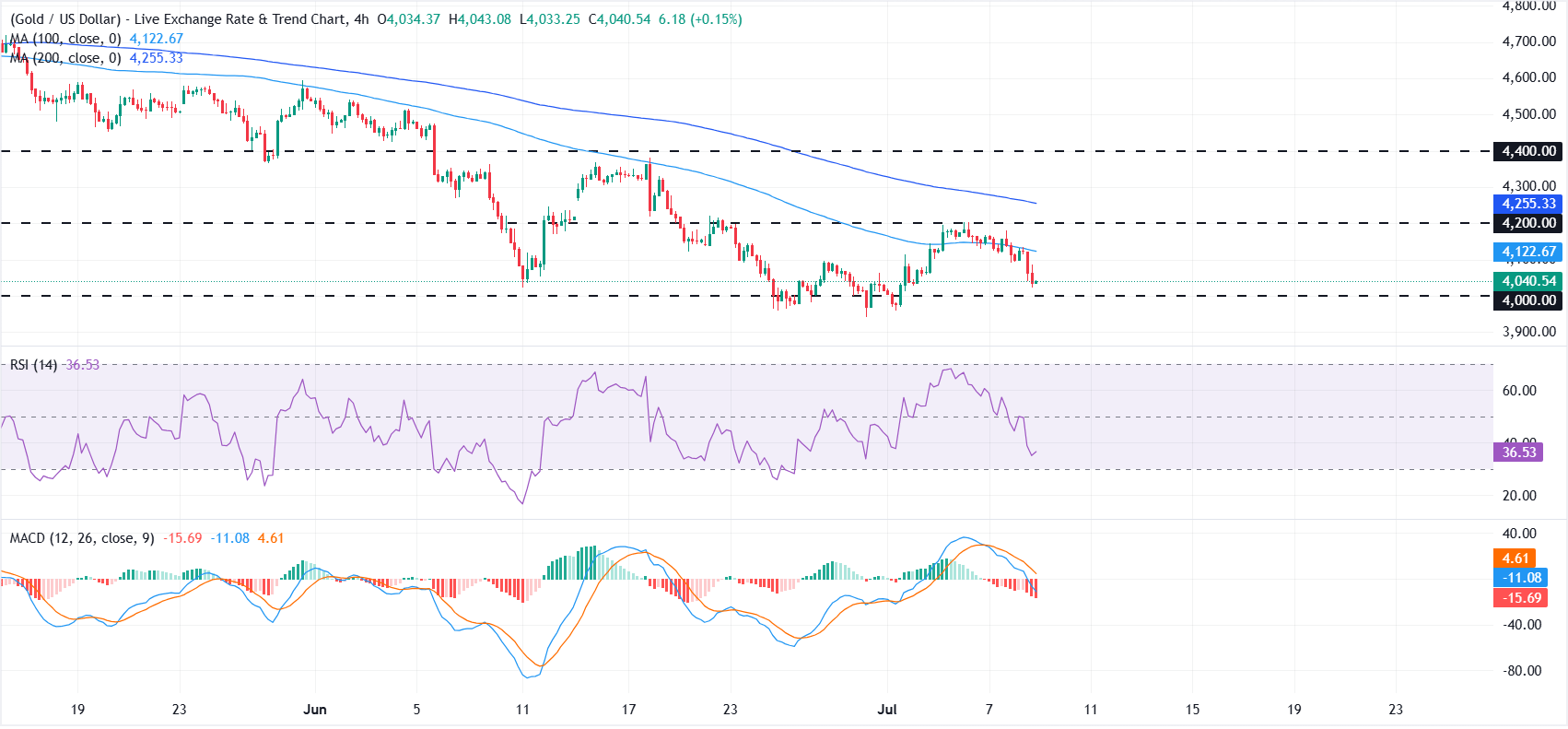
On the 4-hour chart, XAU/USD retains a bearish near-term tone as price holds below the 100-period Simple Moving Average (SMA) at $4,122.
The yellow metal is retreating from recent highs and remains capped by a dense overhead structure, while momentum indicators reinforce the softer bias: the Relative Strength Index (14) has slipped toward 36, and the Moving Average Convergence Divergence (MACD) has turned negative with a declining histogram, hinting at persistent downside pressure.
On the topside, immediate resistance is located at the 100-period SMA near $4,128, followed by the horizontal barrier at $4,200 and the 200-period SMA at $4,255, before a stronger cap emerges at $4,400.
On the downside, initial support is seen at the horizontal level of $4,000, where a break would likely open the door to a deeper corrective slide, while holding above this floor would keep XAU/USD in a consolidative bearish phase beneath the mentioned moving averages.
(The technical analysis of this story was written with the help of an AI tool. Know more.)
Gold FAQs
Gold has played a key role in human’s history as it has been widely used as a store of value and medium of exchange. Currently, apart from its shine and usage for jewelry, the precious metal is widely seen as a safe-haven asset, meaning that it is considered a good investment during turbulent times. Gold is also widely seen as a hedge against inflation and against depreciating currencies as it doesn’t rely on any specific issuer or government.
Central banks are the biggest Gold holders. In their aim to support their currencies in turbulent times, central banks tend to diversify their reserves and buy Gold to improve the perceived strength of the economy and the currency. High Gold reserves can be a source of trust for a country’s solvency. Central banks added 1,136 tonnes of Gold worth around $70 billion to their reserves in 2022, according to data from the World Gold Council. This is the highest yearly purchase since records began. Central banks from emerging economies such as China, India and Turkey are quickly increasing their Gold reserves.
Gold has an inverse correlation with the US Dollar and US Treasuries, which are both major reserve and safe-haven assets. When the Dollar depreciates, Gold tends to rise, enabling investors and central banks to diversify their assets in turbulent times. Gold is also inversely correlated with risk assets. A rally in the stock market tends to weaken Gold price, while sell-offs in riskier markets tend to favor the precious metal.
The price can move due to a wide range of factors. Geopolitical instability or fears of a deep recession can quickly make Gold price escalate due to its safe-haven status. As a yield-less asset, Gold tends to rise with lower interest rates, while higher cost of money usually weighs down on the yellow metal. Still, most moves depend on how the US Dollar (USD) behaves as the asset is priced in dollars (XAU/USD). A strong Dollar tends to keep the price of Gold controlled, whereas a weaker Dollar is likely to push Gold prices up.
Author

Vishal Chaturvedi
FXStreet
I am a macro-focused research analyst with over four years of experience covering forex and commodities market. I enjoy breaking down complex economic trends and turning them into clear, actionable insights that help traders stay ahead of the curve.