Gold reclaims $4,000 as US midterm sweep sinks USD, Oil plunges
- Gold rallies above $4,000 after rebounding from daily lows of $3,919.
- US 10-year Treasury yields drop six basis points to 4.904%.
- December Fed hike odds remain elevated at 79% ahead of NFP.

Gold (XAU/USD) rallied near 3% on Wednesday as the Greenback tumbled following the Democrats' sweep in the US midterm elections. Markets now look ahead to the release of October’s Nonfarm Payrolls data on Friday. The XAU/USD trades at $4,047, after bouncing off daily lows of $3,919.
XAU/USD surges nearly 3% as US Dollar weakness, falling Treasury yields fuel Bullion's recovery
Wall Street is trading in the green, reversing some of its earlier losses. Fears of tighter regulation of artificial intelligence (AI), including a potential ban on data centers, could weigh on the economy, with the preliminary Q3 US GDP reading hitting the 3% threshold.
The depreciation of the US Dollar (USD) boosted the appetite for Bullion, which has recovered after hitting a year-to-date (YTD) low on October 30 at $3,870.
Analysts have argued that a Democratic-dominated Congress could be negative for GDP since some of the administration's proposals might get blocked, possibly leading to an economic slowdown.
US data showed that services-sector business activity continued to expand, although at a slower pace. The ISM Services Purchasing Managers Index (PMI) for October came in softer than expected at 54.5, down from 54.9 a month earlier and below the 54.8 estimate. Within the survey, the employment sub-component rose, while new orders and prices paid declined but remained in expansionary territory.
The October ADP Employment Change report showed private hiring holding steady as companies added 86K workers — above the 69K forecast.
Oil prices edged lower after the election amid growing expectations that the US Congress may strip US President Trump of his war powers, but not until the Democratic wave takes over in January 2027. West Texas Intermediate (WTI) is down more than 8% at $87.50 per barrel.
In the meantime, expectations that the Federal Reserve (Fed) will raise interest rates in December are at 79% for a 25-basis-point move. This is negative for Gold, which usually performs well amid low-interest-rate scenarios.
The fall of US Treasury yields, however, supports Gold’s rise. The US 10-year Treasury note drops by 6 basis points, yielding 4.904%.
Traders' eyes shift to the release of jobless claims and speeches by Fed officials on Thursday, followed by the highlight on Friday: the release of Nonfarm Payrolls data.
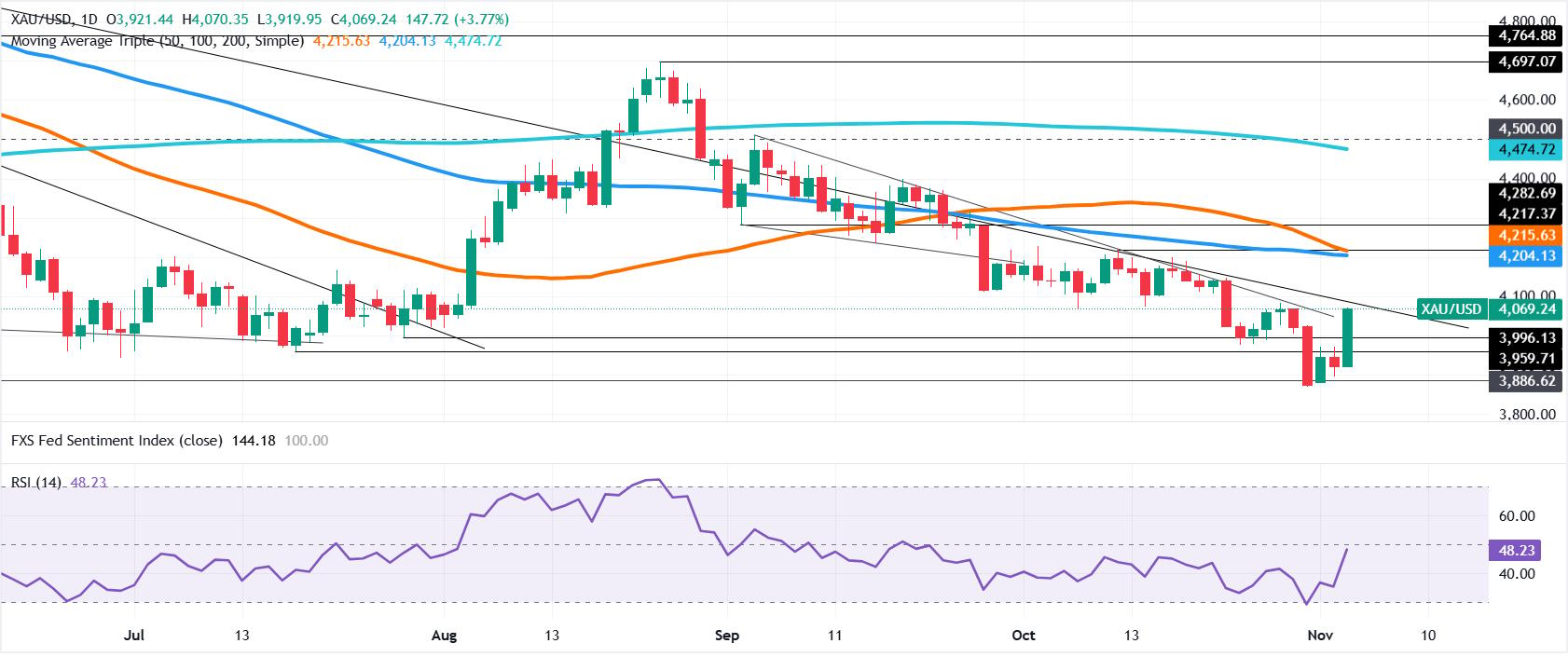
XAU/USD technical outlook: Gold reclaims $4,000, eyes on $4,100
Per market structure, the Gold trend remains downward, but buyers are gaining momentum as the price nears a key resistance trendline. The Relative Strength Index (RSI) is about to turn bullish after staging a parabolic jump toward its 50-neutral level.
If XAU/USD reclaims $4,100, this clears the path to challenge the confluence of the 100-day and 50-day Simple Moving Averages (SMAs) at $4,204 and $4,215, respectively. Once cleared, the next stop is the 200-day SMA at $4,474.
For a bearish continuation, Gold must drop below $4,000. A breach of the latter will expose the November 3 high-turned-support at $3,971, then the October 30 year-to-date low of $3,879, and finally the April 22, 2025 daily high-turned-support at $3,500.
Gold FAQs
Gold has played a key role in human’s history as it has been widely used as a store of value and medium of exchange. Currently, apart from its shine and usage for jewelry, the precious metal is widely seen as a safe-haven asset, meaning that it is considered a good investment during turbulent times. Gold is also widely seen as a hedge against inflation and against depreciating currencies as it doesn’t rely on any specific issuer or government.
Central banks are the biggest Gold holders. In their aim to support their currencies in turbulent times, central banks tend to diversify their reserves and buy Gold to improve the perceived strength of the economy and the currency. High Gold reserves can be a source of trust for a country’s solvency. Central banks added 1,136 tonnes of Gold worth around $70 billion to their reserves in 2022, according to data from the World Gold Council. This is the highest yearly purchase since records began. Central banks from emerging economies such as China, India and Turkey are quickly increasing their Gold reserves.
Gold has an inverse correlation with the US Dollar and US Treasuries, which are both major reserve and safe-haven assets. When the Dollar depreciates, Gold tends to rise, enabling investors and central banks to diversify their assets in turbulent times. Gold is also inversely correlated with risk assets. A rally in the stock market tends to weaken Gold price, while sell-offs in riskier markets tend to favor the precious metal.
The price can move due to a wide range of factors. Geopolitical instability or fears of a deep recession can quickly make Gold price escalate due to its safe-haven status. As a yield-less asset, Gold tends to rise with lower interest rates, while higher cost of money usually weighs down on the yellow metal. Still, most moves depend on how the US Dollar (USD) behaves as the asset is priced in dollars (XAU/USD). A strong Dollar tends to keep the price of Gold controlled, whereas a weaker Dollar is likely to push Gold prices up.
Author

Christian Borjon Valencia
FXStreet
Markets analyst, news editor, and trading instructor with over 14 years of experience across FX, commodities, US equity indices, and global macro markets.