Gold rebounds modestly as USD eases, but higher-for-longer interest rate outlook cap gains
- Gold trims intraday losses as US Dollar eases.
- Oil-driven inflation fuels higher-for-longer rate expectations, weighing on Gold
- Technically, XAU/USD trades below the Bollinger midline on the 4-hour chart, signaling downside pressure.

Gold (XAU/USD) trims earlier intraday losses on Thursday as the US Dollar loses momentum, but gains remain capped amid higher-for-longer rate expectations fueled by Oil-driven inflation.
At the time of writing, XAU/USD is trading around $4,730, after hitting an intraday low of $4,684. Meanwhile, the US Dollar Index (DXY), which tracks the Greenback’s value against a basket of six major currencies, is trading around 98.57 after hitting an intraday high of 98.80.
Shipping disruptions in Hormuz sustain inflation fears
Tensions in the Strait of Hormuz are rising as the route remains under a dual blockade by the US Navy and Iran. US President Donald Trump said on Truth Social that “we have total control over the Strait of Hormuz, no ship can enter or leave without the approval of the United States Navy.” He also added that he has ordered the Navy to “shoot any boat putting mines in Hormuz.”
Meanwhile, The Washington Post, citing a Pentagon assessment, reported that it could take up to six months to fully clear mines from the waterway, underscoring the risk of prolonged disruption to global oil supply.
Islamic Revolutionary Guard Corps (IRGC) reportedly seized two vessels in the strait on Wednesday, according to shipping companies and the semi-official Tasnim news agency.
Rising crude Oil prices, driven by these disruptions, continue to fuel inflation concerns globally, increasing the likelihood of a “higher-for-longer” interest rate environment across major central banks, including the Federal Reserve (Fed). While Gold is typically viewed as a hedge against inflation, higher borrowing costs tend to weigh on demand for the non-yielding asset as investors shift toward yield-bearing assets such as bonds.
Markets remain skeptical about whether the United States (US) and Iran will resume negotiations anytime soon. This comes despite the ceasefire extension announced by Trump, which Iranian officials have not formally accepted. Tehran has criticized Washington’s decision to maintain the naval blockade, calling it a key obstacle to negotiations.
On the data front, US Initial Jobless Claims rose to 214K, above the 212K forecast and up from 208K previously. The preliminary S&P Global Manufacturing PMI rose to 54 in April from 52.3 in March, marking a 47-month high, while the Services PMI improved to 51.3 from 49.8, reaching a two-month high.
Technical Analysis: XAU/USD trades below the Bollinger midline, downside risks linger
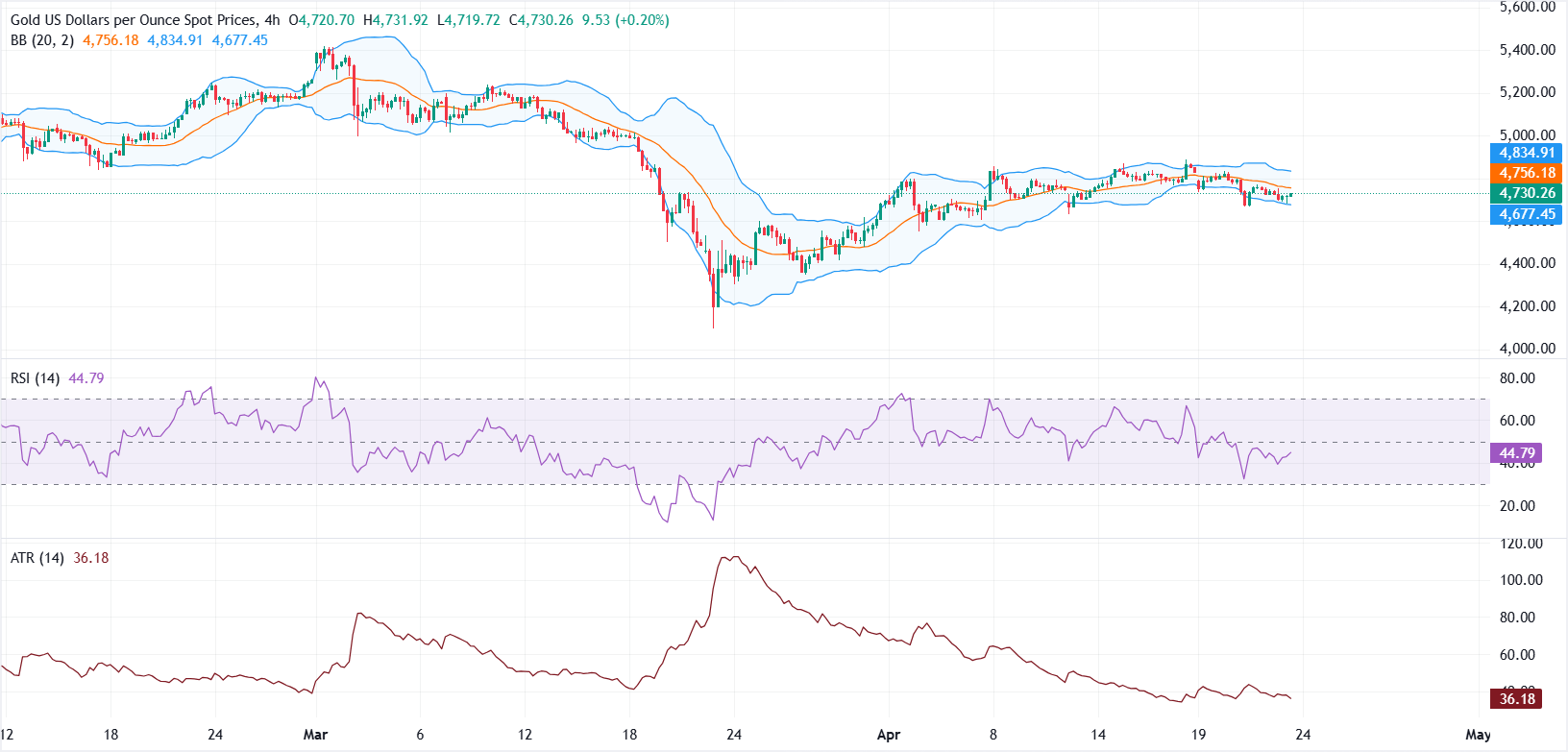
In the 4-hour chart, XAU/USD remains capped in the near term, trading under the 20-period Simple Moving Average (the Bollinger middle band) at roughly $4,756, which reinforces a bearish bias despite still holding comfortably above the lower band support near $4,677. The Relative Strength Index (14) around 41 leans to the downside, suggesting sellers retain the upper hand, while the modest Average True Range (14) near 38 points to contained but persistent volatility.
On the topside, initial resistance is aligned with the 20-period SMA/Bollinger middle band at about $4,756, with a further hurdle at the upper Bollinger band near $4,834, where failure would keep the broader corrective tone intact. On the downside, immediate support emerges at the lower Bollinger band around $4,677; a decisive break below this floor would open the door to a deeper pullback, whereas sustained defense of this area could encourage a consolidation phase.
(The technical analysis of this story was written with the help of an AI tool.)
Inflation FAQs
Inflation measures the rise in the price of a representative basket of goods and services. Headline inflation is usually expressed as a percentage change on a month-on-month (MoM) and year-on-year (YoY) basis. Core inflation excludes more volatile elements such as food and fuel which can fluctuate because of geopolitical and seasonal factors. Core inflation is the figure economists focus on and is the level targeted by central banks, which are mandated to keep inflation at a manageable level, usually around 2%.
The Consumer Price Index (CPI) measures the change in prices of a basket of goods and services over a period of time. It is usually expressed as a percentage change on a month-on-month (MoM) and year-on-year (YoY) basis. Core CPI is the figure targeted by central banks as it excludes volatile food and fuel inputs. When Core CPI rises above 2% it usually results in higher interest rates and vice versa when it falls below 2%. Since higher interest rates are positive for a currency, higher inflation usually results in a stronger currency. The opposite is true when inflation falls.
Although it may seem counter-intuitive, high inflation in a country pushes up the value of its currency and vice versa for lower inflation. This is because the central bank will normally raise interest rates to combat the higher inflation, which attract more global capital inflows from investors looking for a lucrative place to park their money.
Formerly, Gold was the asset investors turned to in times of high inflation because it preserved its value, and whilst investors will often still buy Gold for its safe-haven properties in times of extreme market turmoil, this is not the case most of the time. This is because when inflation is high, central banks will put up interest rates to combat it. Higher interest rates are negative for Gold because they increase the opportunity-cost of holding Gold vis-a-vis an interest-bearing asset or placing the money in a cash deposit account. On the flipside, lower inflation tends to be positive for Gold as it brings interest rates down, making the bright metal a more viable investment alternative.
Author

Vishal Chaturvedi
FXStreet
I am a macro-focused research analyst with over four years of experience covering forex and commodities market. I enjoy breaking down complex economic trends and turning them into clear, actionable insights that help traders stay ahead of the curve.