Gold rebounds from year-to-date lows as Trump delays Iran energy strikes
- Gold rebounds on Monday, partly erasing earlier losses that led prices to hit year-to-date lows after a sharp sell-off of nearly 8%.
- Gold's rebound came as Trump announced he is postponing planned strikes on Iran's energy facilities after engaging in "productive" conversations with Tehran.
- Technically, XAU/USD remains bearish even as the RSI shows oversold conditions.

Gold (XAU/USD) rebounds from year-to-date lows on Monday as bargain hunting emerges after a steep sell-off, with the metal finding support after news that US President Donald Trump postponed planned strikes against Iran's power plants and energy infrastructure.
At the time of writing, XAU/USD is trading around $4,375, after briefly sliding below $4,100 during the Asian session, its lowest level since November 2025, before rebounding to an intraday high of $4,536.
Trump said he had instructed the Department of War to postpone planned strikes on Iranian power plants and energy infrastructure for five days, subject to the outcome of the ongoing discussions, Reuters reported. The news pushed Crude Oil prices sharply lower, easing inflation concerns and triggering a pullback in the US Dollar (USD) and Treasury yields.
However, Iran’s Fars News Agency, citing sources, said there are no direct communications with the US, nor through intermediaries. Meanwhile, Iran’s Foreign Ministry reiterated that its stance on the Strait of Hormuz and conditions to end the war remain unchanged, adding that Tehran has not responded to messages relayed by other countries regarding US requests for talks, according to IRNA.
This comes after Trump warned over the weekend that Iran’s power infrastructure could be targeted if the Strait of Hormuz was not reopened within forty-eight hours. In response, Iran threatened retaliation, warning it could target all energy, information technology, and desalination infrastructure belonging to the US and Israel.
The move marks a temporary easing in geopolitical tensions and has lifted market sentiment, although uncertainty around the conflict remains high and could cap further upside in the metal unless there is a clear de-escalation and reopening of the Strait of Hormuz. Oil prices remain elevated despite the intraday pullback, keeping inflation concerns and their economic impact in focus.
As a result, markets are increasingly anticipating that central banks will keep interest rates higher for longer, or even consider rate hikes if the war drags on and inflation remains persistent.
The repricing of rate expectations was further supported by last week’s central bank meetings, where policymakers broadly opted to hold rates while emphasizing upside inflation risks and uncertainty tied to the evolving geopolitical backdrop.
Markets have priced out Federal Reserve (Fed) interest rate cuts for this year, while in other major economies, expectations for further tightening have strengthened. Higher interest rates increase the opportunity cost of holding non-yielding assets such as Gold.
Looking ahead, markets will keep a close eye on geopolitical developments for direction. With little US economic data scheduled on Monday, Gold will likely be driven by broader market sentiment and any subsequent war-related announcements.
Technical analysis: XAU/USD rebounds from 200-day SMA, downside risks remain
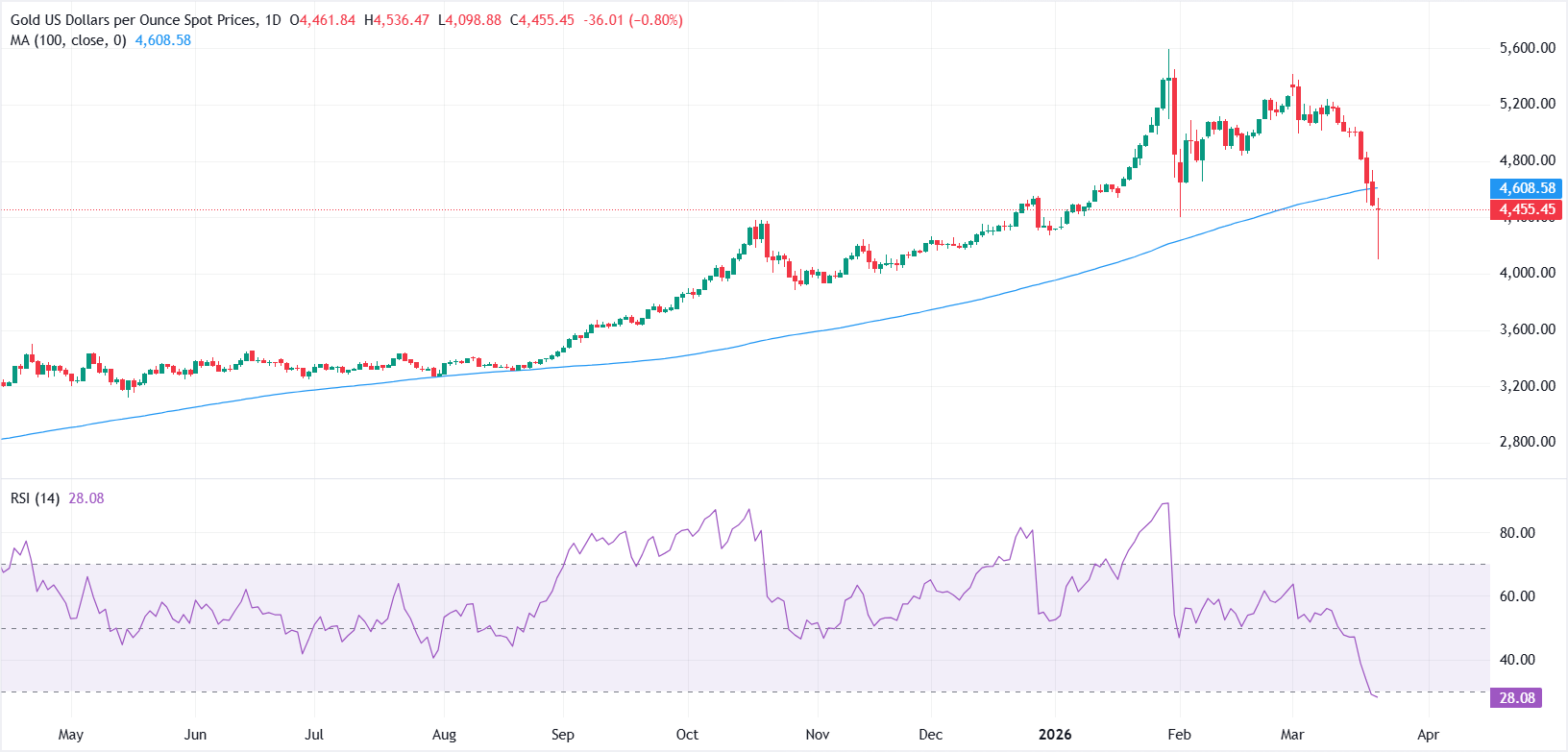
From a technical perspective, XAU/USD has attracted buying interest after bouncing off the 200-day Simple Moving Average (SMA) near $4,095, helping preserve the broader uptrend. However, the near-term bias remains slightly bearish as the metal continues to trade below the 100-day and 50-day SMAs, indicating lingering selling pressure.
Momentum indicators reflect this mixed outlook, with the Relative Strength Index (RSI) hovering near 26, suggesting oversold conditions that could support a short-term rebound, while the Average True Range (ATR) remains elevated, pointing to heightened volatility.
On the upside, the $4,500 level acts as immediate resistance, followed by the 100-day SMA around $4,600. A sustained break above this zone could shift focus toward the 50-day SMA near $4,970 and the key psychological $5,000 mark. On the downside, a sustained break below the 200-day SMA may trigger a deeper pullback toward $4,000.
Gold FAQs
Gold has played a key role in human’s history as it has been widely used as a store of value and medium of exchange. Currently, apart from its shine and usage for jewelry, the precious metal is widely seen as a safe-haven asset, meaning that it is considered a good investment during turbulent times. Gold is also widely seen as a hedge against inflation and against depreciating currencies as it doesn’t rely on any specific issuer or government.
Central banks are the biggest Gold holders. In their aim to support their currencies in turbulent times, central banks tend to diversify their reserves and buy Gold to improve the perceived strength of the economy and the currency. High Gold reserves can be a source of trust for a country’s solvency. Central banks added 1,136 tonnes of Gold worth around $70 billion to their reserves in 2022, according to data from the World Gold Council. This is the highest yearly purchase since records began. Central banks from emerging economies such as China, India and Turkey are quickly increasing their Gold reserves.
Gold has an inverse correlation with the US Dollar and US Treasuries, which are both major reserve and safe-haven assets. When the Dollar depreciates, Gold tends to rise, enabling investors and central banks to diversify their assets in turbulent times. Gold is also inversely correlated with risk assets. A rally in the stock market tends to weaken Gold price, while sell-offs in riskier markets tend to favor the precious metal.
The price can move due to a wide range of factors. Geopolitical instability or fears of a deep recession can quickly make Gold price escalate due to its safe-haven status. As a yield-less asset, Gold tends to rise with lower interest rates, while higher cost of money usually weighs down on the yellow metal. Still, most moves depend on how the US Dollar (USD) behaves as the asset is priced in dollars (XAU/USD). A strong Dollar tends to keep the price of Gold controlled, whereas a weaker Dollar is likely to push Gold prices up.
Author

Vishal Chaturvedi
FXStreet
I am a macro-focused research analyst with over four years of experience covering forex and commodities market. I enjoy breaking down complex economic trends and turning them into clear, actionable insights that help traders stay ahead of the curve.