British Pound gains ground as Japanese Yen underperforms
- GBP/JPY edges higher as falling Japanese bond yields weigh on the Yen.
- The wide UK-Japan yield gap supports the British Pound, although intervention and UK fiscal risks cap gains.
- The cross remains below all major daily SMAs, keeping the broader bias bearish.

GBP/JPY trades with a mild positive bias on Friday as the Japanese Yen (JPY) underperforms across the board. A pause in the global bond sell-off has pushed government bond yields lower, with Japanese yields falling more sharply than their UK counterparts. Japan’s relatively low interest rates and broader fiscal concerns also remain persistent headwinds for the Yen. At the time of writing, the cross trades around 209.16, up 0.14% on the day.
Japan’s benchmark 10-year government bond yield falls toward 3.00% after reaching 3.153% earlier this week, its highest level in around 30 years. Meanwhile, the UK 10-year gilt yield stands near 5.432%, below Thursday’s peak of 5.527%, its highest level since 2007. This leaves UK yields roughly 243 basis points above Japanese yields, helping the Pound hold firm against the Yen.
Expectations that the Bank of England (BoE) could raise interest rates before the end of the year also favour the British Pound (GBP), even as the Bank of Japan (BoJ) remains on a gradual tightening path.
BoE Governor Andrew Bailey said on Thursday, “Monetary policy needs an unwavering commitment to returning inflation to target.” Bailey added, “Evidence of pass-through of energy costs into broader inflation is currently quite subdued, but there are risks. Inflation risks rise the longer high energy prices persist.”
On the Japanese side, BoJ Governor Kazuo Ueda said on Tuesday, “We’re to keep raising rates in response to the economy and inflation.” However, Ueda added that the “pace and timing of future policy adjustment will be decided based on the likelihood of our baseline projections materialising, as well as risks.”
Meanwhile, traders remain cautious about building aggressive bullish positions. Intervention risks keep traders wary as USD/JPY holds around 158.00, not far from the 160.00 level. Concerns over the UK’s fiscal outlook ahead of the October 28 budget also limit demand for the British Pound, keeping GBP/JPY within the narrow range that has been in place since early September.
Technical analysis
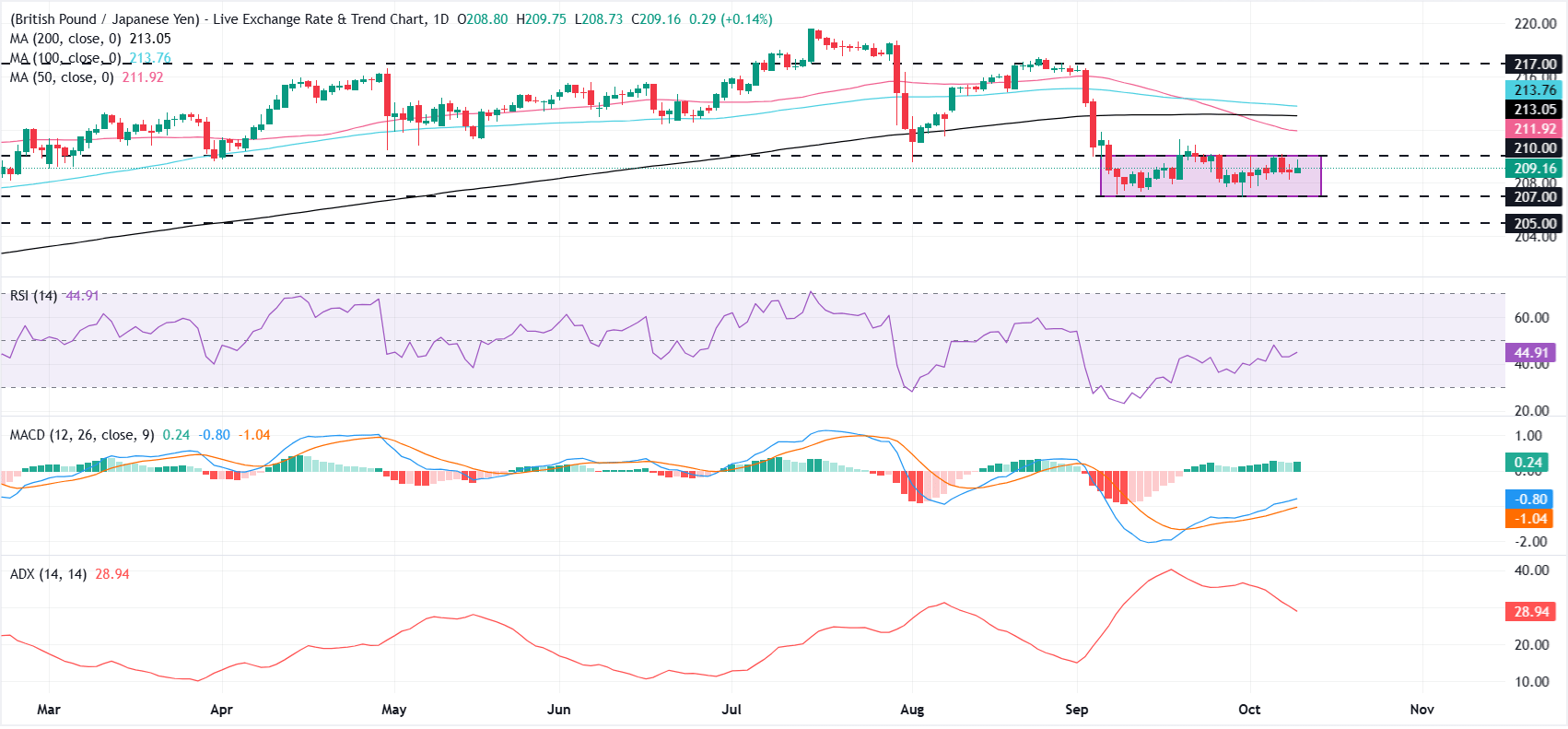
On the daily chart, GBP/JPY remains trapped within the 207-210range. The cross trades below the 50-day, 100-day and 200-day Simple Moving Averages (SMAs), which collectively cap the topside and keep the near-term bias bearish.
Momentum indicators offer mixed signals. The Relative Strength Index (RSI) stands near 46, slightly below the neutral 50 level, while the Moving Average Convergence Divergence (MACD) has turned positive, pointing to an attempt to stabilise rather than a clear bullish reversal.
On the downside, initial support is seen at 207, ahead of a deeper floor at 205 that would come into view on a renewed slide. On the topside, a daily close above 210 would be the first step to easing bearish pressure, though bulls would still need to reclaim the 50-day SMA at 211.92, followed by the 200-day SMA at 213.05 and the 100-day SMA at 213.77, before the broader picture turns more constructive, with the distant horizontal barrier at 217 marking a stronger resistance zone.
(The technical analysis of this story was written with the help of an AI tool. Know more.)
Japanese Yen Price Today
The table below shows the percentage change of Japanese Yen (JPY) against listed major currencies today. Japanese Yen was the strongest against the Euro.
| USD | EUR | GBP | JPY | CAD | AUD | NZD | CHF | |
|---|---|---|---|---|---|---|---|---|
| USD | 0.07% | 0.08% | 0.19% | 0.01% | -0.34% | -0.18% | -0.12% | |
| EUR | -0.07% | 0.02% | 0.12% | -0.06% | -0.40% | -0.20% | -0.20% | |
| GBP | -0.08% | -0.02% | 0.13% | -0.04% | -0.40% | -0.23% | -0.15% | |
| JPY | -0.19% | -0.12% | -0.13% | -0.18% | -0.54% | -0.37% | -0.29% | |
| CAD | -0.01% | 0.06% | 0.04% | 0.18% | -0.38% | -0.20% | -0.11% | |
| AUD | 0.34% | 0.40% | 0.40% | 0.54% | 0.38% | 0.17% | 0.28% | |
| NZD | 0.18% | 0.20% | 0.23% | 0.37% | 0.20% | -0.17% | 0.10% | |
| CHF | 0.12% | 0.20% | 0.15% | 0.29% | 0.11% | -0.28% | -0.10% |
The heat map shows percentage changes of major currencies against each other. The base currency is picked from the left column, while the quote currency is picked from the top row. For example, if you pick the Japanese Yen from the left column and move along the horizontal line to the US Dollar, the percentage change displayed in the box will represent JPY (base)/USD (quote).
Author

Vishal Chaturvedi
FXStreet
I am a macro-focused research analyst with over four years of experience covering forex and commodities market. I enjoy breaking down complex economic trends and turning them into clear, actionable insights that help traders stay ahead of the curve.