Gold price steadies near $3,300 after Fed flags stagflation risks in May minutes
- Fed minutes warn of stagflation risks if tariffs drive inflation and weaken jobs outlook.
- Policymakers favor cautious stance as economic effects of trade policy remain unclear.
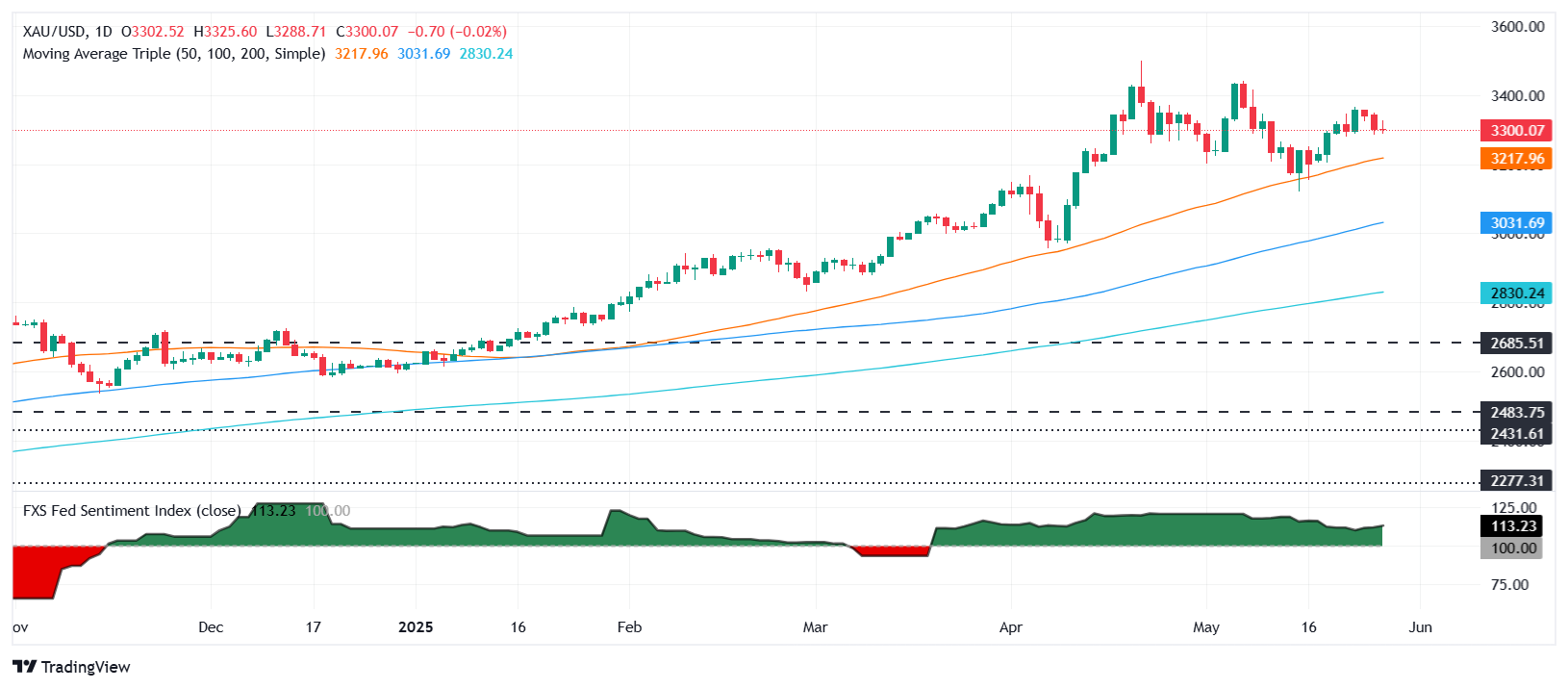
- Gold trades rangebound between $3,280–$3,360; RSI suggests limited near-term momentum.
Gold prices recovered some ground on Wednesday as the Federal Reserve revealed in the May 6-7 minutes that they see rising inflation and unemployment risks increasing due to the trade war. At the time of writing, XAU/USD is trading at $3,300, virtually unchanged.
XAU/USD trims losses as Fed highlights inflation persistence and rising uncertainty amid ongoing trade war
The minutes revealed that inflation could be “more persistent than expected,” fueled by higher import taxes proposed by the Washington government. The Fed acknowledged some stagflation risks as “Participants noted that the (Federal Open Market) Committee might face difficult tradeoffs if inflation proves to be more persistent while the outlooks for growth and employment weaken.”
Policymakers noted that uncertainty about the economic outlook had risen, “making it appropriate to take a cautious approach until the net economic effects of the array of changes to government policies become clearer.”
It is worth noting the Fed meeting was before Trump reduced tariffs on China from 145% to 30%.
Gold price reaction to Fed minutes
XAU/USD edged back above $3,300 and remains hovering around that level. Momentum remains slightly bearish, though the RSI shifted flat, hinting that the yellow metal could continue to trade rangebound within the $3,280-$3,3360 area.
Fed FAQs
Monetary policy in the US is shaped by the Federal Reserve (Fed). The Fed has two mandates: to achieve price stability and foster full employment. Its primary tool to achieve these goals is by adjusting interest rates. When prices are rising too quickly and inflation is above the Fed’s 2% target, it raises interest rates, increasing borrowing costs throughout the economy. This results in a stronger US Dollar (USD) as it makes the US a more attractive place for international investors to park their money. When inflation falls below 2% or the Unemployment Rate is too high, the Fed may lower interest rates to encourage borrowing, which weighs on the Greenback.
The Federal Reserve (Fed) holds eight policy meetings a year, where the Federal Open Market Committee (FOMC) assesses economic conditions and makes monetary policy decisions. The FOMC is attended by twelve Fed officials – the seven members of the Board of Governors, the president of the Federal Reserve Bank of New York, and four of the remaining eleven regional Reserve Bank presidents, who serve one-year terms on a rotating basis.
In extreme situations, the Federal Reserve may resort to a policy named Quantitative Easing (QE). QE is the process by which the Fed substantially increases the flow of credit in a stuck financial system. It is a non-standard policy measure used during crises or when inflation is extremely low. It was the Fed’s weapon of choice during the Great Financial Crisis in 2008. It involves the Fed printing more Dollars and using them to buy high grade bonds from financial institutions. QE usually weakens the US Dollar.
Quantitative tightening (QT) is the reverse process of QE, whereby the Federal Reserve stops buying bonds from financial institutions and does not reinvest the principal from the bonds it holds maturing, to purchase new bonds. It is usually positive for the value of the US Dollar.
Author

Christian Borjon Valencia
FXStreet
Markets analyst, news editor, and trading instructor with over 14 years of experience across FX, commodities, US equity indices, and global macro markets.