Gold price slips as Waller’s hawkish comments lift USD
- Waller warns rate hikes are possible if inflation expectations are unanchored.
- Iran deal doubts lift Oil prices and support Greenback.
- Traders eye GDP and Core PCE for Fed clues.

Gold price edges lower during the day as the Greenback recovers some ground amid doubts that the US and Iran could reach a deal to end the conflict, and traders are pricing in a Federal Reserve (Fed) rate hike by the end of the year. At the time of writing, XAU/USD trades at $4,518, down 0.50%.
XAU/USD falls as US Dollar strength pressures Bullion demand
The Greenback is weighing on the yellow metal, underpinned by hawkish remarks of a Fed official. The US Dollar Index (DXY), which tracks the buck’s performance against a basket of six currencies, is up 0.07%, at 99.26.
Oil prices continued to rise as doubts about a possible Iran deal increased. Mixed messages regarding Iran’s uranium, the “draft” sent by Washington to Tehran, and Al-Arabiya citing sources that a deal is not within reach circulated despite the visit of the Pakistan Army Chief to Iran.
Fed Governor Christopher Waller indicated that he doesn’t anticipate backing a policy rate change at this time, but he prefers to eliminate the easing bias from the statement. He also mentioned that if inflation expectations drift away from the target, he “would not hesitate” to support increasing the rate. He now labels rate cut talk as “crazy.”
The recently sworn in new Fed Chair, Kevin Warsh, said that he will lead a “reform-oriented” central bank, that he is not naïve about the challenges he faces, and that he “will learn from past mistakes and successes.” During Warsh’s swearing-in, US President Donald Trump did not call for rate cuts, emphasizing that he wants him to remain “fully independent” in his new role.
Money markets received a warning, with the odds of a US rate hike by December 2026 rising, according to Prime Terminal data.
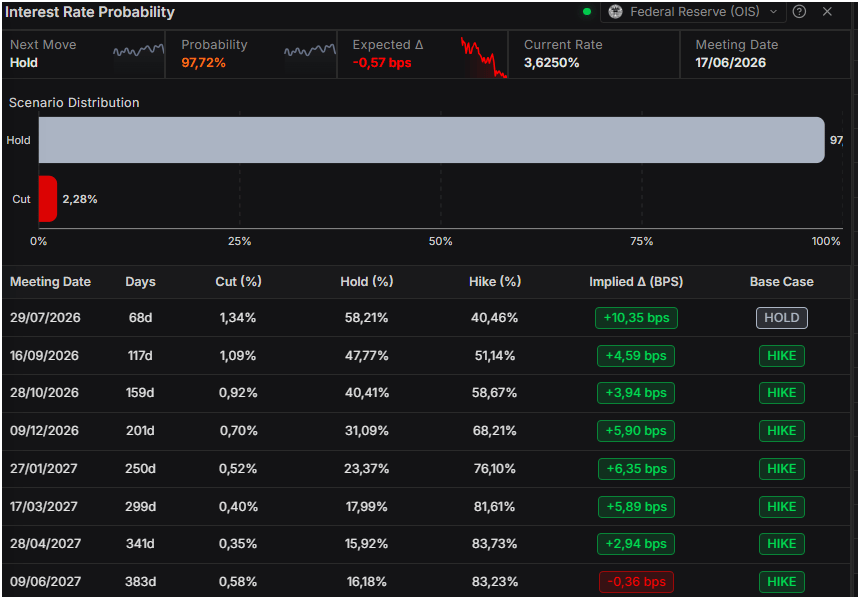
US Consumer Sentiment deteriorated sharply, with the University of Michigan index falling from the preliminary May reading of 48.2 to 44.8 — a record low and below the 48.2 economists had expected. The survey also showed growing concern over the cost of living, with Joanne Hsu, the survey director, saying high prices are straining household finances, up from 50% last month.
Inflation expectations rose from 4.7% to 4.8% over the next twelve months and from 3.5% to 3.9% over the next five years.
Next week, the US economic docket will feature speeches by Fed officials, housing data, first-quarter 2026 Gross Domestic Product (GDP) figures, and the Fed’s preferred inflation gauge, the Core Personal Consumption Expenditures (PCE) Price Index.
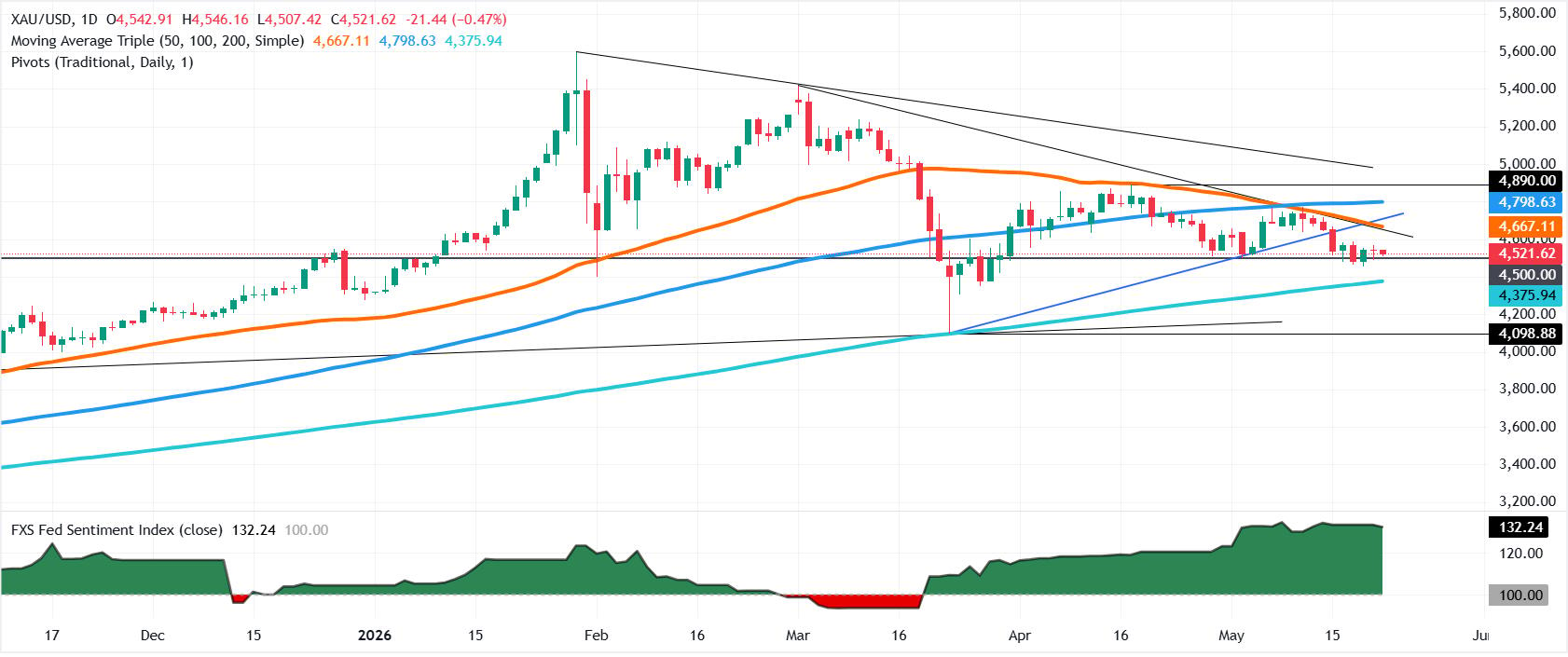
XAU/USD technical outlook: Gold to consolidate further as bulls eye $4,550
Gold price seems to have bottomed at around $4,450 during the week. Since then, the XAU/USD has registered back-to-back trading days printing higher lows, with buyers eyeing a clear breakout of the May 19 daily high of $4,589 to extend the upward move toward the $4,600 milestone.
Momentum remains bearish, as indicated by the Relative Strength Index (RSI), which is aiming lower, deep into oversold territory.
For a bearish continuation, Gold must clear $4,450, which could pave the way for a challenge of $4,400. Below here lies the 200-day Simple Moving Average (SMA) at $4,352, seen by buyers as the last line of defense, before the non-yielding metal turns bearishly biased.
On the upside, if XAU/USD surpasses the $4,550 mark, expect a test of the 20-day SMA at $4,609. Up next, the 50-day SMA at $4,667 is the area of interest.
Gold FAQs
Gold has played a key role in human’s history as it has been widely used as a store of value and medium of exchange. Currently, apart from its shine and usage for jewelry, the precious metal is widely seen as a safe-haven asset, meaning that it is considered a good investment during turbulent times. Gold is also widely seen as a hedge against inflation and against depreciating currencies as it doesn’t rely on any specific issuer or government.
Central banks are the biggest Gold holders. In their aim to support their currencies in turbulent times, central banks tend to diversify their reserves and buy Gold to improve the perceived strength of the economy and the currency. High Gold reserves can be a source of trust for a country’s solvency. Central banks added 1,136 tonnes of Gold worth around $70 billion to their reserves in 2022, according to data from the World Gold Council. This is the highest yearly purchase since records began. Central banks from emerging economies such as China, India and Turkey are quickly increasing their Gold reserves.
Gold has an inverse correlation with the US Dollar and US Treasuries, which are both major reserve and safe-haven assets. When the Dollar depreciates, Gold tends to rise, enabling investors and central banks to diversify their assets in turbulent times. Gold is also inversely correlated with risk assets. A rally in the stock market tends to weaken Gold price, while sell-offs in riskier markets tend to favor the precious metal.
The price can move due to a wide range of factors. Geopolitical instability or fears of a deep recession can quickly make Gold price escalate due to its safe-haven status. As a yield-less asset, Gold tends to rise with lower interest rates, while higher cost of money usually weighs down on the yellow metal. Still, most moves depend on how the US Dollar (USD) behaves as the asset is priced in dollars (XAU/USD). A strong Dollar tends to keep the price of Gold controlled, whereas a weaker Dollar is likely to push Gold prices up.
Author

Christian Borjon Valencia
FXStreet
Markets analyst, news editor, and trading instructor with over 14 years of experience across FX, commodities, US equity indices, and global macro markets.