Gold price seems vulnerable while below $2,700 amid stronger USD, positive risk tone
- Gold price met with a fresh supply and eroded a part of the overnight recovery gains.
- The Trump trade optimism revives the USD demand and weighs on the precious metal.
- Retreating US bond yields and bets for additional Fed rate cuts could help limit losses.

Gold price (XAU/USD) drops to the $2,680 area during the first half of the European session on Friday and is pressured by a combination of factors. Hopes that Trump's policies would spur economic growth and inflation, to a larger extent, overshadow the Federal Reserve's (Fed) dovish outlook, which, in turn, helps revive the US Dollar (USD) demand. Apart from this, a generally positive risk tone undermines the safe-haven precious metal.
Meanwhile, retreating US Treasury bond yields might hold back the US bulls from placing aggressive bets and help limit any further depreciating move for the non-yielding Gold price. Nevertheless, the XAU/USD, for now, seems to have stalled its goodish recovery from the 50-day Simple Moving Average (SMA) support, or over a three-week low touched on Thursday and remains on track to register losses for the second successive week.
Gold price continues to be weighed down by a pickup in the USD demand and risk-on mood
- Traders closed out some profitable Trump trades, which triggered a US Dollar corrective decline from a four-month high and provided a goodish lift to the Gold price on Thursday.
- The USD decline remained uninterrupted after the Federal Reserve decided to lower its benchmark overnight borrowing rate by a 25 basis point, to a target range of 4.50%-4.75%.
- In the accompanying policy statement, Fed officials justified the easing mode as they view supporting employment becoming at least as much of a priority as arresting inflation.
- Furthermore, Fed Chair Jerome Powell, during the post-meeting press conference, failed to offer cues that the central bank may pause rate cuts in the near term amid sticky inflation.
- According to the CME Group's FedWatch Tool, traders are pricing in 75% odds the Fed will cut rates again in December, leading to a further decline in the US Treasury bond yields.
- Donald Trump's presidential election victory fueled speculations about economic policy shifts that could increase deficits and inflation, and restrict the Fed's ability to cut rates.
- Meanwhile, hopes for an announcement of additional stimulus from China after a five-day meeting of the Standing Committee of the NPC remains supportive of the upbeat mood.
Technical Outlook: Gold price could accelerate the slide once $2,660-2,658 support is broken
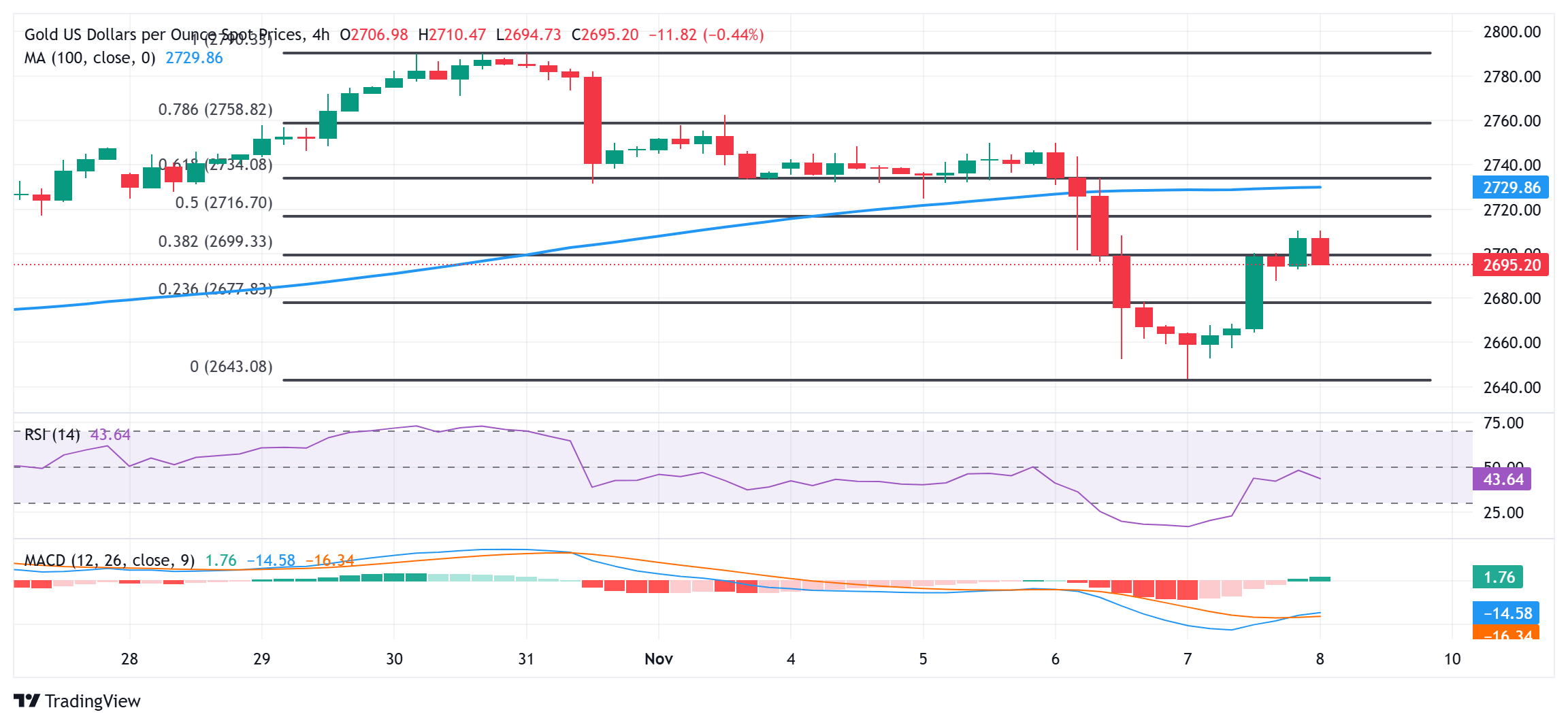
From a technical perspective, the recovery momentum falters ahead of a resistance marked by the 50% Fibonacci retracement level of the recent slide from the all-time peak. The said barrier is pegged near the $2,718 region, above which the Gold price could climb to the $2,734 area (61.8% Fibo. level). Some follow-through buying will suggest that the corrective pullback has run its course and lift the XAU/USD beyond the $2,750 static resistance en route to the $2,758-2,790 zone, or the record high touched on October 31.
On the flip side, the $2,672 region now seems to protect the immediate downside ahead of the $2,660 zone and the overnight swing low, around the $2,643 area, or the 50-day SMA support. A convincing break below the latter will be seen as a fresh trigger for bearish traders. Given that oscillators on the daily chart have been losing positive traction, the Gold price might then accelerate the fall toward the October monthly swing low, around the $2,605-2,602 region.
Interest rates FAQs
Interest rates are charged by financial institutions on loans to borrowers and are paid as interest to savers and depositors. They are influenced by base lending rates, which are set by central banks in response to changes in the economy. Central banks normally have a mandate to ensure price stability, which in most cases means targeting a core inflation rate of around 2%. If inflation falls below target the central bank may cut base lending rates, with a view to stimulating lending and boosting the economy. If inflation rises substantially above 2% it normally results in the central bank raising base lending rates in an attempt to lower inflation.
Higher interest rates generally help strengthen a country’s currency as they make it a more attractive place for global investors to park their money.
Higher interest rates overall weigh on the price of Gold because they increase the opportunity cost of holding Gold instead of investing in an interest-bearing asset or placing cash in the bank. If interest rates are high that usually pushes up the price of the US Dollar (USD), and since Gold is priced in Dollars, this has the effect of lowering the price of Gold.
The Fed funds rate is the overnight rate at which US banks lend to each other. It is the oft-quoted headline rate set by the Federal Reserve at its FOMC meetings. It is set as a range, for example 4.75%-5.00%, though the upper limit (in that case 5.00%) is the quoted figure. Market expectations for future Fed funds rate are tracked by the CME FedWatch tool, which shapes how many financial markets behave in anticipation of future Federal Reserve monetary policy decisions.
Author

Haresh Menghani
FXStreet
Haresh Menghani is a detail-oriented professional with 10+ years of extensive experience in analysing the global financial markets.

















