Gold price slides as AI rout fuels US Dollar flight
- AI valuation fears sour risk mood, boosting US Dollar demand.
- Fed hike bets keep two-year Treasury yields elevated, boosting the USD.
- US Core PCE, GDP and jobless claims drive the next catalyst.

Gold (XAU/USD) price erases Monday’s gains, diving over 1.30% on Tuesday, pressured by broad US Dollar (USD) strength, driven by a hawkish Federal Reserve (Fed), as well as a risk-off mood that is driving flows toward the Greenback's safe-haven appeal. The XAU/USD pair trades at $4,139, after reaching a daily high of $4,198.
XAU/USD falls as Dollar strength and higher yields dominate
Market sentiment remains dismal, driven by losses in technology companies, amid investors' concerns about frothy valuations in AI-related companies. At the same time, the US Dollar Index (DXY), which tracks the Dollar’s performance against a basket of six peers, is up 0.40% at 101.39, a year-to-date (YTD) high.
The hawkish tilt by the Federal Reserve continues to weigh on the non-yielding metal, after nearly half of its members favor a restrictive policy. Money markets now expect at least 34 basis points of tightening toward the end of 2026, a huge reversal after anticipating close to 60 bps of easing in mid-January.
Hence, expectations for a higher-for-longer scenario are underpinning US Treasury yields, with the 2-year T-note, the most sensitive to the path of interest rates, sitting at 4.19%, 71 basis points higher than at the beginning of 2026, when it was 3.475%.
US data was also benign, as the S&P Global Manufacturing PMI in June rose to 55.7, up from 55.1 in May and exceeding estimates of 54.8. The report showed that activity improved due to companies front-loading orders to avoid shortages and rising prices, derived from the US-Iran war energy shock.
In the meantime, talks between the US and Iran show progress, according to Iran’s ambassador to the UN. At the same time, Washington lifted sanctions on Iran for 60 days from Monday, even though hostilities in Lebanon remained.
The re-opening of the Strait of Hormuz is alleviating inflationary pressures, with Oil prices continuing to fall for the second straight week. In the day, WTI is down 1.34% to $73.08 per barrel, losing over 3% so far this week.
Ahead this week, the US economic docket will feature the Fed’s preferred inflation gauge, the Core Personal Consumption Expenditures (PCE) Price Index, Gross Domestic Product (GDP) figures, and jobless claims data on Thursday.
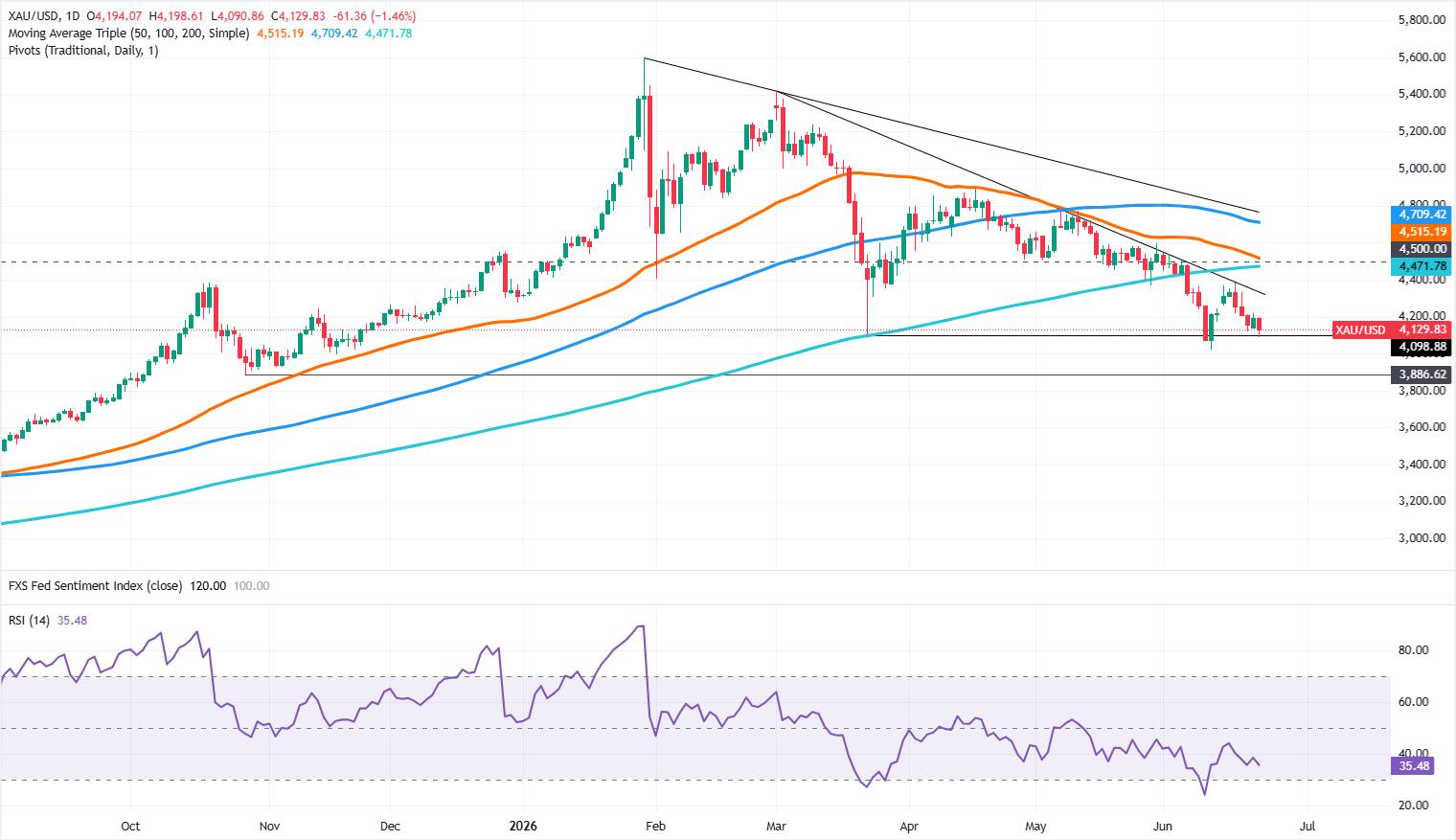
XAU/USD price forecast: Gold bearish bias intact, sellers eye $4,000
Gold’s technical picture shows that sellers remain in charge after the XAU plunged below the 200-day Simple Moving Average (SMA) at $4,446, which is a crucial level for buyers to reclaim if the yellow metal is set to recover.
Worth noting that the downtrend remains in place, as XAU/USD has posted four consecutive trading days of lower highs and lower lows, with bears eyeing a clear break below $4,100, which would open the door to a test of the June 11 daily low at $4,023. Below this level is $4,000.
Gold FAQs
Gold has played a key role in human’s history as it has been widely used as a store of value and medium of exchange. Currently, apart from its shine and usage for jewelry, the precious metal is widely seen as a safe-haven asset, meaning that it is considered a good investment during turbulent times. Gold is also widely seen as a hedge against inflation and against depreciating currencies as it doesn’t rely on any specific issuer or government.
Central banks are the biggest Gold holders. In their aim to support their currencies in turbulent times, central banks tend to diversify their reserves and buy Gold to improve the perceived strength of the economy and the currency. High Gold reserves can be a source of trust for a country’s solvency. Central banks added 1,136 tonnes of Gold worth around $70 billion to their reserves in 2022, according to data from the World Gold Council. This is the highest yearly purchase since records began. Central banks from emerging economies such as China, India and Turkey are quickly increasing their Gold reserves.
Gold has an inverse correlation with the US Dollar and US Treasuries, which are both major reserve and safe-haven assets. When the Dollar depreciates, Gold tends to rise, enabling investors and central banks to diversify their assets in turbulent times. Gold is also inversely correlated with risk assets. A rally in the stock market tends to weaken Gold price, while sell-offs in riskier markets tend to favor the precious metal.
The price can move due to a wide range of factors. Geopolitical instability or fears of a deep recession can quickly make Gold price escalate due to its safe-haven status. As a yield-less asset, Gold tends to rise with lower interest rates, while higher cost of money usually weighs down on the yellow metal. Still, most moves depend on how the US Dollar (USD) behaves as the asset is priced in dollars (XAU/USD). A strong Dollar tends to keep the price of Gold controlled, whereas a weaker Dollar is likely to push Gold prices up.
Author

Christian Borjon Valencia
FXStreet
Markets analyst, news editor, and trading instructor with over 14 years of experience across FX, commodities, US equity indices, and global macro markets.