Gold price sinks as hot CPI, Oil surge crush Fed cut bets
- Hot US CPI pushes investors to price out Fed cuts.
- Oil surge and stronger US Dollar pressure bullion below $4,700.
- Warsh's confirmation adds uncertainty before Powell’s final Fed day.

Gold (XAU/USD) price falls more than 1% on Tuesday as US inflation came in hotter than expected, prompting investors to price out Federal Reserve (Fed) rate cuts in 2026. The XAU/USD pair trades at $4,678 after reaching a daily high of $4,773.
XAU/USD slides as hot CPI lifts Dollar, yields and Fed hike bets
The US and Iran reached an impasse regarding the end of the conflict. Tehran’s response angered US President Donald Trump, who said on Monday that Iran’s response was “totally unacceptable,” while calling for a meeting of his national security council to evaluate his options. Axios reported that US officials said there were different scenarios, including the possibility of resuming military activities.
Oil prices jumped on the headlines, and as of writing, West Texas Intermediate (WTI) is up over 3.20% to $101.50, a headwind for the yellow metal. The Greenback, which is positively correlated with WTI, advances by 0.48% according to the US Dollar Index (DXY).
The DXY, which tracks the US Dollar performance against a basket of six currencies, is trading near five-day highs at around 98.37.
US inflation to prevent Fed rate cuts
The rise in energy prices underpinned April’s US inflation data. The Consumer Price Index (CPI) rose by 3.8% YoY, up from 3.3% previously, exceeding estimates of 3.7%, according to the US Bureau of Labor Statistics (BLS). The Core CPI, which excludes volatile energy and food prices, increased 2.8% YoY, also above the 2.7% estimate.
Consequently, US Treasury yields edged higher, with the US 10-year Treasury yield rising 4.5 basis points to 4.457%. Meanwhile, investors priced in a nearly 30% chance for a rate hike towards the end of 2026, according to Prime Terminal data.
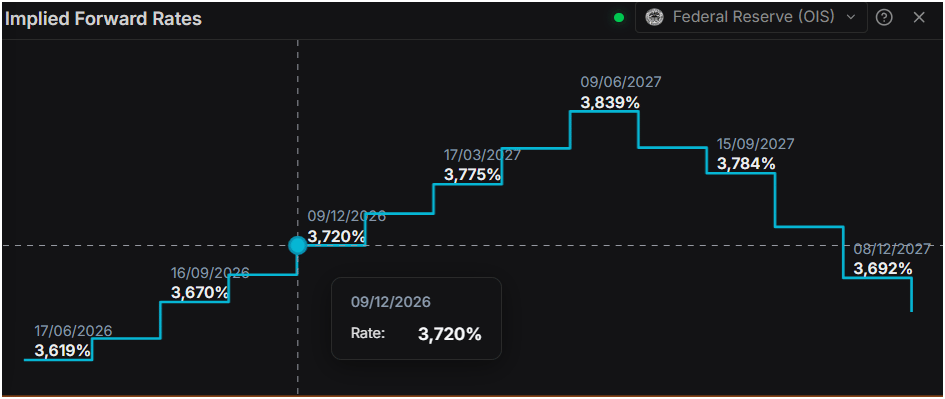
In other news, the US Senate confirmed Trump’s nominee to become the new chief of the Federal Reserve, Kevin Warsh, to the Fed board. The vote for his confirmation as Fed Chair will be onWednesday, two days before Jerome Powell’s last day as Chairman of the Board.
What’s next for Wednesday?
The US economic schedule will feature the Producer Price Index (PPI) for April, and a speech by the Minneapolis Fed President Neel Kashkari.
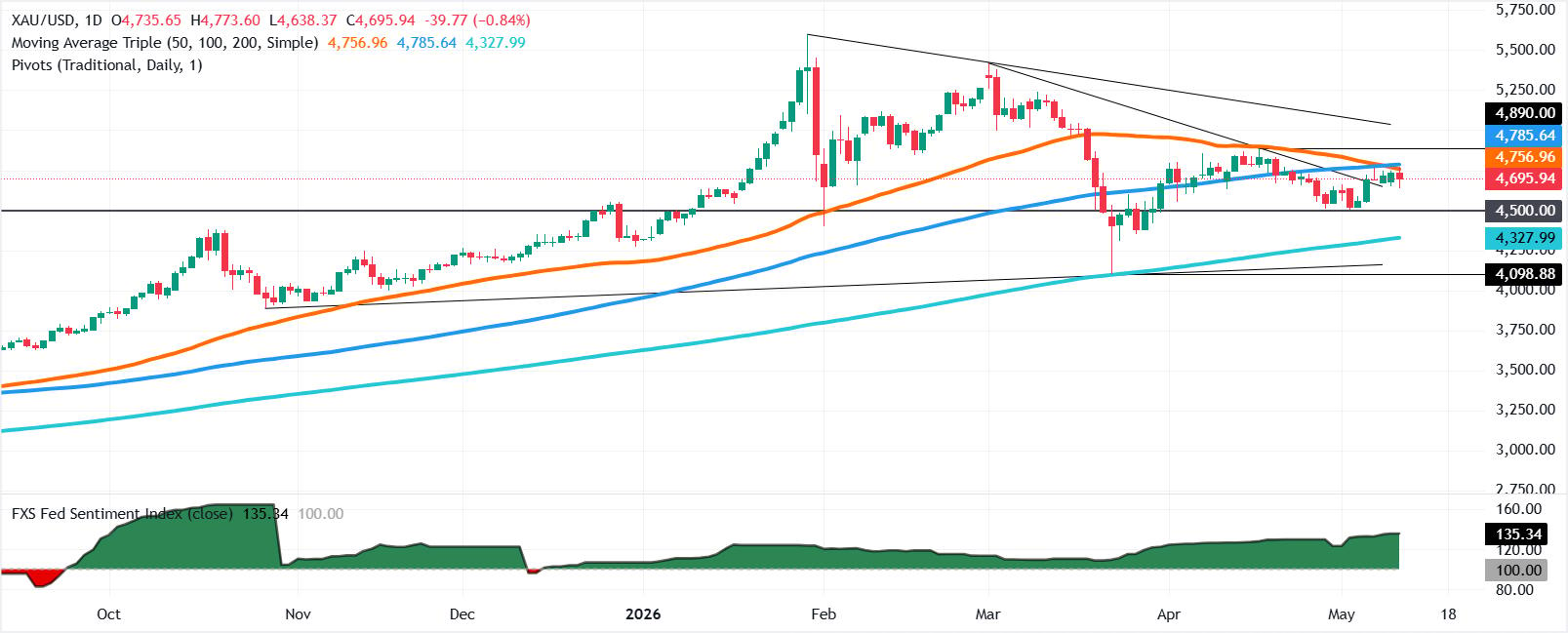
XAU/USD technical outlook: Gold reverses course, tumbles below $4,700
Gold looks set to keep consolidating between major support and resistance, with momentum turning moderately bearish, as shown by the Relative Strength Index (RSI), which recently cleared the 50-neutral level downwards. In addition, XAU/USD has fallen below $4,700, opening the door to a challenge of key support levels.
First, the 20-day Simple Moving Average (SMA) lies at $4,687, ahead of testing the $4,600 mark. From here, the next area of interest is the May 4 swing low around $4,500, which is the next key level.
Above, the first key resistance is the $4,700 milestone. A breach of the latter will expose the 50-day SMA at $4,757. If that level gives way, bulls may target the 100-day SMA near $4,776, followed by the $4,800 round number.
Gold FAQs
Gold has played a key role in human’s history as it has been widely used as a store of value and medium of exchange. Currently, apart from its shine and usage for jewelry, the precious metal is widely seen as a safe-haven asset, meaning that it is considered a good investment during turbulent times. Gold is also widely seen as a hedge against inflation and against depreciating currencies as it doesn’t rely on any specific issuer or government.
Central banks are the biggest Gold holders. In their aim to support their currencies in turbulent times, central banks tend to diversify their reserves and buy Gold to improve the perceived strength of the economy and the currency. High Gold reserves can be a source of trust for a country’s solvency. Central banks added 1,136 tonnes of Gold worth around $70 billion to their reserves in 2022, according to data from the World Gold Council. This is the highest yearly purchase since records began. Central banks from emerging economies such as China, India and Turkey are quickly increasing their Gold reserves.
Gold has an inverse correlation with the US Dollar and US Treasuries, which are both major reserve and safe-haven assets. When the Dollar depreciates, Gold tends to rise, enabling investors and central banks to diversify their assets in turbulent times. Gold is also inversely correlated with risk assets. A rally in the stock market tends to weaken Gold price, while sell-offs in riskier markets tend to favor the precious metal.
The price can move due to a wide range of factors. Geopolitical instability or fears of a deep recession can quickly make Gold price escalate due to its safe-haven status. As a yield-less asset, Gold tends to rise with lower interest rates, while higher cost of money usually weighs down on the yellow metal. Still, most moves depend on how the US Dollar (USD) behaves as the asset is priced in dollars (XAU/USD). A strong Dollar tends to keep the price of Gold controlled, whereas a weaker Dollar is likely to push Gold prices up.
Author

Christian Borjon Valencia
FXStreet
Markets analyst, news editor, and trading instructor with over 14 years of experience across FX, commodities, US equity indices, and global macro markets.