Gold Price Forecast: XAU/USD eases from tops, trades below $1,790 ahead of FOMC minutes
- USD’s pullback, covid concerns keep gold price buoyed ahead of Fed minutes.
- Gold price advances towards $1800 but the rebound in yields poses a risk.
- Gold Price Forecast: $1800 testing bullish commitments, Fed minutes hold the key

Update: Gold held on to its modest intraday gains through the first half of the European session, albeit lacked any follow-through buying and remained confined in the overnight trading range. Currently trading just below the $1,790 level, the prevalent risk-off mood was seen as a key factor that extended some support to the safe-haven XAU/USD. Worries about the potential economic fallout from the fast-spreading Delta variant of the coronavirus, along with political tensions in Afghanistan continued weighing on investors sentiment. Apart from this, a subdued US dollar price action further acted as a tailwind for dollar-denominated commodities, including gold.
The incoming US economic data indicated that the US consumer has grown more cautious in response to the latest surge in COVID-19 cases. This was reaffirmed by Tuesday's weaker US monthly Retail Sales report, which forced investors to reprice the likely timing for the policy tightening by the Fed. This, in turn, failed to assist the USD to capitalize on the previous day's strong positive move. That said, a modest uptick in the US Treasury bond yields helped limit any meaningful USD losses and kept a lid on any runaway rally for the non-yielding gold, at least for now. Investors also seemed reluctant to place any aggressive bets ahead of Wednesday's release of the FOMC minutes.
Market participants will look for clues about the likely timing of when the Fed will begin tapering its asset purchases. This will play a key role in influencing the near-term USD price dynamics and provide a fresh directional impetus to gold.
Previous update: After a temporary breather on Tuesday, bulls are back in the game this Wednesday, driving gold price closer towards the $1800 mark. The US dollar has paused its two-day uptrend, as the risk sentiment is improving, despite the looming fears over the coronavirus spread on the global economic recovery. Traders are repositioning heading towards the July Fed meeting’s minutes due on the cards at 1800 GMT. The Fed minutes is likely to provide fresh insights on the US central bank’s tapering plans. Looking ahead, the rebound in the Treasury yields could limit the upside attempts in gold price.
Read: FOMC Minutes July Preview: More new questions than answers
Gold Price: Key levels to watch
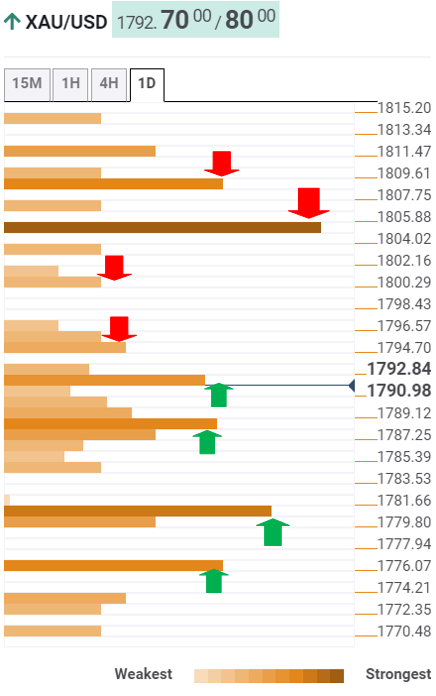
The Technical Confluences Detector shows that gold is fast approaching a dense cluster of healthy resistance levels around $1795, where the previous day’s high converges with the SMA200 four-hour and pivot point one-day R1.
The next resistance awaits at the SMA50 one-day at $1798, above which $1802 (pivot point one-day R2) could challenge the bulls.
Acceptance above the Fibonacci 161.8% one-day at $1805 is needed to unleash additional upside towards the Fibonacci 38.2% one-month at $1808.
Alternatively, the immediate downside target for gold bears is aligned near the $1787 region, which is the confluence zone of the Fibonacci 38.2% one-day, SMA100 four-hour and Fibonacci and the previous low four-hour.
Another strong cap is seen at previous day’s and week’s lows around $1780.
If the bearish interests pick up momentum, then the pivot point one-month S1 at $1776 could come to the rescue of gold bulls.
Here is how it looks on the tool
About Technical Confluences Detector
The TCD (Technical Confluences Detector) is a tool to locate and point out those price levels where there is a congestion of indicators, moving averages, Fibonacci levels, Pivot Points, etc. If you are a short-term trader, you will find entry points for counter-trend strategies and hunt a few points at a time. If you are a medium-to-long-term trader, this tool will allow you to know in advance the price levels where a medium-to-long-term trend may stop and rest, where to unwind positions, or where to increase your position size.
Author

Dhwani Mehta
FXStreet
Residing in Mumbai (India), Dhwani is a Senior Analyst and Manager of the Asian session at FXStreet. She has over 10 years of experience in analyzing and covering the global financial markets, with specialization in Forex and commodities markets.