Gold Price Forecast: XAU/USD approaches key resistance around $3,330
- Gold is trimming losses after a two-day reversal, but the broader trend remains negative.
- Risk aversion after Wall Street's sell-off and lower geopolitical optimism is supporting the precious metal's recovery.
- XAU/USD approaches the top of a descending wedge pattern, at $3,335.

Gold (XAU/USD) is trimming some losses on Wednesday, drawing support from the sour market sentiment. The precious metal has bounced from two-week lows right above $3,300, but remains capped below previous support at the $3,330 area, which leaves the broader bearish trend intact.
Bullion is drawing support from the sourer market sentiment, with equity markets in red after a sell-off in Wall Street on Tuesday, while investors cool their expectations of an immediate peace deal in Ukraine after the Kremlin played down direct talks between Russian President Putin and his Ukrainian counterpart, Volodymyr Zelenskyy.
Technical analysis: Bulls need to break the wedge top at $3,335
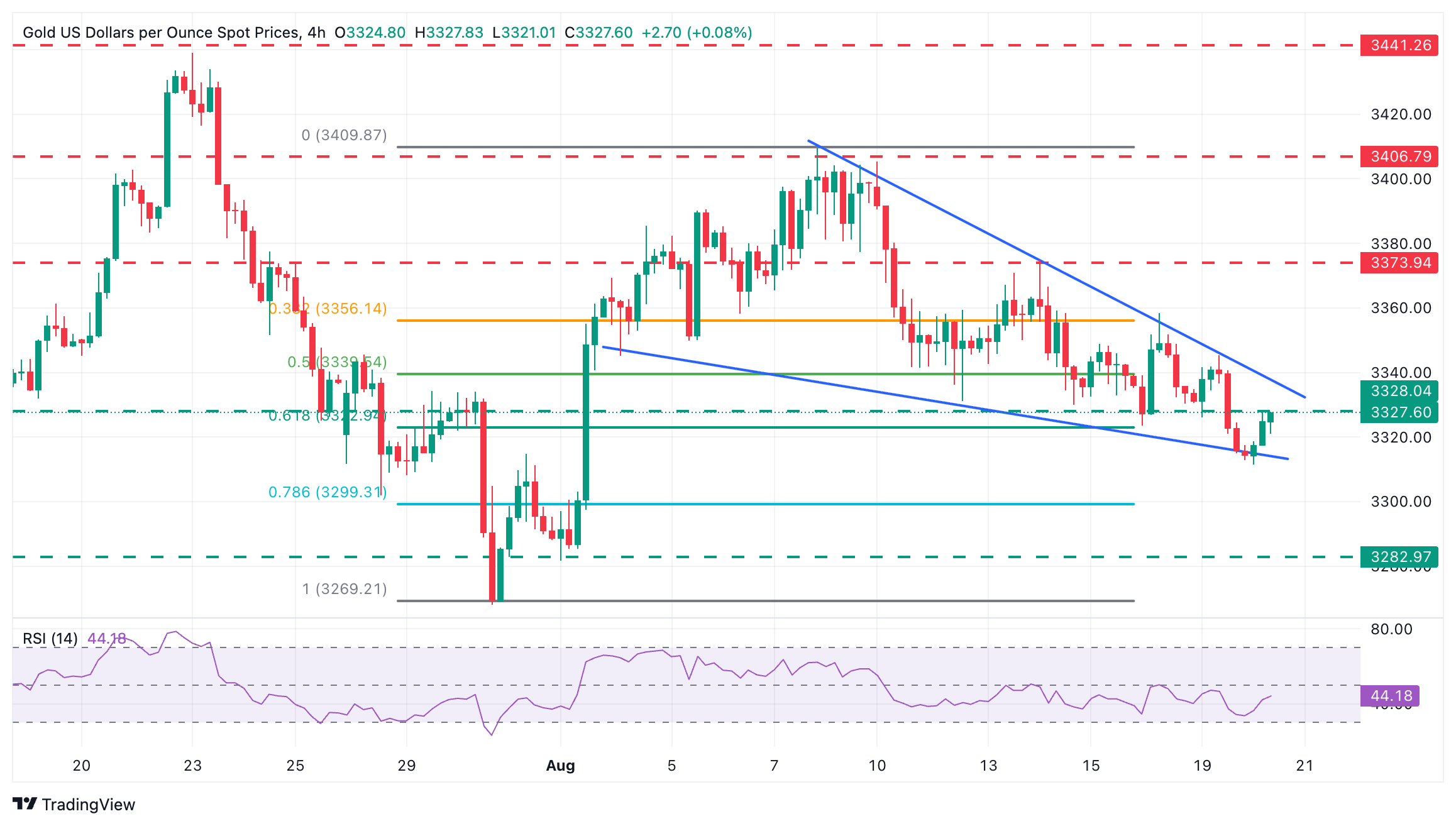
The 4-hour chart shows the XAU/USD pair trading within a descending wedge. This is often a continuation figure, which points to a positive outcome. Bulls, however, are likely to meet significant resistance at the $3,325-$3,335 area where the lows of August 12, 14 and 18 meet the descending trendline from the August 8 peak.
Above that level, the next upside targets would be Tuesday’s high, at $3,345, ahead of the August 18 high of $3,360 and the August 18 high, at $3,375.
To the downside, immediate support is at the $3,305-$3,315 area, Tuesday’s low and August 31 high, where the wedge´s bottom will also meet the price. Further down, the next target would be the August 1 low, near $3,280.
Gold FAQs
Gold has played a key role in human’s history as it has been widely used as a store of value and medium of exchange. Currently, apart from its shine and usage for jewelry, the precious metal is widely seen as a safe-haven asset, meaning that it is considered a good investment during turbulent times. Gold is also widely seen as a hedge against inflation and against depreciating currencies as it doesn’t rely on any specific issuer or government.
Central banks are the biggest Gold holders. In their aim to support their currencies in turbulent times, central banks tend to diversify their reserves and buy Gold to improve the perceived strength of the economy and the currency. High Gold reserves can be a source of trust for a country’s solvency. Central banks added 1,136 tonnes of Gold worth around $70 billion to their reserves in 2022, according to data from the World Gold Council. This is the highest yearly purchase since records began. Central banks from emerging economies such as China, India and Turkey are quickly increasing their Gold reserves.
Gold has an inverse correlation with the US Dollar and US Treasuries, which are both major reserve and safe-haven assets. When the Dollar depreciates, Gold tends to rise, enabling investors and central banks to diversify their assets in turbulent times. Gold is also inversely correlated with risk assets. A rally in the stock market tends to weaken Gold price, while sell-offs in riskier markets tend to favor the precious metal.
The price can move due to a wide range of factors. Geopolitical instability or fears of a deep recession can quickly make Gold price escalate due to its safe-haven status. As a yield-less asset, Gold tends to rise with lower interest rates, while higher cost of money usually weighs down on the yellow metal. Still, most moves depend on how the US Dollar (USD) behaves as the asset is priced in dollars (XAU/USD). A strong Dollar tends to keep the price of Gold controlled, whereas a weaker Dollar is likely to push Gold prices up.
Author

Guillermo Alcala
FXStreet
Graduated in Communication Sciences at the Universidad del Pais Vasco and Universiteit van Amsterdam, Guillermo has been working as financial news editor and copywriter in diverse Forex-related firms, like FXStreet and Kantox.
















