Gold price edges lower, potential downside seems limited amid firmer Fed rate cut bets

Most recent article: Gold extends rally as geopolitical risks boost haven demand
- Gold price edges lower in Monday’s early European session.
- Fed’s rate cut expectation and ongoing geopolitical tensions continue to underpin Gold price.
- The US July Durable Goods Orders are due later on Monday.
The Gold price (XAU/USD) trades with mild losses near the $2,500 psychological support on Monday. However, the downside of the precious metal might be limited amid rising expectations that the US Federal Reserve (Fed) will begin lowering borrowing costs in September. Lower interest rates are generally positive for Gold as it reduces the opportunity cost of holding the non-interest paying asset.
Furthermore, the escalating geopolitical tensions in the Middle East and the economic uncertainty are likely to boost the safe-haven demand, benefiting Gold price. On the other hand, the sluggish demand in the Chinese economy might undermine the yellow metal as China is the largest producer and consumer of gold worldwide. Later on Monday, the US July Durable Goods Orders are due. The highlights for this week will be the preliminary US Gross Domestic Product Annualized (GDP) for the second quarter and the Personal Consumption Expenditures-Price Index (PCE) for July, which will be released on Thursday and Friday, respectively.
Daily Digest Market Movers: Gold price loses ground despite rising Fed rate cut expectations
- Fed Chair Powell said on Friday at the Kansas City Fed's annual economic symposium in Jackson Hole, "The time has come for policy to adjust.”
- The July FOMC Minutes released last week indicated a “vast majority” of Fed officials believe a September cut will be appropriate so long as there are no data surprises.
- Philadelphia Fed President Patrick Harker said that he supports two or three interest rate cuts in 2024, barring any substantial changes to US economic data.
- Chicago Fed President Austan Goolsbee stated that monetary policy is currently at its most restrictive level, and the Fed’s focus is now shifting towards achieving its employment mandate.
- Hezbollah launched hundreds of rockets and drones at Israel early on Sunday, as Israel's military said it carried out a wave of pre-emptive strikes across southern Lebanon to thwart a large-scale rocket and drone attack by Hezbollah, per Reuters.
- Financial markets have fully priced in a 25 basis points (bps) rate cut, while the chance for a deeper cut stand at 36.5%, up from 24% last week, according to the CME FedWatch Tool.
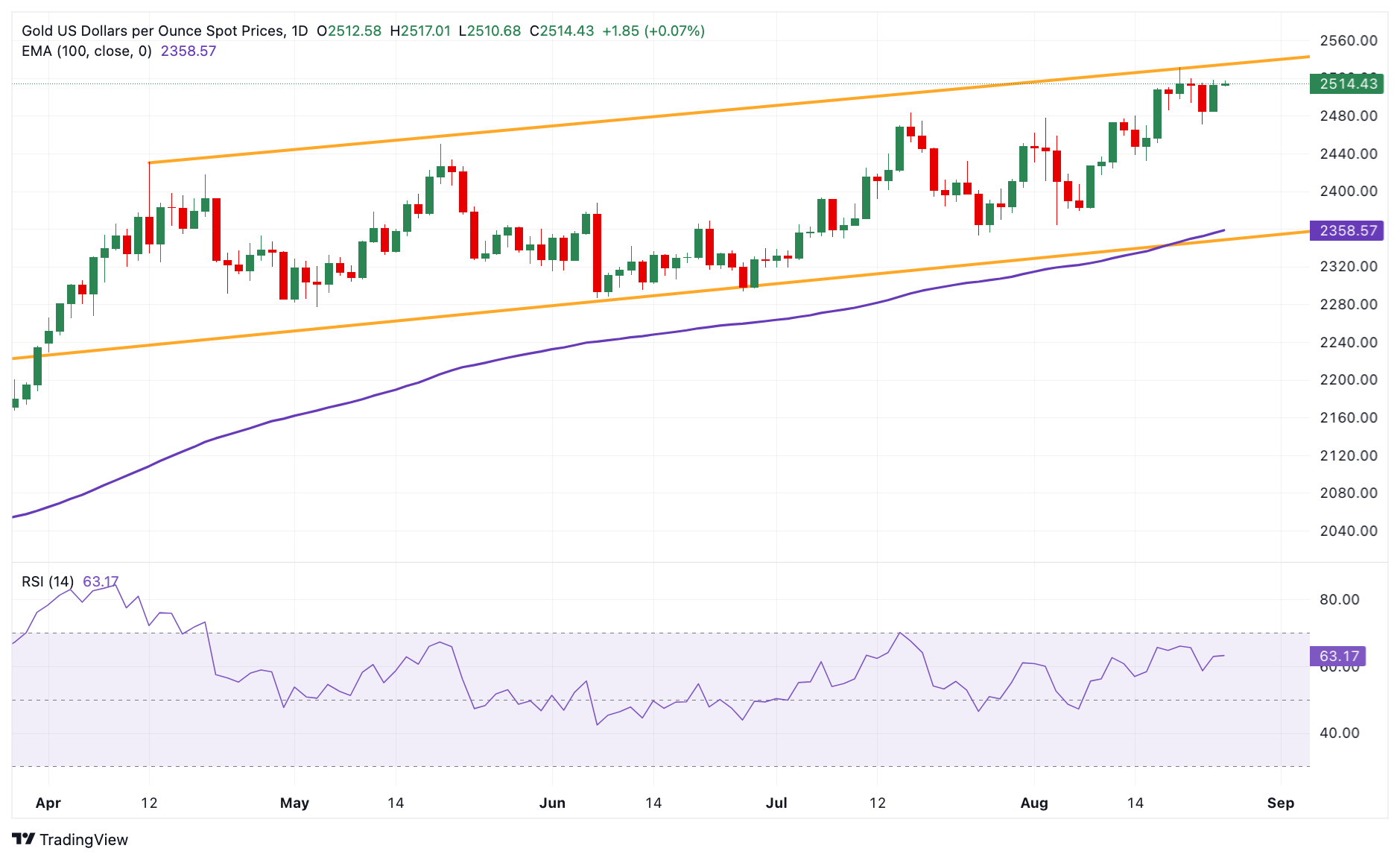
Technical Analysis: Gold price continues its long-term bullish momentum
If Gold prints a couple more bullish candlesticks, we could see a rally to the $2,530-$2535 region, the record high and the upper boundary of the trend channel. A decisive break above this level may draw in more buyers who could sustain an upswing all the way to the $2,600 psychological barrier.
On the flip side, the initial support level emerges at $2,470, the low of August 22. If XAU/USD sees more bearish candlesticks below the mentioned level, then the yellow metal could draw in enough sellers to drag it down to the $2,432, the low of August 15. The crucial contention level is seen in the $2,350-$2,360 zone, the lower limit of the trend channel and the 100-day EMA.
US Dollar price in the last 7 days
The table below shows the percentage change of US Dollar (USD) against listed major currencies in the last 7 days. US Dollar was the weakest against the Japanese Yen.
| USD | EUR | GBP | CAD | AUD | JPY | NZD | CHF | |
| USD | -1.43% | -1.96% | -1.26% | -1.54% | -2.67% | -2.59% | -2.41% | |
| EUR | 1.41% | -0.53% | 0.18% | -0.10% | -1.23% | -1.15% | -0.95% | |
| GBP | 1.93% | 0.52% | 0.70% | 0.42% | -0.70% | -0.62% | -0.42% | |
| CAD | 1.23% | -0.18% | -0.71% | -0.28% | -1.42% | -1.33% | -1.13% | |
| AUD | 1.51% | 0.10% | -0.44% | 0.28% | -1.13% | -1.04% | -0.85% | |
| JPY | 2.63% | 1.21% | 0.72% | 1.42% | 1.13% | 0.12% | -9870.18% | |
| NZD | 2.53% | 1.13% | 0.61% | 1.31% | 1.03% | -0.08% | 0.19% | |
| CHF | 2.34% | 0.94% | 0.42% | 1.12% | 0.84% | -0.27% | -0.19% |
The heat map shows percentage changes of major currencies against each other. The base currency is picked from the left column, while the quote currency is picked from the top row. For example, if you pick the Euro from the left column and move along the horizontal line to the Japanese Yen, the percentage change displayed in the box will represent EUR (base)/JPY (quote).
Gold FAQs
Gold has played a key role in human’s history as it has been widely used as a store of value and medium of exchange. Currently, apart from its shine and usage for jewelry, the precious metal is widely seen as a safe-haven asset, meaning that it is considered a good investment during turbulent times. Gold is also widely seen as a hedge against inflation and against depreciating currencies as it doesn’t rely on any specific issuer or government.
Central banks are the biggest Gold holders. In their aim to support their currencies in turbulent times, central banks tend to diversify their reserves and buy Gold to improve the perceived strength of the economy and the currency. High Gold reserves can be a source of trust for a country’s solvency. Central banks added 1,136 tonnes of Gold worth around $70 billion to their reserves in 2022, according to data from the World Gold Council. This is the highest yearly purchase since records began. Central banks from emerging economies such as China, India and Turkey are quickly increasing their Gold reserves.
Gold has an inverse correlation with the US Dollar and US Treasuries, which are both major reserve and safe-haven assets. When the Dollar depreciates, Gold tends to rise, enabling investors and central banks to diversify their assets in turbulent times. Gold is also inversely correlated with risk assets. A rally in the stock market tends to weaken Gold price, while sell-offs in riskier markets tend to favor the precious metal.
The price can move due to a wide range of factors. Geopolitical instability or fears of a deep recession can quickly make Gold price escalate due to its safe-haven status. As a yield-less asset, Gold tends to rise with lower interest rates, while higher cost of money usually weighs down on the yellow metal. Still, most moves depend on how the US Dollar (USD) behaves as the asset is priced in dollars (XAU/USD). A strong Dollar tends to keep the price of Gold controlled, whereas a weaker Dollar is likely to push Gold prices up.
Author

Lallalit Srijandorn
FXStreet
Lallalit Srijandorn is a Parisian at heart. She has lived in France since 2019 and now becomes a digital entrepreneur based in Paris and Bangkok.