Gold price moves further away from all-time peak amid profit-taking; $3,300 holds the key for bulls
- Gold price attracts some intraday sellers following an uptick to a fresh all-time peak on Thursday.
- A modest USD bounce and a positive risk tone prompt some profit-taking around the commodity.
- US-China trade war concerns, recession fears, and Fed rate cut bets could support the XAU/USD.

Gold price (XAU/USD) remains depressed below a fresh all-time peak touched earlier this Thursday and touches a daily low, around the $3,314 area during the first half of the European session. Hopes of US trade negotiations trigger a modest recovery in the global risk sentiment. This, along with the emergence of some US Dollar (USD) buying, bolstered by the upbeat US Retail Sales and Federal Reserve (Fed) Chair Jerome Powell's hawkish remarks on Wednesday, prompted some profit-taking around the precious metal.
However, the uncertainty around US President Donald Trump's tariff announcements, the rapidly escalating US-China trade war, and global recession fears might continue to act as a tailwind for the safe-haven Gold price. Furthermore, bets that the US central bank will resume its rate-cutting cycle in June and lower borrowing costs by a full percentage point by the end of this year might cap the USD recovery. This should contribute to limiting losses for the non-yielding yellow metal and warrants some caution for bearish traders.
Daily Digest Market Movers: Gold price is weighed down by a combination of factors; downside seems protected
- The US Census Bureau reported on Wednesday that Retail Sales climbed 1.4% in March, the most in over two years. The reading followed a revised 0.2% increase in the previous month and was better than the market expectation for a 1.3% rise.
- Adding to this Federal Reserve Chair Jerome Powell said the US central bank was not inclined to cut interest rates in the near future, citing the potential inflationary pressure stemming from US President Donald Trump's aggressive tariffs policies.
- Meanwhile, the equity market in Asia-Pacific largely advanced on Thursday, which, along with the emergence of some US Dollar (USD) buying, holds back traders from placing fresh bullish bets and caps the upside for the Gold price.
- US President Donald Trump kickstarted a bitter trade war with China earlier this month. In response, China retaliated with 125% duties on US goods and imposed new export licensing restrictions on seven rare earths.
- The US government also imposed new licensing requirements and limited exports of H20 artificial intelligence chips to China. Meanwhile, China’s Foreign Ministry said that Beijing will pay no attention if the US continues to play the tariff game.
- Investors remain worried that tit-for-tat tariffs the world's two countries are imposing on one another will hinder global economic growth. This keeps a lid on any optimism in the market and continues to support the safe-haven commodity.
- Moreover, traders are still pricing in the possibility that the US central bank will resume its rate-cutting cycle in June. This holds back the USD bulls from placing aggressive bets and further acts as a tailwind for the non-yielding yellow metal.
- Traders now look forward to the US economic docket – featuring the release of the usual Weekly Initial Jobless Claims, the Philly Fed Manufacturing Index, and housing market data – and Fed-speak to grab short-term opportunities.
Gold price could accelerate the corrective pullback once the $3,300 pivotal support is broken decisively
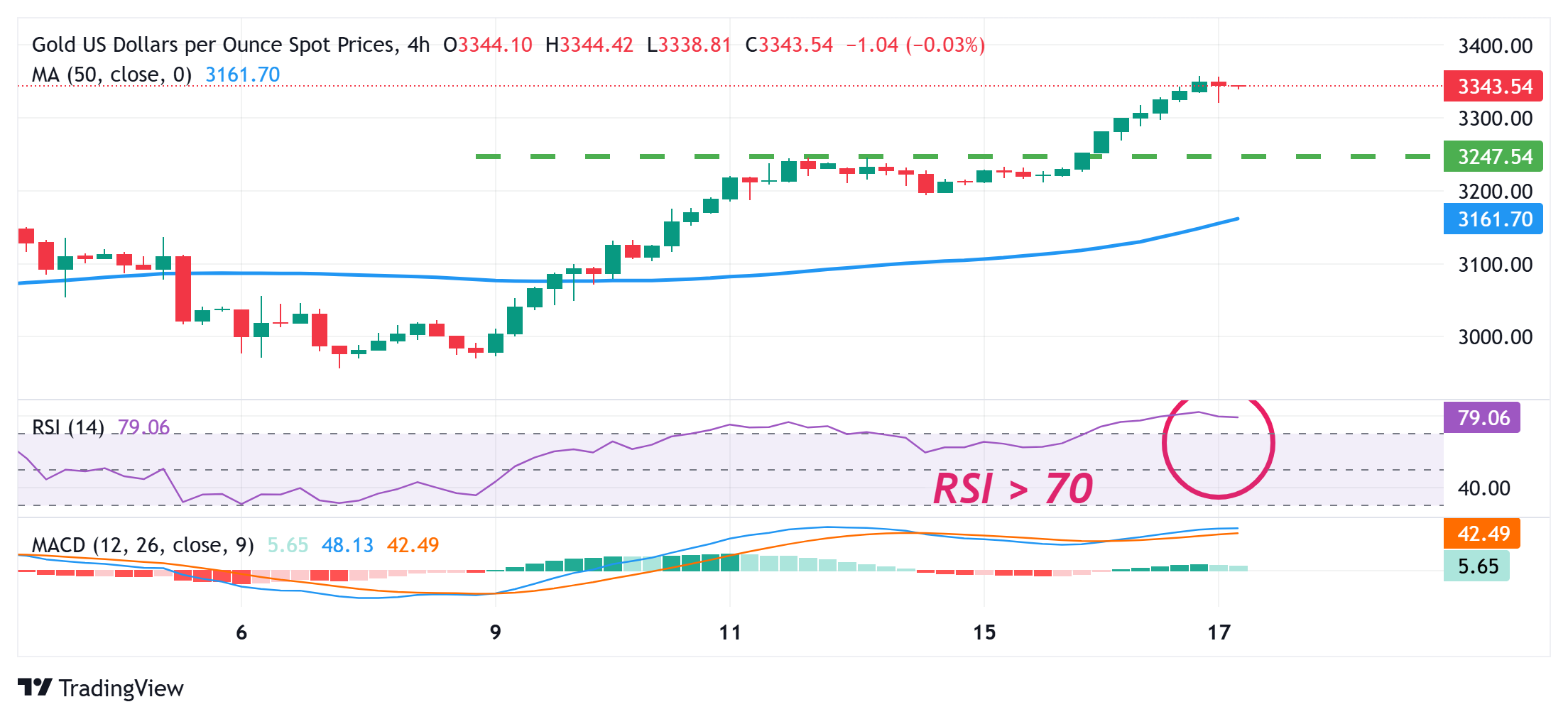
From a technical perspective, the daily Relative Strength Index (RSI) is holding above the 70 mark and flashing overbought conditions. This makes it prudent to wait for some near-term consolidation or a modest pullback before positioning for an extension of a well-established uptrend witnessed over the past four months or so. In the meantime, any corrective pullback could be seen as an opportunity to initial fresh bullish positions and is more likely to remain cushioned near the $3,300 mark. The latter should act as a key pivotal point, which if broken decisively could pave the way for deeper losses.
Fed FAQs
Monetary policy in the US is shaped by the Federal Reserve (Fed). The Fed has two mandates: to achieve price stability and foster full employment. Its primary tool to achieve these goals is by adjusting interest rates. When prices are rising too quickly and inflation is above the Fed’s 2% target, it raises interest rates, increasing borrowing costs throughout the economy. This results in a stronger US Dollar (USD) as it makes the US a more attractive place for international investors to park their money. When inflation falls below 2% or the Unemployment Rate is too high, the Fed may lower interest rates to encourage borrowing, which weighs on the Greenback.
The Federal Reserve (Fed) holds eight policy meetings a year, where the Federal Open Market Committee (FOMC) assesses economic conditions and makes monetary policy decisions. The FOMC is attended by twelve Fed officials – the seven members of the Board of Governors, the president of the Federal Reserve Bank of New York, and four of the remaining eleven regional Reserve Bank presidents, who serve one-year terms on a rotating basis.
In extreme situations, the Federal Reserve may resort to a policy named Quantitative Easing (QE). QE is the process by which the Fed substantially increases the flow of credit in a stuck financial system. It is a non-standard policy measure used during crises or when inflation is extremely low. It was the Fed’s weapon of choice during the Great Financial Crisis in 2008. It involves the Fed printing more Dollars and using them to buy high grade bonds from financial institutions. QE usually weakens the US Dollar.
Quantitative tightening (QT) is the reverse process of QE, whereby the Federal Reserve stops buying bonds from financial institutions and does not reinvest the principal from the bonds it holds maturing, to purchase new bonds. It is usually positive for the value of the US Dollar.
BRANDED CONTENT
Finding the right broker for trading Gold is crucial, as not all brokers offer the same advantages. Explore our list of top-performing brokers to discover the best options for seamless and cost-effective Gold trading.
Author

Haresh Menghani
FXStreet
Haresh Menghani is a detail-oriented professional with 10+ years of extensive experience in analysing the global financial markets.
















