Gold nears $4,800 as softer Dollar and yields lift demand
- Gold gains as softer Treasury yields and a weaker Dollar offer support.
- Israel-Lebanon headlines and Hormuz disruptions keep haven demand elevated.
- Traders now await the US CPI and Michigan inflation expectations data.

Gold price (XAU/USD) resumed its rally on Thursday after Israeli Prime Minister Benjamin Netanyahu said that he is open to negotiations with Lebanon. This, along with broad US Dollar weakness, keeps the yellow metal underpinned, rising to challenge the $4,800 milestone.
Bullion stays bid as truce hopes, weak data weigh on greenback
In a turn of events, Netanyahu said on Thursday that he is seeking direct talks with Beirut, a day after Israel's largest attack killed more than 300 people in Lebanon. Netanyahu said that the negotiation “will focus on disarming Hezbollah and establishing peaceful relations between Israel and Lebanon.”
Recently, AFP reported that Lebanon is seeking a ceasefire before talks with Israel. In the meantime, the Strait of Hormuz remains largely shut despite the first 24 hours of the US-Iran two-week truce, as news revealed that just 5 vessels — one carrying oil — passed through the strait, compared with roughly 140 ships per day before the war.
In the meantime, Pakistan is preparing for the first round of talks between the US and Iran in Islamabad.
This news pushed Oil prices lower, with WTI trading around $95.60, down 0.13% on the day. The Greenback, which had been treading water throughout the day, fell 0.30%, as the US Dollar Index (DXY), which measures its performance against six currencies, fell to 98.63.
Gold rally extends as the drop in US Treasury yields boosts the yellow metal’s appeal as a haven. The US 10-year Treasury yield drops two basis points to 4.279%.
Data that had taken a back seat showed that the US economy grew at a rate below 0.7% YoY in the last quarter of 2025, as analysts estimated. The Gross Domestic Product (GDP) rose by 0.5% YoY, according to the US Bureau of Economic Analysis. At the same time, other data showed that the Fed’s favorite inflation gauge, the Core Personal Consumption Expenditure (PCE) Price Index, decreased in February from 3.1% to 3% YoY as estimated.
US jobs data held up despite a rise in Initial Jobless Claims to 219K last week, above expectations and the prior reading. Still, Continuing Claims fell to 1.794 million, their lowest since May 2024, signaling ongoing labor market resilience.
Traders' expectations for Fed rate cuts remained unchanged, as shown by money markets, which estimated 7.5 basis points of easing towards the end of the year, according to Prime Market Terminal (PMT) data.
Fed interest rate probabilities
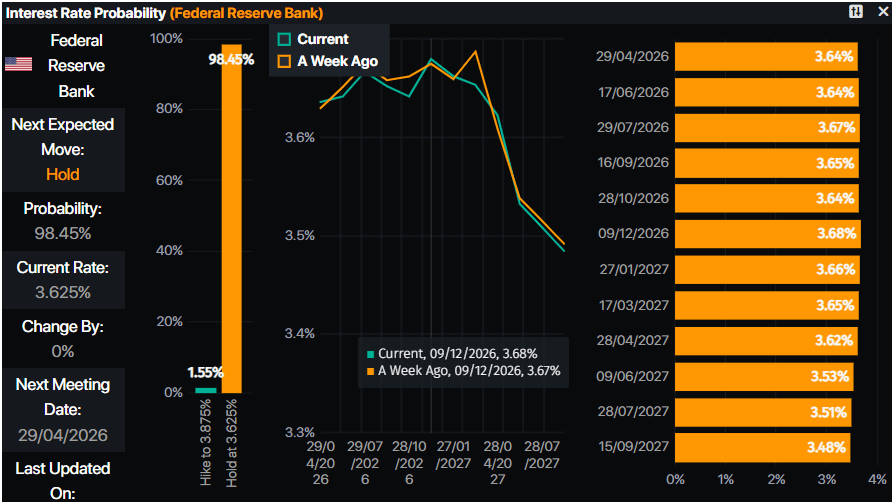
Ahead on Friday, the US economic docket will feature the Consumer Price Index (CPI) report for March, which is projected to show a substantial increase, mostly in the headline print, rising from 2.4% to 3.3%. Core CPI is expected to rise from 2.5% to 2.7%. Besides this, traders' focus will be on the University of Michigan Consumer Sentiment and the release of inflation expectations.
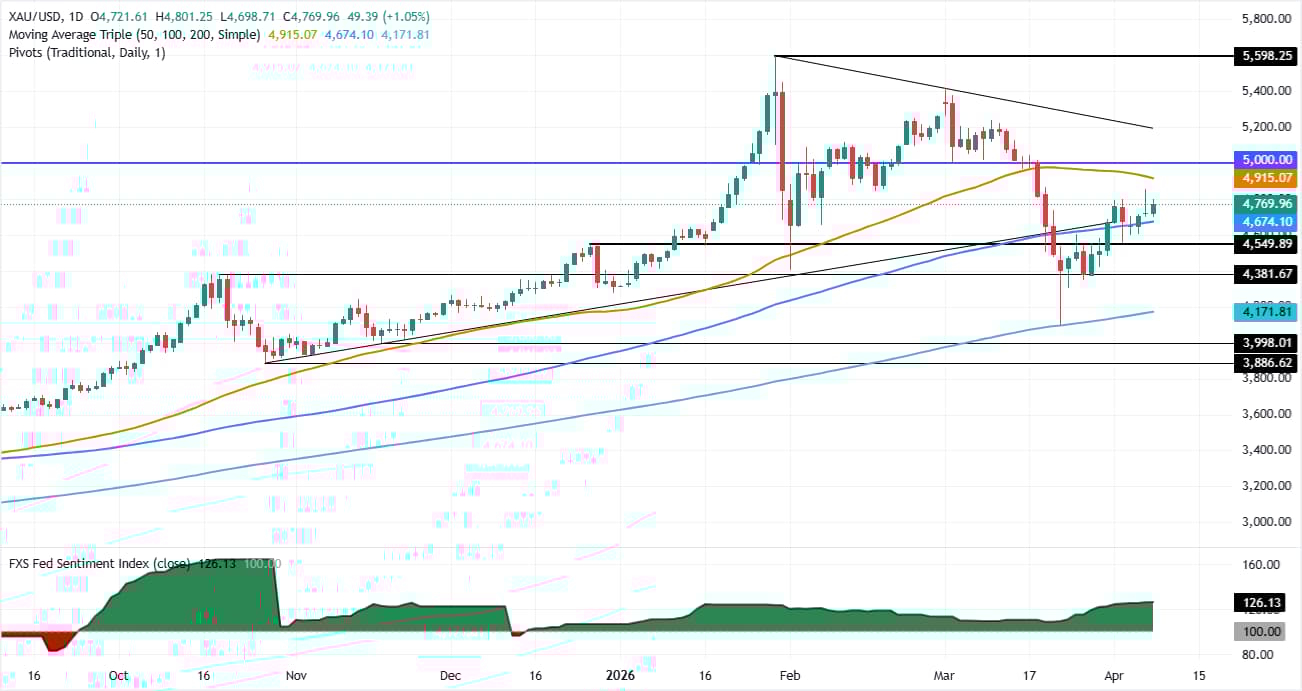
XAU technical analysis: Gold’s recovery stalls at $4,800 as bears eye 20-day SMA
Despite forming a shooting star on Wednesday, Gold is showing signs of recovery, even though buyers remain far from reclaiming the next key resistance seen at $4,857, April’s 8 daily high. The Relative Strength Index (RSI) shows buyers are gathering momentum as the index cleared the 50 neutral level.
With that said, should Gold reclaim $4,800, traders could challenge $4,857 before targeting the psychological $4,900. Further upside lies overhead at $5,000.
On the other hand, if Gold slumps below the 20-day Simple Moving Average at $4,690, it would open the path to challenge the 100-day SMA at $4,656. Below this level sits the April 2 daily low of $4,553.
Gold FAQs
Gold has played a key role in human’s history as it has been widely used as a store of value and medium of exchange. Currently, apart from its shine and usage for jewelry, the precious metal is widely seen as a safe-haven asset, meaning that it is considered a good investment during turbulent times. Gold is also widely seen as a hedge against inflation and against depreciating currencies as it doesn’t rely on any specific issuer or government.
Central banks are the biggest Gold holders. In their aim to support their currencies in turbulent times, central banks tend to diversify their reserves and buy Gold to improve the perceived strength of the economy and the currency. High Gold reserves can be a source of trust for a country’s solvency. Central banks added 1,136 tonnes of Gold worth around $70 billion to their reserves in 2022, according to data from the World Gold Council. This is the highest yearly purchase since records began. Central banks from emerging economies such as China, India and Turkey are quickly increasing their Gold reserves.
Gold has an inverse correlation with the US Dollar and US Treasuries, which are both major reserve and safe-haven assets. When the Dollar depreciates, Gold tends to rise, enabling investors and central banks to diversify their assets in turbulent times. Gold is also inversely correlated with risk assets. A rally in the stock market tends to weaken Gold price, while sell-offs in riskier markets tend to favor the precious metal.
The price can move due to a wide range of factors. Geopolitical instability or fears of a deep recession can quickly make Gold price escalate due to its safe-haven status. As a yield-less asset, Gold tends to rise with lower interest rates, while higher cost of money usually weighs down on the yellow metal. Still, most moves depend on how the US Dollar (USD) behaves as the asset is priced in dollars (XAU/USD). A strong Dollar tends to keep the price of Gold controlled, whereas a weaker Dollar is likely to push Gold prices up.
Author

Christian Borjon Valencia
FXStreet
Markets analyst, news editor, and trading instructor with over 14 years of experience across FX, commodities, US equity indices, and global macro markets.