Gold reclaims $4,500 as softer US Dollar offers support amid Iran tensions
- Gold edges higher as the US Dollar eases, but geopolitical tensions keep markets volatile.
- Oil-driven inflation risks lift interest rate hike expectations across major central banks.
- Technically, XAU/USD stabilizes around recent lows, but the near-term trend remains weak.

Gold (XAU/USD) edges higher on Friday, rebounding after falling nearly 2.75% the previous day, as evolving geopolitical headlines around the US-Israel war with Iran continue to drive volatility across global markets. At the time of writing, XAU/USD is trading around $4,527, up over 3.00% on the day.
Meanwhile, a modest pullback in the Greenback is also offering support, with the US Dollar Index (DXY) easing after briefly climbing above the 100.00 mark earlier in the day.
The University of Michigan’s March data showed a mixed picture. Consumer Sentiment Index came in at 53.3, below expectations of 54 and down from the previous 55.5. The Consumer Expectations Index also declined to 51.7 from 54.1. Meanwhile, 1-year inflation expectations rose to 3.8% from 3.4%, while the 5-year outlook remained steady at 3.2%.
Trump pauses strikes on Iran's energy plants, but uncertainty lingers
US President Donald Trump announced a delay in planned military strikes targeting Iran’s energy infrastructure. The deadline, initially set to expire on Friday, has now been extended by 10 days. In a post on Truth Social, Trump said that “As per Iranian Government request” he would pause the strikes until “April 6, 2026, at 8 P.M., Eastern Time,” adding that “talks are ongoing.”
However, the move did little to calm market nerves. While the delay may reduce some immediate escalation risk, it offers limited clarity on a path toward resolution, particularly as Iran continues to push back against negotiations. Meanwhile, The Wall Street Journal reported on Thursday that the Pentagon is considering sending additional 10,000 ground troops to the Middle East, keeping the risk of further escalation alive if no resolution is reached.
Oil-driven inflation fears reshape interest rate expectations
The Strait of Hormuz remains a key focal point of the ongoing conflict and continues to face significant restrictions, keeping Oil prices elevated. Against this backdrop, Gold is behaving more like an interest rate-sensitive asset rather than a traditional haven, as Oil-driven inflation risks are prompting traders to price in potential rate hikes across major central banks, including the Federal Reserve (Fed), the European Central Bank (ECB), and the Bank of England (BoE).
According to the CME FedWatch Tool, markets are pricing out any rate cut this year and are betting on a 50% chance of higher borrowing costs by the end of 2026, compared with the 2-3 cuts projected before the US-Iran war started.
Firm US Dollar and rising yields weigh on Gold
The hawkish rate repricing of Fed rate cut expectations is pushing US Treasury yields higher across the board, with the 10-year benchmark rising to around 4.45%, its highest level since July 2025. This is weighing on Gold, as rising yields increase the opportunity cost of holding non-yielding assets.
At the same time, the US Dollar (USD) remains broadly firm amid escalating tensions, benefiting from its status as the world’s primary reserve currency, adding further pressure on the bullion. As both Oil and Gold are priced in USD, rising Oil prices tend to support the Greenback, in turn limiting Gold’s upside.
Looking ahead, focus shifts to the Fed speakers, including Richmond Fed President Tom Barkin, Philadelphia Fed President Anna Paulson, and San Francisco Fed President Mary Daly, as markets look for clues on the monetary policy path.
Technical analysis: Sellers remain in control below key resistance levels
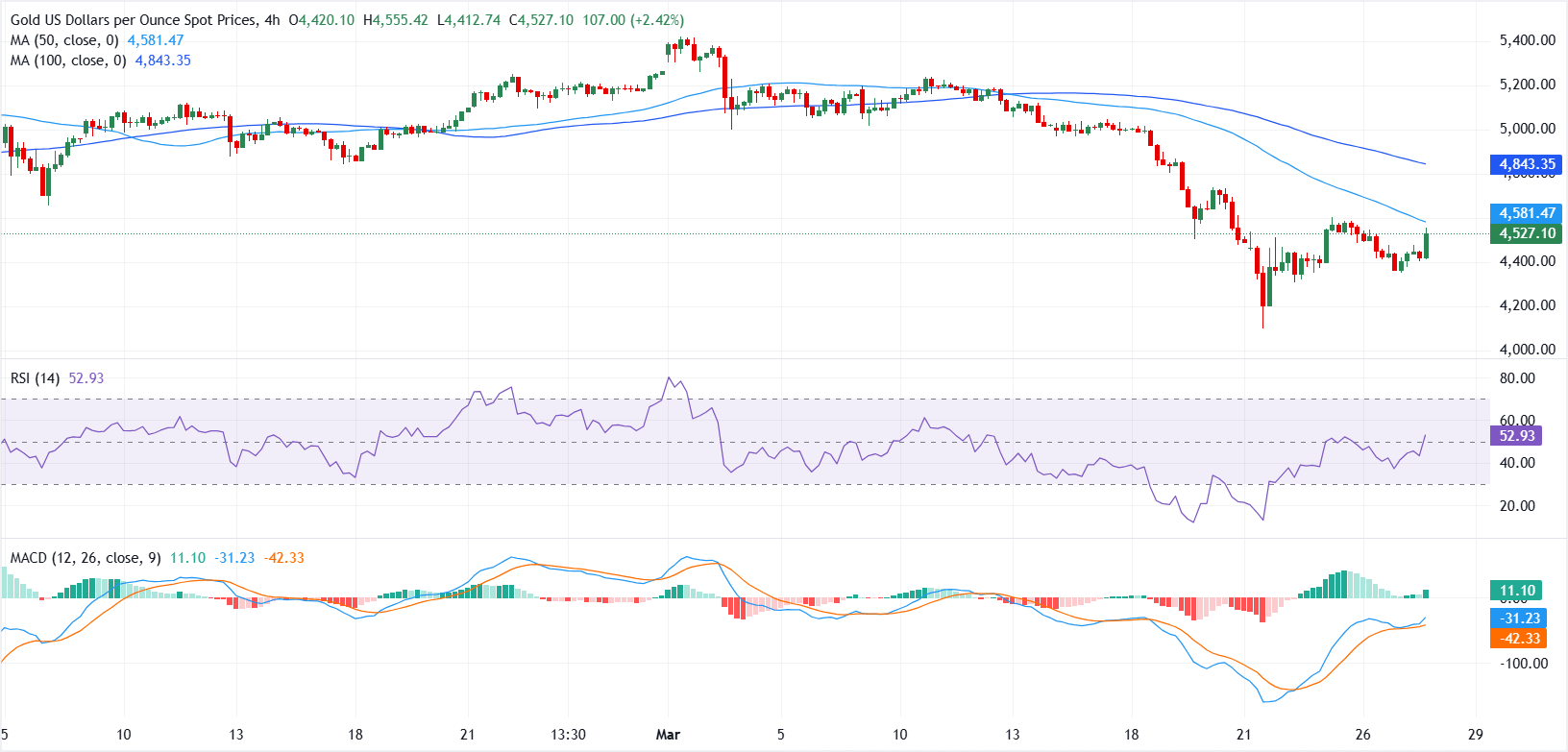
From a technical perspective, XAU/USD is showing early signs of stabilization after briefly slipping to four-month lows near $4,100 earlier this week. However, the near-term outlook remains tilted to the downside, with price trading below key moving averages on both the hourly and daily charts.
On the 4-hour chart, the bearish structure remains intact, with price holding below the 50- and 100-period Simple Moving Averages (SMA), both of which continue to slope lower, indicating persistent downside pressure.
The Relative Strength Index (RSI) has turned higher to 53 from mid-40s, and the Moving Average Convergence Divergence (MACD) line advances above the Signal line in positive territory with an expanding histogram, suggesting recovering upside momentum
On the upside, the 50-period SMA at $4,581 acts as immediate resistance, followed by the 100-period SMA near $4,843. On the downside, $4,300 serves as immediate support, with the weekly swing low around $4,098 as the next key level to watch.
US Dollar Price Today
The table below shows the percentage change of US Dollar (USD) against listed major currencies today. US Dollar was the strongest against the British Pound.
| USD | EUR | GBP | JPY | CAD | AUD | NZD | CHF | |
|---|---|---|---|---|---|---|---|---|
| USD | 0.22% | 0.40% | 0.06% | 0.04% | 0.05% | 0.14% | 0.33% | |
| EUR | -0.22% | 0.18% | -0.17% | -0.19% | -0.18% | -0.08% | 0.11% | |
| GBP | -0.40% | -0.18% | -0.34% | -0.37% | -0.36% | -0.26% | -0.07% | |
| JPY | -0.06% | 0.17% | 0.34% | -0.01% | -0.02% | 0.08% | 0.28% | |
| CAD | -0.04% | 0.19% | 0.37% | 0.00% | -0.01% | 0.11% | 0.29% | |
| AUD | -0.05% | 0.18% | 0.36% | 0.02% | 0.00% | 0.10% | 0.29% | |
| NZD | -0.14% | 0.08% | 0.26% | -0.08% | -0.11% | -0.10% | 0.19% | |
| CHF | -0.33% | -0.11% | 0.07% | -0.28% | -0.29% | -0.29% | -0.19% |
The heat map shows percentage changes of major currencies against each other. The base currency is picked from the left column, while the quote currency is picked from the top row. For example, if you pick the US Dollar from the left column and move along the horizontal line to the Japanese Yen, the percentage change displayed in the box will represent USD (base)/JPY (quote).
Author

Vishal Chaturvedi
FXStreet
I am a macro-focused research analyst with over four years of experience covering forex and commodities market. I enjoy breaking down complex economic trends and turning them into clear, actionable insights that help traders stay ahead of the curve.