Gold struggles for direction below $4,700 amid stronger US Dollar and hawkish Fed outlook
- Gold trades sideways below $4,700 as elevated US Treasury yields and a firmer US Dollar cap upside momentum.
- Sticky US inflation and hawkish Fed commentary reinforce expectations that interest rates could remain elevated for longer.
- Technically, XAU/USD remains trapped between the 21-day and 50-day SMAs as momentum indicators signal neutral, range-bound price action.

Gold (XAU/USD) trades under modest pressure on Thursday as the US Dollar (USD) extends its advance amid uncertainty surrounding US-Iran negotiations and a hawkish Federal Reserve (Fed) outlook.

At the time of writing, XAU/USD is trading around $4,680, remaining trapped within a narrow trading range after rising to a three-week high near $4,773 on Tuesday.
Buyers are showing little conviction to push XAU/USD higher as expectations that the Federal Reserve (Fed) will keep interest rates elevated for longer continue to weigh on sentiment. The view was further reinforced by the latest US inflation data, which showed elevated energy costs linked to the ongoing Middle East war continued to pressure both consumers and producers for a second straight month.
Hotter-than-expected inflation data, combined with a somewhat stable labor market, suggest the Fed can afford to remain patient before adjusting policy settings. However, traders have increased bets that the US central bank could deliver a rate hike by year-end.
The hawkish repricing has pushed US Treasury yields and the US Dollar (USD) higher, keeping upside moves in the non-yielding metal limited. At the same time, lingering uncertainty surrounding the US-Iran negotiations is providing additional support to the Greenback.
The US Dollar Index (DXY), which tracks the Greenback’s value against a basket of six major currencies, is trading around 98.54, hovering near its highest level in more than a week.
Boston Fed President Susan Collins said on Wednesday that “it’s possible” the US central bank may need to raise interest rates to cool inflation pressures and added that she expects the Fed will need to keep policy restrictive “for some time." Collins also noted that job growth over the past year has been running near the breakeven rate, while the unemployment rate remains “relatively low.”
On the geopolitical front, Trump arrived in Beijing for the two-day summit, where discussions focused on key issues including trade, US relations with Taiwan and the ongoing war in Iran. According to a White House readout cited by Reuters, both sides discussed expanding market access for American businesses in China and increasing Chinese investment in the United States. The readout also said both leaders agreed that the Strait of Hormuz must remain open and that Iran can never be allowed to obtain a nuclear weapon.
Technical Analysis: XAU/USD struggles for direction between 21-day and 50-day SMAs
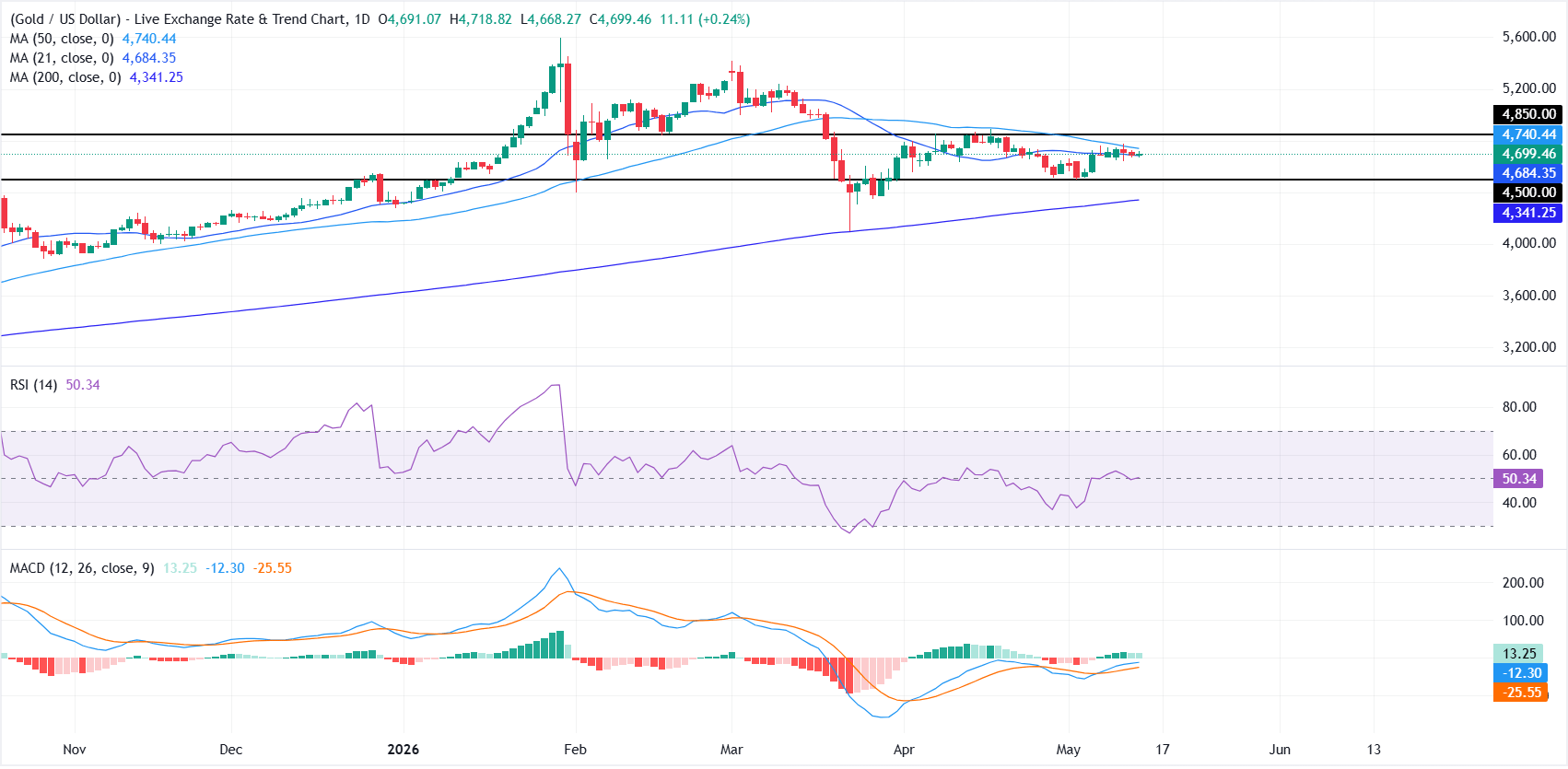
On the daily chart, XAU/USD holds just above the 21-day Simple Moving Average (SMA) at around $4,684, but remains capped by the 50-day SMA near $4,740, leaving the near-term tone sideways to mildly corrective after its recent advance.
The 200-day SMA down at roughly $4,341 continues to underpin the broader uptrend, while a neutral Relative Strength Index (RSI) around 50 and a positive, stabilizing Moving Average Convergence Divergence (MACD) histogram suggest consolidative price action rather than a clear directional push.
On the topside, initial resistance is seen at the 50-day SMA around $4,740, with a subsequent barrier at the horizontal level near $4,850, where sellers could re-emerge.
On the downside, immediate support is provided by the 21-day SMA at about $4,684. A break below this area would expose the next notable floor around $4,500, ahead of the more strategic 200-day SMA near $4,341.
(The technical analysis of this story was written with the help of an AI tool.)
Author

Vishal Chaturvedi
FXStreet
I am a macro-focused research analyst with over four years of experience covering forex and commodities market. I enjoy breaking down complex economic trends and turning them into clear, actionable insights that help traders stay ahead of the curve.















