Gold steadies as risk-off mood lifts safe-haven demand
- Gold steadies as risk-off sentiment sparks mild safe-haven flows.
- Global equities slide, with tech-led losses driving caution ahead of Nvidia’s earnings.
- Traders await delayed US data releases, including September NFP on Thursday.

Gold (XAU/USD) steadies on Tuesday as risk-off sentiment across global markets prompts a mild pickup in safe-haven demand. At the time of writing, XAU/USD is trading around $4,060, bouncing back after slipping to $3,998 earlier in the Asian session.
The risk-off tone is being driven by broad equity weakness, with global stocks sliding after a sharp tech-led selloff spilled over from Wall Street into Asia and Europe. Investors are pulling back as worries build around stretched AI valuations ahead of Nvidia’s earnings on Wednesday.
However, the upside in Gold remains constrained amid diverging views among Federal Reserve (Fed) officials regarding a December rate cut. Traders are also refraining from taking large directional positions ahead of the delayed US economic data, keeping momentum subdued.
Market movers: Fed divergence sharpens as labor trend weakens
- ADP data showed US private payrolls fell by an average of 2,500 per week in the four weeks to November 1, after an 11.25K decline in the prior period. Meanwhile, August Factory Orders rose 1.4% MoM, meeting estimates and reversing the 1.3% drop seen in July.
- Fed Governor Christopher Waller struck a notably dovish tone on Tuesday, saying the US labor market is “weak” and “near stall-speed.” He noted that restrictive policy appears to be weighing on the economy and reiterated that a 25 bps rate cut at the December 9-10 meeting would provide “additional insurance” for the labor market. Waller added that inflation expectations remain well-anchored and that underlying inflation is now close to the Fed’s 2% target, reinforcing his case for earlier easing. His stance contrasts with several Fed officials last week, who signaled caution on cutting rates while inflation remains elevated.
- According to the CME FedWatch Tool, markets now assign a 46.6% probability of a December rate cut, down from 66.9% a week ago. Traders are awaiting the upcoming backlog of US data, especially the September Nonfarm Payroll (NFP) report due on Thursday, to reassess the monetary policy outlook.
- The US Department of Labor has started releasing the backlog of missed weekly Jobless Claims data. Initial claims came in at 232K, while continuing claims rose to 1.957 million for the week ending October 18, with the latest figures due on Thursday.
Technical analysis: XAU/USD holds above $4,000 but lacks momentum
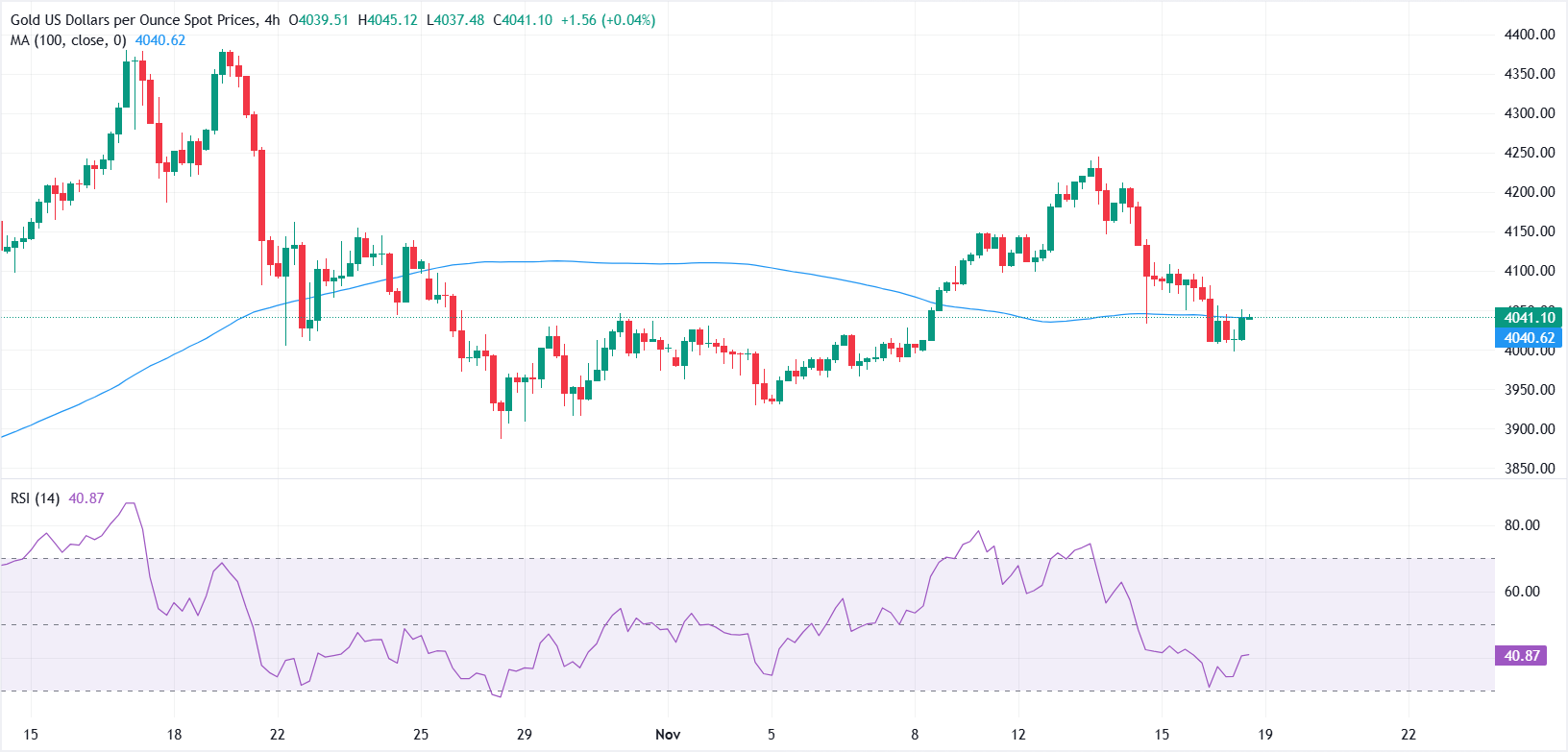
Gold’s momentum remains subdued, though dip-buying continues to emerge after bulls successfully defended the $4,000 psychological support. On the upside, XAU/USD faces a confluence resistance zone near $4,050, reinforced by the 100-period Simple Moving Average (SMA) on the 4-hour chart.
A decisive break above $4,100 would be the first signal of renewed upside traction, with the $4,150 region likely to attract fresh selling pressure given the near-term bearish tone.
On the downside, the $4,000 level remains the key support to watch. A sustained move below this barrier would open the door for a deeper pullback toward $3,900, where buyers may attempt to re-enter.
Momentum indicators align with the soft tone, with the RSI holding below the 50 threshold and hovering near 40, signalling weak buying strength and risk of further consolidation.
Gold FAQs
Gold has played a key role in human’s history as it has been widely used as a store of value and medium of exchange. Currently, apart from its shine and usage for jewelry, the precious metal is widely seen as a safe-haven asset, meaning that it is considered a good investment during turbulent times. Gold is also widely seen as a hedge against inflation and against depreciating currencies as it doesn’t rely on any specific issuer or government.
Central banks are the biggest Gold holders. In their aim to support their currencies in turbulent times, central banks tend to diversify their reserves and buy Gold to improve the perceived strength of the economy and the currency. High Gold reserves can be a source of trust for a country’s solvency. Central banks added 1,136 tonnes of Gold worth around $70 billion to their reserves in 2022, according to data from the World Gold Council. This is the highest yearly purchase since records began. Central banks from emerging economies such as China, India and Turkey are quickly increasing their Gold reserves.
Gold has an inverse correlation with the US Dollar and US Treasuries, which are both major reserve and safe-haven assets. When the Dollar depreciates, Gold tends to rise, enabling investors and central banks to diversify their assets in turbulent times. Gold is also inversely correlated with risk assets. A rally in the stock market tends to weaken Gold price, while sell-offs in riskier markets tend to favor the precious metal.
The price can move due to a wide range of factors. Geopolitical instability or fears of a deep recession can quickly make Gold price escalate due to its safe-haven status. As a yield-less asset, Gold tends to rise with lower interest rates, while higher cost of money usually weighs down on the yellow metal. Still, most moves depend on how the US Dollar (USD) behaves as the asset is priced in dollars (XAU/USD). A strong Dollar tends to keep the price of Gold controlled, whereas a weaker Dollar is likely to push Gold prices up.
Author

Vishal Chaturvedi
FXStreet
I am a macro-focused research analyst with over four years of experience covering forex and commodities market. I enjoy breaking down complex economic trends and turning them into clear, actionable insights that help traders stay ahead of the curve.

















