Gold heads for third weekly loss as hawkish Fed rate bets reinforce bearish trend
- Gold heads for a third straight weekly loss as higher-for-longer Fed expectations weigh on sentiment.
- Traders price in a 70% chance of a September Fed rate hike following this week's hawkish FOMC meeting.
- Technically, XAU/USD remains below the Bollinger SMA middle band, while the RSI points to sustained bearish momentum.

Gold (XAU/USD) remains under pressure on Friday as traders assess the latest news about the US-Iran peace deal and the Federal Reserve's (Fed) hawkish monetary policy announcement. At the time of writing, XAU/USD trades around $4,150 after hitting a one-week low of $4,121 earlier in the day.
A modest pullback in the US Dollar (USD) is keeping downside contained, but the metal remains on track for its third straight weekly loss. Gold is down nearly 25% from its all-time high after the US-Iran war led traders to price out Fed rate-cut bets for this year, while the Fed's hawkish tilt further reinforced expectations that interest rates would remain higher for longer.
Traders now see a 70% chance that the US central bank could raise rates as soon as September, according to the CME FedWatch Tool. The shift toward tighter monetary policy comes after nearly half of FOMC members signaled at least one rate increase by year-end at the June meeting this week.
As a non-yielding asset, Gold tends to struggle in a high-interest-rate environment, as investors favor yield-bearing assets such as bonds.
The increasingly hawkish stance reflects a deteriorating inflation outlook, driven in part by the recent surge in Oil prices, which pushed annual inflation to 4.2% in May, well above the Fed's 2% target. Newly appointed Fed Chair Kevin Warsh reiterated that the central bank remains committed to bringing inflation back down to 2%.
Weak physical demand is adding to Gold's woes. According to sources cited by Indian media outlets, Gold imports into India, one of the world's largest bullion consumers, have fallen nearly 70% since the government raised import duties to 15% from 6% last month. However, Gold's longer-term outlook remains underpinned by steady central bank buying.
On the geopolitical front, the 60-day Memorandum of Understanding (MoU) between the United States and Iran has improved market sentiment.
The White House said US Vice President JD Vance had delayed a planned trip to Switzerland, where he was expected to lead a new round of talks with Iran. Iran's Foreign Ministry later said the MoU had already been signed digitally, making Friday's meeting in Switzerland no longer urgent. Meanwhile, Reuters reported Israel and Hezbollah agreed to a ceasefire, according to a senior US official.
Technical analysis: XAU/USD remains under pressure below the Bollinger mid-band
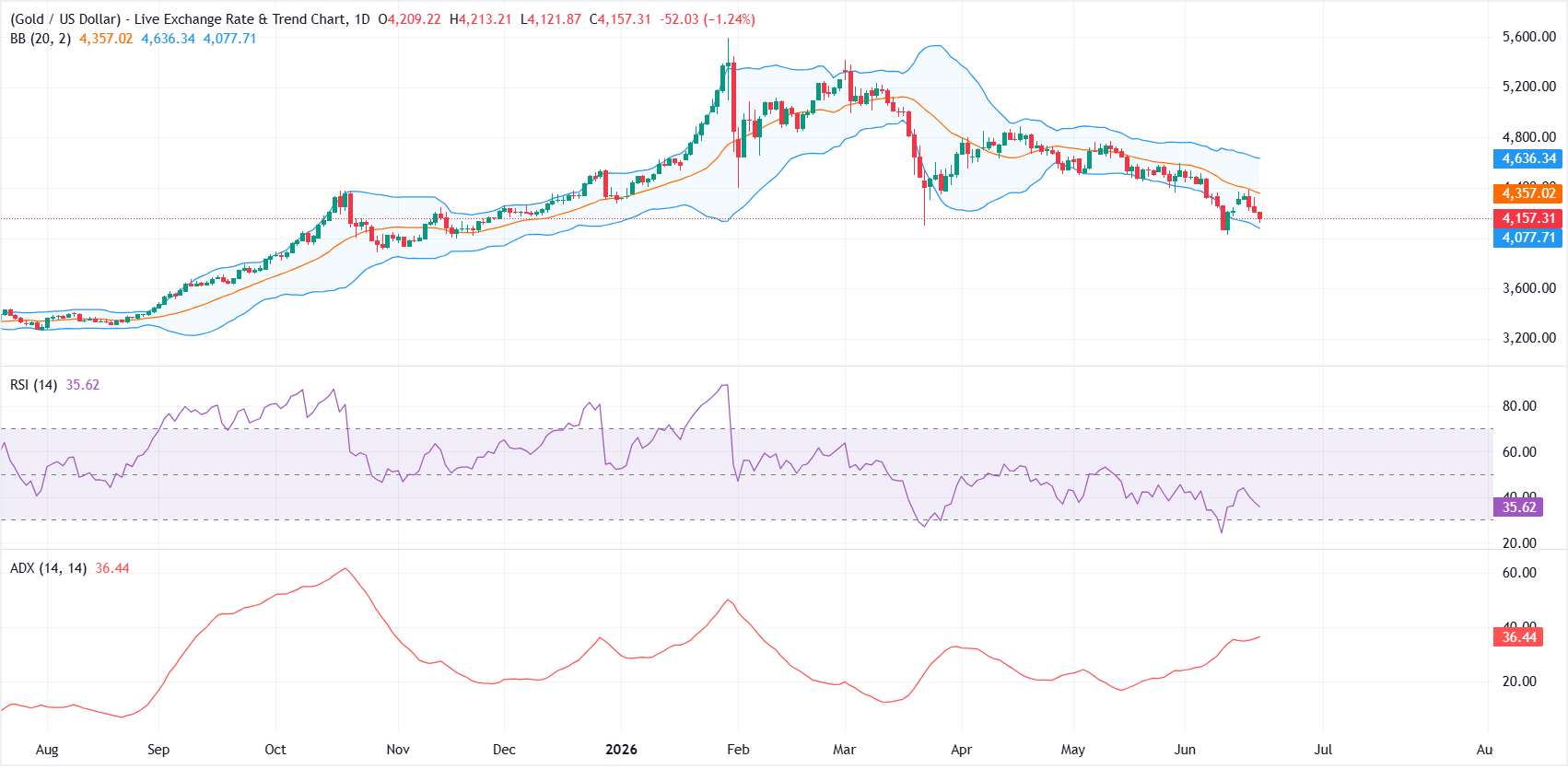
On the daily chart, XAU/USD extends its corrective slide below the Bollinger Simple Moving Average (SMA) middle band at $4,357. The metal holds closer to the lower half of the Bollinger envelope, while the Relative Strength Index (RSI) around 35 leans toward bearish momentum, and the Average Directional Index (ADX) in the mid‑30s suggests a strengthening downtrend bias.
On the topside, initial resistance emerges at the Bollinger SMA middle band near $4,356, with the upper Bollinger band coming in higher around $4,636 as a more distant cap if a rebound accelerates. On the downside, immediate support is seen near the recent base around $4,150, followed by the lower Bollinger band near $4,077, where sellers could hesitate before considering a deeper extension of the current pullback.
(The technical analysis of this story was written with the help of an AI tool.)
Gold FAQs
Gold has played a key role in human’s history as it has been widely used as a store of value and medium of exchange. Currently, apart from its shine and usage for jewelry, the precious metal is widely seen as a safe-haven asset, meaning that it is considered a good investment during turbulent times. Gold is also widely seen as a hedge against inflation and against depreciating currencies as it doesn’t rely on any specific issuer or government.
Central banks are the biggest Gold holders. In their aim to support their currencies in turbulent times, central banks tend to diversify their reserves and buy Gold to improve the perceived strength of the economy and the currency. High Gold reserves can be a source of trust for a country’s solvency. Central banks added 1,136 tonnes of Gold worth around $70 billion to their reserves in 2022, according to data from the World Gold Council. This is the highest yearly purchase since records began. Central banks from emerging economies such as China, India and Turkey are quickly increasing their Gold reserves.
Gold has an inverse correlation with the US Dollar and US Treasuries, which are both major reserve and safe-haven assets. When the Dollar depreciates, Gold tends to rise, enabling investors and central banks to diversify their assets in turbulent times. Gold is also inversely correlated with risk assets. A rally in the stock market tends to weaken Gold price, while sell-offs in riskier markets tend to favor the precious metal.
The price can move due to a wide range of factors. Geopolitical instability or fears of a deep recession can quickly make Gold price escalate due to its safe-haven status. As a yield-less asset, Gold tends to rise with lower interest rates, while higher cost of money usually weighs down on the yellow metal. Still, most moves depend on how the US Dollar (USD) behaves as the asset is priced in dollars (XAU/USD). A strong Dollar tends to keep the price of Gold controlled, whereas a weaker Dollar is likely to push Gold prices up.
Author

Vishal Chaturvedi
FXStreet
I am a macro-focused research analyst with over four years of experience covering forex and commodities market. I enjoy breaking down complex economic trends and turning them into clear, actionable insights that help traders stay ahead of the curve.