Gold surges to new all-time high supported by Fed easing expectations, safe-haven demand
- Gold hits a fresh all-time high above $3,730 on Monday, extending gains for a sixth straight week.
- US Dollar and Treasury yields ease at the start of the week, adding fresh support to bullion.
- Fed Chair Jerome Powell speaks on Tuesday, alongside several other Fed officials throughout the week.

Gold (XAU/USD) continues its record-breaking rally on Monday, extending gains for the sixth straight week as dovish Federal Reserve (Fed) expectations and robust safe-haven flows keep demand elevated. At the time of writing, XAU/USD is trading at a fresh all-time high of $3,731, pushing deeper into uncharted territory.
The latest leg higher is underpinned by growing market conviction that the Fed could deliver additional easing before year-end. While last week’s 25 basis points (bps) interest rate cut by the central bank was widely anticipated, investors are increasingly pricing in the possibility of two more reductions in October and December, even as Fed Chair Jerome Powell has stressed that future policy moves remain data-dependent.
Gold’s rally shows no signs of slowing, with the metal up more than 40% year-to-date as a combination of global risks drives demand. Beyond the expectations of further Fed easing, persistent geopolitical tensions, ongoing central bank accumulation, robust inflows into Gold-backed Exchange Traded Funds (ETFs), and uncertainty surrounding US tariff policy have all added momentum to bullion’s record-breaking run.
Looking ahead, no major US economic data is scheduled for release on Monday, but all eyes will be on a wave of Fed speeches due later in the day. Market participants will parse remarks from New York Fed President John Williams, along with speeches from St. Louis Fed President Alberto Musalem, Richmond Fed President Thomas Barkin, Cleveland Fed President Beth Hammack, and Fed Governor Stephen Miran for signals on how policymakers are assessing the evolving economic outlook after last week’s cautious rate cut.
Market movers: Busy US calendar ahead with Powell, GDP, and PCE in focus
- Atlanta Fed President Raphael Bostic told the Wall Street Journal on Monday that he sees little reason to cut rates further for now, noting he penciled in only one reduction for all of 2025. He described the current environment as one of the most difficult periods for policymakers, with risks rising on both sides of the mandate. On the one hand, lingering inflation pressures could flare up again if policy eases too quickly, while on the other, a cooling labor market poses downside risks to growth. Bostic also stressed that he does not view the labor market as being in crisis at this stage.
- Alberto Musalem said he supported the recent 25 basis point rate cut as a “precautionary move” to support the labor market, but emphasized that further easing should be approached with caution. Musalem noted the US economy is operating near full employment and argued that the recent rate cut should be sufficient to help sustain that strength. However, he warned that placing too much emphasis on labor market conditions could lead to an overly loose policy stance, potentially doing more harm than good.
- On Wednesday, the Federal Open Market Committee (FOMC) lowered the federal funds rate by 25 basis points to a target range of 4.00%-4.25%. In its statement, the Fed said that economic activity has moderated in recent months and that job growth is slowing as labor market conditions soften. Policymakers highlighted that inflation has come down from its highs but is still above the 2% goal, while also warning that risks to employment are becoming more pronounced.
- The latest CFTC Commitments of Traders (COT) report, published on Friday for the week ending September 16, showed speculators holding a net long position of 266,410 contracts in Gold (COMEX futures). Long positions increased by 1,903 contracts, while shorts declined by 2,767 contracts.
- Commercial hedgers added 33,013 new short positions, and total open interest rose by 6,596 contracts to 516,221. The data points to fresh inflows into the futures market as Gold trades at record highs, with commercials ramping up hedging activity against further price gains.
- The US Dollar (USD) and Treasury yields ease on Monday, snapping a three-day winning streak. The US Dollar index (DXY), which tracks the Greenback's value against a basket of six major currencies, is hovering near 97.50, while yields remain subdued across the curve, adding fresh support to Gold at record highs.
- This week’s US economic calendar is packed with key events. On Tuesday, September preliminaries S&P Global Purchasing Managers Indexes (PMIs) will be released, alongside remarks from Fed Chair Jerome Powell and other policymakers. On Thursday, attention will shift to the second-quarter annualized Gross Domestic Product (GDP), Durable Goods Orders, and the weekly Initial Jobless Claims. The week will conclude on Friday with the core Personal Consumption Expenditures (PCE) Price Index, the Fed’s preferred inflation measure, while several other Fed officials are also scheduled to cross the wires throughout the week.
Technical analysis: XAU/USD extends record-breaking run, key support at $3,700
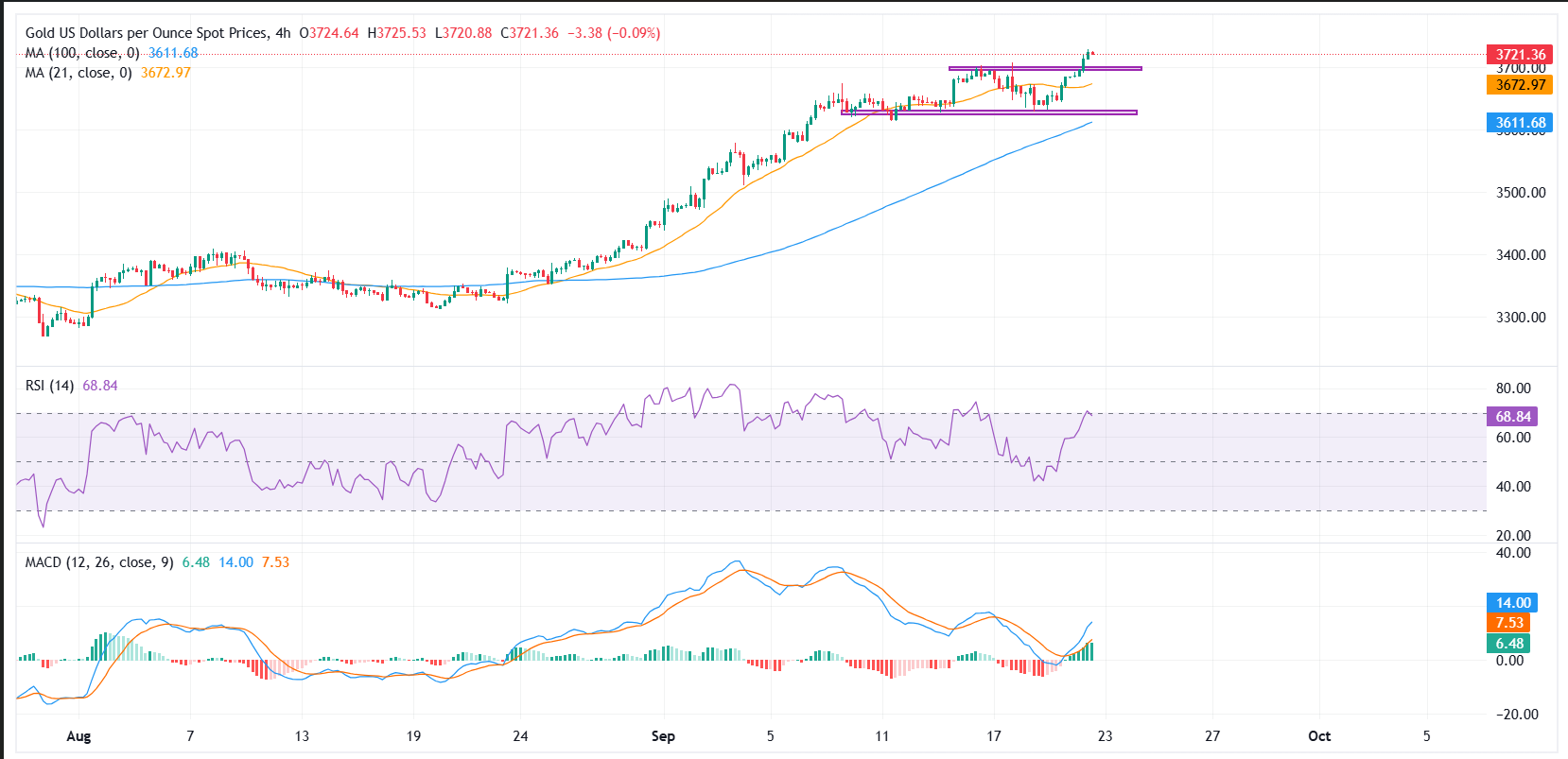
XAU/USD is trading at record highs after breaking above its previous peak at $3,703, confirming bullish momentum. The breakout has extended the metal’s record-breaking rally, with buyers firmly in control as it pushes into uncharted territory.
On the downside, immediate support is now seen at $3,700, which has turned into a key pivot after the breakout above $3,703. The 21-period Simple Moving Average (SMA) on the 4-hour chart around $3,673 offers the next cushion, while a stronger floor lies near $3,630, which marks the base of the prior consolidation zone, reinforced by the 100-period SMA at $3,611.
Momentum indicators back the bullish case. The Relative Strength Index (RSI) is holding above 70, signaling strong upward momentum even as conditions stretch into overbought territory. The Moving Average Convergence Divergence (MACD) is also trending higher, with widening green histogram bars suggesting continued positive momentum. As long as Gold stays above $3,700, bulls are likely to target further gains toward fresh record levels.
(This story was corrected on September 22 at 15:30 GMT to fix that the Fed's Cleveland President's name is Beth M. Hammack, not Adriana Hammack)
Fed FAQs
Monetary policy in the US is shaped by the Federal Reserve (Fed). The Fed has two mandates: to achieve price stability and foster full employment. Its primary tool to achieve these goals is by adjusting interest rates. When prices are rising too quickly and inflation is above the Fed’s 2% target, it raises interest rates, increasing borrowing costs throughout the economy. This results in a stronger US Dollar (USD) as it makes the US a more attractive place for international investors to park their money. When inflation falls below 2% or the Unemployment Rate is too high, the Fed may lower interest rates to encourage borrowing, which weighs on the Greenback.
The Federal Reserve (Fed) holds eight policy meetings a year, where the Federal Open Market Committee (FOMC) assesses economic conditions and makes monetary policy decisions. The FOMC is attended by twelve Fed officials – the seven members of the Board of Governors, the president of the Federal Reserve Bank of New York, and four of the remaining eleven regional Reserve Bank presidents, who serve one-year terms on a rotating basis.
In extreme situations, the Federal Reserve may resort to a policy named Quantitative Easing (QE). QE is the process by which the Fed substantially increases the flow of credit in a stuck financial system. It is a non-standard policy measure used during crises or when inflation is extremely low. It was the Fed’s weapon of choice during the Great Financial Crisis in 2008. It involves the Fed printing more Dollars and using them to buy high grade bonds from financial institutions. QE usually weakens the US Dollar.
Quantitative tightening (QT) is the reverse process of QE, whereby the Federal Reserve stops buying bonds from financial institutions and does not reinvest the principal from the bonds it holds maturing, to purchase new bonds. It is usually positive for the value of the US Dollar.
Author

Vishal Chaturvedi
FXStreet
I am a macro-focused research analyst with over four years of experience covering forex and commodities market. I enjoy breaking down complex economic trends and turning them into clear, actionable insights that help traders stay ahead of the curve.