Gold eyes first weekly gain in five weeks as weak US NFP delays Fed hike bets
- Gold extends gains as a weak US NFP report weighs on the US Dollar.
- Softer labor market data prompts markets to delay expectations for a Fed rate hike.
- Technical indicators suggest bullish momentum is gradually rebuilding, with the MACD turning positive and the RSI recovering toward neutral.

Gold (XAU/USD) extends gains on Friday as weaker-than-expected US Nonfarm Payrolls (NFP) data released on Thursday batters the US Dollar (USD) and cools expectations of an imminent Federal Reserve (Fed) interest rate hike.
At the time of writing, XAU/USD is trading around $4,170, up about 1.16% on the day. The US Dollar Index (DXY), which tracks the Greenback's value against a basket of six major currencies, is trading around 100.76, near two-week lows.
The US economy added just 57K jobs in June, nearly half the market expectation of 110K. Following the data, markets shifted expectations for a Fed interest rate hike from September to December. According to the CME FedWatch Tool, the probability of a September rate hike fell to 53% from the 63% expected before the data release, while the odds for a December hike stand at a still high 76.8%.
The delay in Fed rate hike expectations eases near-term pressure on the non-yielding metal, helping Gold stage a solid rebound from the seven-month low of $3,949 touched on Tuesday and putting it on track for its first weekly gain in five weeks.
Can Gold extend its rebound?
While Gold is showing signs of resilience above the $4,000 mark after correcting nearly 28% from its record high near $5,600 reached in January, further upside is likely to depend on the evolving macroeconomic backdrop.
Oil prices have fallen significantly from the highs seen during the US-Iran war, easing a key source of inflationary pressure. Combined with softer US labor market conditions, this weakens the case for an immediate Fed rate hike.
However, monetary policy is still expected to remain restrictive until inflation shows meaningful progress toward the Fed's 2% target. In that environment, Gold's upside is likely to remain limited unless the Fed clearly adopts a dovish stance.
A hawkish Fed outlook should also support the US Dollar, creating an additional headwind for Gold by making the precious metal more expensive for overseas buyers.
Still, Gold's longer-term outlook remains supported by robust central bank demand. The latest World Gold Council (WGC) data showed central banks added a net 41 tonnes of Gold to their reserves in May.
The Council's Central Bank Gold Reserves Survey 2026, released last month, found that 89% of central bankers expect global Gold reserves to increase over the next 12 months, while a record-high 45% plan to increase their own Gold holdings.
Technical Analysis: Bullish momentum rebuilds as XAU/USD reclaims 20-day SMA
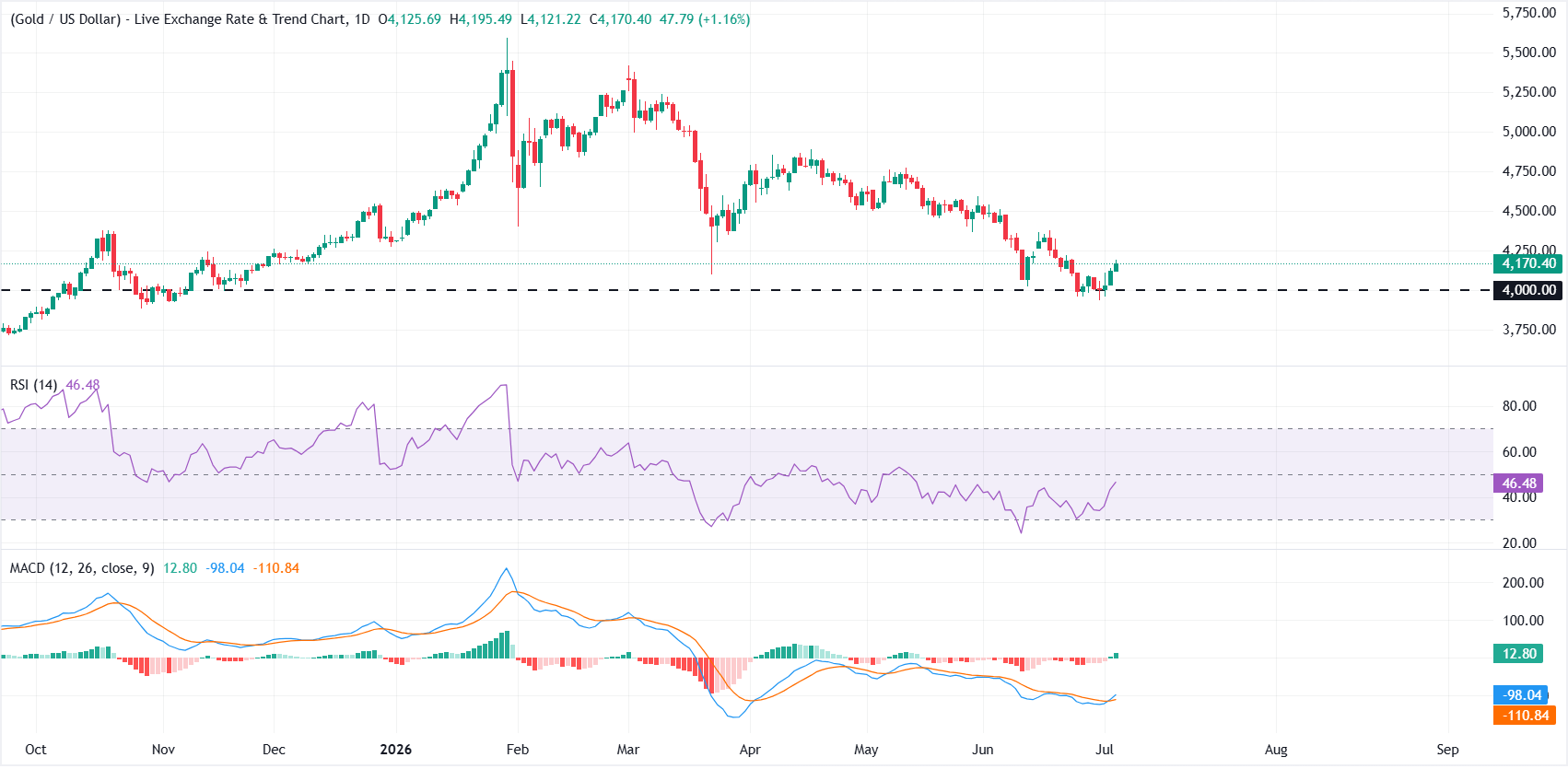
On the daily chart, XAU/USD holds a near-term bullish bias as it retests the 20-day Simple Moving Average (the Bollinger middle band) at roughly $4,156, suggesting dip-buying interest persists.
Price remains well below the Bollinger upper band near $4,371, leaving room for further upside, while the Relative Strength Index around 47 stays just below neutral and the Moving Average Convergence Divergence (MACD) prints in positive territory, hinting that bullish momentum is rebuilding.
On the topside, initial resistance is aligned with the Bollinger upper band at $4,371, where a daily close above would open the door to a stronger extension of the uptrend.
On the downside, immediate support emerges at the 20-day SMA around $4,156, followed by the horizontal floor at $4,000 and the lower Bollinger band near $3,942, levels that together define a broader demand zone that would need to give way to meaningfully undermine the prevailing constructive bias.
(The technical analysis of this story was written with the help of an AI tool.)
Gold FAQs
Gold has played a key role in human’s history as it has been widely used as a store of value and medium of exchange. Currently, apart from its shine and usage for jewelry, the precious metal is widely seen as a safe-haven asset, meaning that it is considered a good investment during turbulent times. Gold is also widely seen as a hedge against inflation and against depreciating currencies as it doesn’t rely on any specific issuer or government.
Central banks are the biggest Gold holders. In their aim to support their currencies in turbulent times, central banks tend to diversify their reserves and buy Gold to improve the perceived strength of the economy and the currency. High Gold reserves can be a source of trust for a country’s solvency. Central banks added 1,136 tonnes of Gold worth around $70 billion to their reserves in 2022, according to data from the World Gold Council. This is the highest yearly purchase since records began. Central banks from emerging economies such as China, India and Turkey are quickly increasing their Gold reserves.
Gold has an inverse correlation with the US Dollar and US Treasuries, which are both major reserve and safe-haven assets. When the Dollar depreciates, Gold tends to rise, enabling investors and central banks to diversify their assets in turbulent times. Gold is also inversely correlated with risk assets. A rally in the stock market tends to weaken Gold price, while sell-offs in riskier markets tend to favor the precious metal.
The price can move due to a wide range of factors. Geopolitical instability or fears of a deep recession can quickly make Gold price escalate due to its safe-haven status. As a yield-less asset, Gold tends to rise with lower interest rates, while higher cost of money usually weighs down on the yellow metal. Still, most moves depend on how the US Dollar (USD) behaves as the asset is priced in dollars (XAU/USD). A strong Dollar tends to keep the price of Gold controlled, whereas a weaker Dollar is likely to push Gold prices up.
Author

Vishal Chaturvedi
FXStreet
I am a macro-focused research analyst with over four years of experience covering forex and commodities market. I enjoy breaking down complex economic trends and turning them into clear, actionable insights that help traders stay ahead of the curve.