Gold extends range play below record high amid positive risk tone; bullish bias remains
- Gold pauses after the recent record-setting run amid the prevalent risk-on mood.
- Fed rate cut bets weigh on the USD and lend support to the non-yielding commodity.
- Overbought conditions hold back the XAU/USD bulls from positioning for further gains.

Gold (XAU/USD) remains confined in a narrow trading band through the first half of the European session as bulls now seem reluctant to place fresh bets amid still overbought conditions. Furthermore, investors seem unfazed by a partial US government shutdown, which is evident from a generally positive tone around the equity markets and contributes to capping the safe-haven commodity. That said, dovish Federal Reserve (Fed) expectations keep the US Dollar (USD) bulls on the defensive and continue to act as a tailwind for the non-yielding yellow metal.
Traders ramped up bets that the US central bank will lower borrowing costs two more times this year following Wednesday's disappointing release of the US ADP Report on private-sector employment. This, in turn, fails to assist the USD to build on the overnight bounce from a one-week low, which, along with rising geopolitical tensions, backs the case for a further near-term appreciating move for the Gold price. Hence, any corrective pullback might still be seen as a buying opportunity and remain limited ahead of speeches from influential FOMC members.
Daily Digest Market Movers: Gold bulls seem non-committed as positive risk tone offsets dovish Fed
- US President Donald Trump's Republican Party failed to agree with opposition Democrats on a way forward on a spending bill. Investors, however, react little amid expectations of a limited impact on the economy due to a government shutdown. This, in turn, remains supportive of the positive risk tone and acts as a headwind for the safe-haven Gold price during the Asian session on Thursday.
- On the economic data front, Automatic Data Processing reported on Wednesday that private-sector employers shed 32K jobs in September, marking the biggest drop since March 2023. Moreover, the August payrolls number was revised down to show a loss of 3K compared to an increase of 54K reported initially. The data reinforced bets for two more rate cuts by the Federal Reserve by the year-end.
- Meanwhile, the Institute for Supply Management's (ISM) Purchasing Managers' Index (PMI) came in slightly above consensus estimates and improved from 48.7 to 49.1 in September. This assisted the US Dollar in bouncing off a one-week low touched on Wednesday. The momentum, however, runs out of steam amid dovish Fed expectations, which continue to support the non-yielding yellow metal.
- According to the Wall Street Journal (WSJ), the US will provide Ukraine with intelligence to support long-range missile strikes on Russian energy infrastructure. Trump approved the move, and US officials are urging NATO allies to do the same. This keeps geopolitical risks in play and should contribute to limiting any corrective decline in the safe-haven precious metal, warranting some caution for bears.
- Important US macro releases scheduled at the start of a new month, including the closely watched US Nonfarm Payrolls (NFP) report on Friday, are likely to be delayed on the back of a partial US government shutdown. Hence, speeches from influential FOMC members will play a key role in driving the USD demand and producing short-term trading opportunities around the XAU/USD pair.
Gold might consolidate further before next leg higher amid still overbought daily RSI
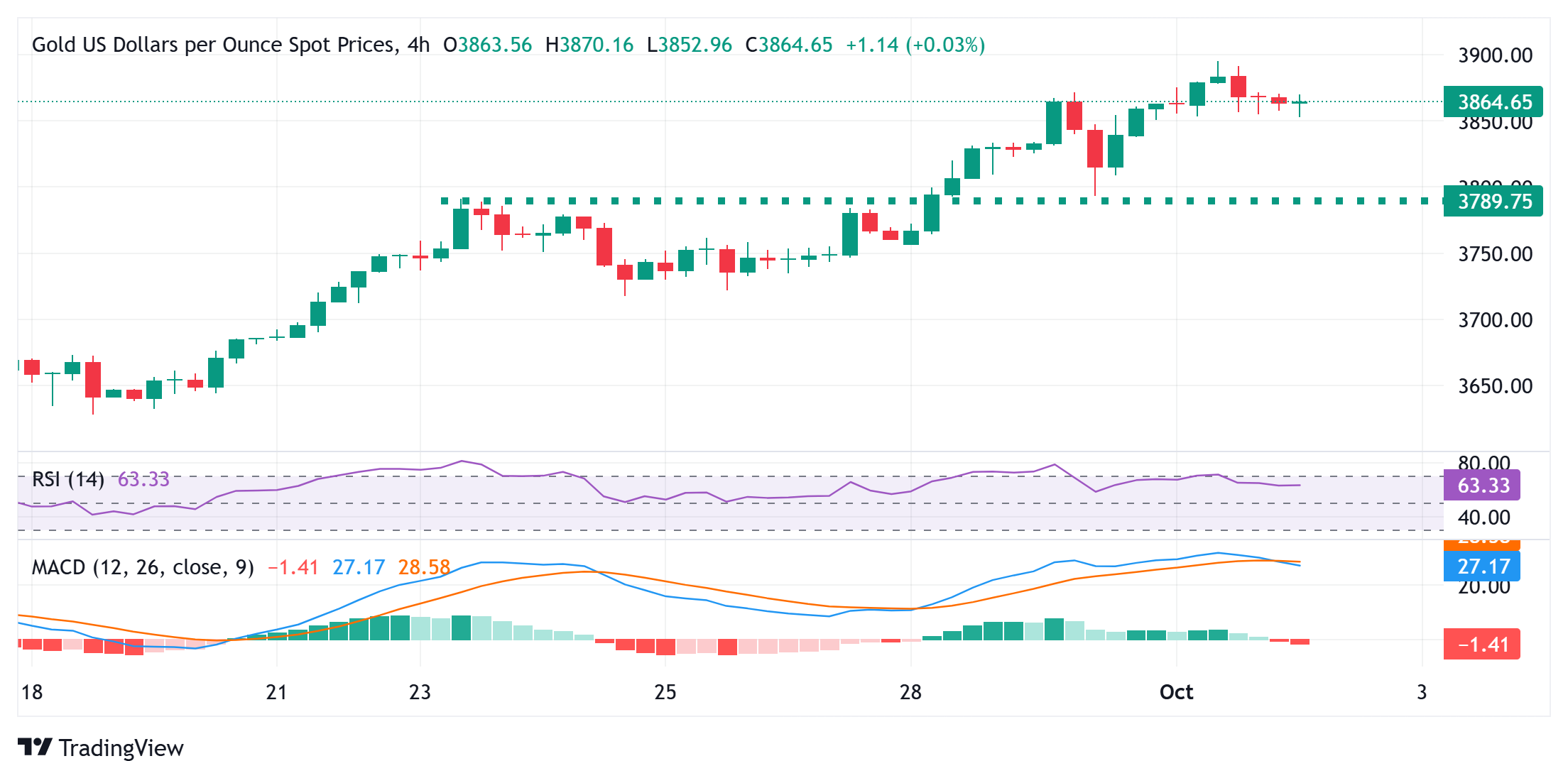
From a technical perspective, the daily Relative Strength Index (RSI) is still flashing extremely overbought conditions and holding back the XAU/USD bulls from placing fresh bets. That said, the lack of any meaningful sellers and a goodish intraday rebound from sub-$3,800 levels on Tuesday validates the near-term positive outlook for the Gold. Nevertheless, it will still be prudent to wait for some near-term consolidation or a modest pullback before positioning for an extension of the recent well-established uptrend witnessed over the past month or so.
In the meantime, weakness below the Asian session low, around the $3,853-3,852 region, is likely to find decent support near the $3,825-3,820 area. Some follow-through selling, leading to a subsequent breakdown and acceptance below the $3,800 mark, could pave the way for deeper losses. The Gold price might then accelerate the fall towards the next relevant support near the $3,758-3,757 zone en route to the $3,735 region before eventually dropping to the $3,700 round figure.
Risk sentiment FAQs
In the world of financial jargon the two widely used terms “risk-on” and “risk off'' refer to the level of risk that investors are willing to stomach during the period referenced. In a “risk-on” market, investors are optimistic about the future and more willing to buy risky assets. In a “risk-off” market investors start to ‘play it safe’ because they are worried about the future, and therefore buy less risky assets that are more certain of bringing a return, even if it is relatively modest.
Typically, during periods of “risk-on”, stock markets will rise, most commodities – except Gold – will also gain in value, since they benefit from a positive growth outlook. The currencies of nations that are heavy commodity exporters strengthen because of increased demand, and Cryptocurrencies rise. In a “risk-off” market, Bonds go up – especially major government Bonds – Gold shines, and safe-haven currencies such as the Japanese Yen, Swiss Franc and US Dollar all benefit.
The Australian Dollar (AUD), the Canadian Dollar (CAD), the New Zealand Dollar (NZD) and minor FX like the Ruble (RUB) and the South African Rand (ZAR), all tend to rise in markets that are “risk-on”. This is because the economies of these currencies are heavily reliant on commodity exports for growth, and commodities tend to rise in price during risk-on periods. This is because investors foresee greater demand for raw materials in the future due to heightened economic activity.
The major currencies that tend to rise during periods of “risk-off” are the US Dollar (USD), the Japanese Yen (JPY) and the Swiss Franc (CHF). The US Dollar, because it is the world’s reserve currency, and because in times of crisis investors buy US government debt, which is seen as safe because the largest economy in the world is unlikely to default. The Yen, from increased demand for Japanese government bonds, because a high proportion are held by domestic investors who are unlikely to dump them – even in a crisis. The Swiss Franc, because strict Swiss banking laws offer investors enhanced capital protection.
Author

Haresh Menghani
FXStreet
Haresh Menghani is a detail-oriented professional with 10+ years of extensive experience in analysing the global financial markets.