Gold climbs toward $4,680 as weaker Dollar offsets war anxiety
- Gold gains as a softer US Dollar and fading oil prices support prices.
- Mixed Iran headlines keep investors cautious and underpin haven demand.
- Fed speakers and rising inflation expectations remain key market drivers.
Gold price (XAU/USD) advances some 0.63% on Tuesday as Oil prices retreat from daily highs amid speculation of broken talks between the US and Iran, which Iranian media denied. However, fears are mounting as US President Donald Trump's deadline to reopen the Hormuz Strait approaches , with investors awaiting a possible agreement before the US resumes attacks on Iran’s installations.
Bullion holds firm as mixed Iran headlines keep haven demand alive
XAU/USD trades at $4,678 after bouncing off daily lows of $4,607, underpinned by a weaker US Dollar, which, according to the US Dollar Index (DXY), which tracks the buck's performance against six currencies, falls 0.17% to 99.82.
Geopolitical news headlines show mixed signals on the Middle East conflict, creating confusion amongst investors, which so far keeps the yellow metal bid. Recent headlines reporting that the US-Iran diplomacy was cut off were denied by the Tehran Times, though the Wall Street Journal reports that both sides are sticking to a hard line, showing no signs of backing down.
So far, attacks by the US, Israel and Iran intensified ahead of Trump’s deadline, which expires at 8.00 p.m. Eastern Time on Tuesday. Although progress has been made in the past 24 hours in the negotiations, reaching a ceasefire seems unlikely, Axios reported, citing a US official, an Israeli official, and others. CNN reported that the Israeli military is on standby, ready to launch strikes, ahead of US President Trump's deadline on Iran to reopen the strait, according to Israeli sources.
Fed’s Goolsbee policy not to please the US President
Federal Reserve (Fed) speakers crossed the wires, led by regional Fed Bank Presidents Austan Goolsbee and John Williams. Chicago Fed President Goolsbee denied that the Fed Act is meant to make the stock market or the US President happy, warning that taking away the central bank’s independence would push inflation higher.
John Williams from the New York Fed warned that the energy shock spurred by the Middle East conflict will likely lift headline inflation, projecting it to stay elevated into mid-year and reach around 2.75% annually. He added that policy remains at an appropriate level.
US data showed that Durable Goods Orders contracted by 1.4% in February, marking a third consecutive decline and missing expectations of a 0.5% contraction. However, core goods surprised to the upside, increasing 0.8% MoM.
The New York Fed’s consumer survey showed inflation expectations drifted higher in March, with the one-year outlook rising to 3.4%, while medium-term expectations ticked up slightly and long-term expectations remained anchored.
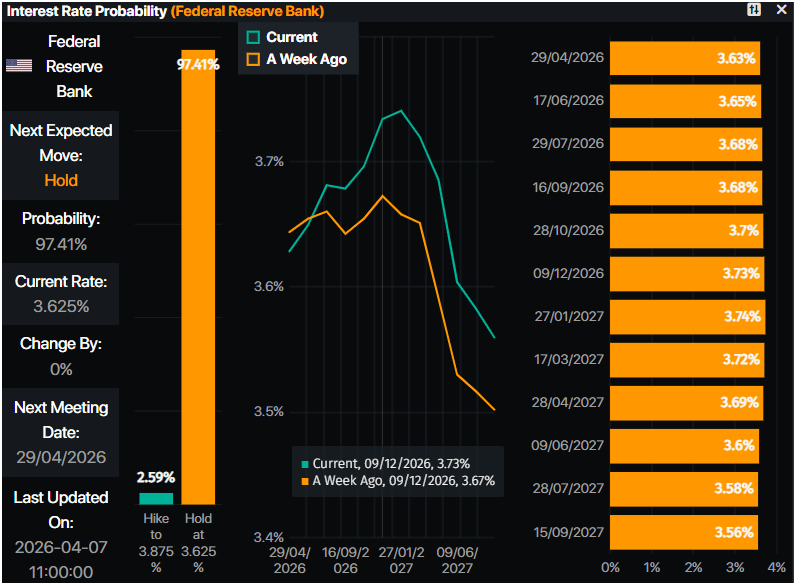
Consequently, traders are not expecting further Fed easing in 2026. Money markets project interest rates to remain unchanged throughout the full year, according to Prime Market data.
Fed interest rate probabilities
Ahead this week, traders are eyeing speeches by Fed officials, the minutes of the FOMC's last meeting, growth data, Initial Jobless Claims and inflation figures.
XAU/USD technical analysis: Gold recoils from $4,700, sellers target 100-day SMA
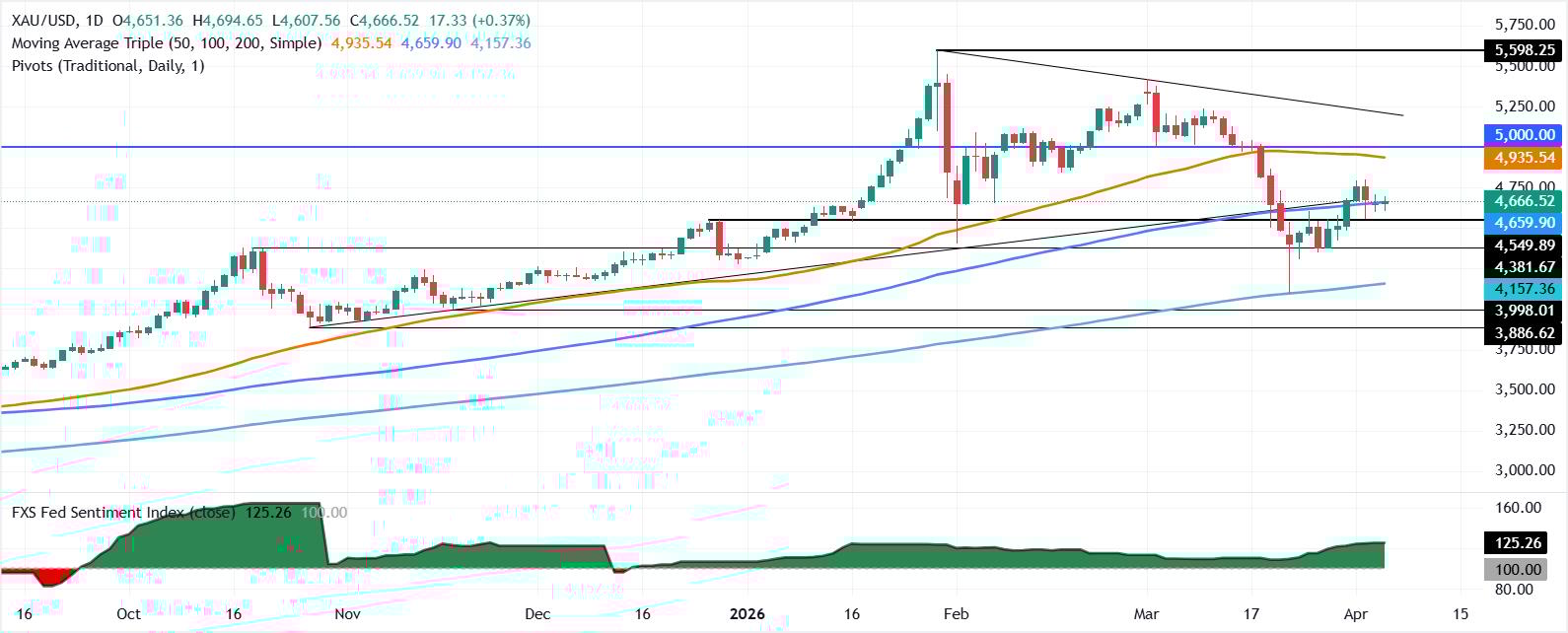
The technical picture shows that Gold prices remain sideways, with key support at the 100-day Simple Moving Average (SMA) at $4,644 and immediate resistance at the 20-day SMA at $4,731. Momentum indicates that neither buyers nor sellers are in control, as shown by the Relative Strength Index (RSI).
For further upside, XAU/USD must clear $4,700, followed by the 20-day SMA at $4,731. Once surpassed, a move towards the 50-day SMA at $4,937 is on the cards. Conversely, if Gold remains below $4,700, the first support would be $4,600, followed by the April 2 daily low at $4,553, ahead of $4,500.
Gold FAQs
Gold has played a key role in human’s history as it has been widely used as a store of value and medium of exchange. Currently, apart from its shine and usage for jewelry, the precious metal is widely seen as a safe-haven asset, meaning that it is considered a good investment during turbulent times. Gold is also widely seen as a hedge against inflation and against depreciating currencies as it doesn’t rely on any specific issuer or government.
Central banks are the biggest Gold holders. In their aim to support their currencies in turbulent times, central banks tend to diversify their reserves and buy Gold to improve the perceived strength of the economy and the currency. High Gold reserves can be a source of trust for a country’s solvency. Central banks added 1,136 tonnes of Gold worth around $70 billion to their reserves in 2022, according to data from the World Gold Council. This is the highest yearly purchase since records began. Central banks from emerging economies such as China, India and Turkey are quickly increasing their Gold reserves.
Gold has an inverse correlation with the US Dollar and US Treasuries, which are both major reserve and safe-haven assets. When the Dollar depreciates, Gold tends to rise, enabling investors and central banks to diversify their assets in turbulent times. Gold is also inversely correlated with risk assets. A rally in the stock market tends to weaken Gold price, while sell-offs in riskier markets tend to favor the precious metal.
The price can move due to a wide range of factors. Geopolitical instability or fears of a deep recession can quickly make Gold price escalate due to its safe-haven status. As a yield-less asset, Gold tends to rise with lower interest rates, while higher cost of money usually weighs down on the yellow metal. Still, most moves depend on how the US Dollar (USD) behaves as the asset is priced in dollars (XAU/USD). A strong Dollar tends to keep the price of Gold controlled, whereas a weaker Dollar is likely to push Gold prices up.
Author

Christian Borjon Valencia
FXStreet
Markets analyst, news editor, and trading instructor with over 14 years of experience across FX, commodities, US equity indices, and global macro markets.