Gold climbs as Oil rout softens Fed hike bets
- Oil slump eases inflation pressure before Warsh’s first Fed decision.
- Fed hike odds fall as traders await SEP projections.
- RBA and BoJ hawkishness keep central bank risks alive.

Gold (XAU/USD) price rises over 0.81% on Tuesday as the US-Iran deal eased inflationary pressures, prompting traders to scale back bets that the Federal Reserve (Fed) will raise rates later in 2026. At the time of writing, the XAU/USD pair trades at $4,344 after bouncing off daily lows of $4,306.
XAU/USD rises as lower yields and Dollar support bullion
Geopolitical noise seems to be calming as the US and Tehran agreed to a truce, set to be signed on Friday. Consequently, Oil prices plummeted over the last two days, easing worldwide inflationary pressures and driving the Greenback lower, which is closely correlated with West Texas Intermediate (WTI).
On Tuesday, the Federal Reserve began its two-day meeting. The central bank is expected to keep rates unchanged and publish the Summary of Economic Projections (SEP), which presents its forecasts for economic growth, inflation, and the future path of the Fed Funds rate.
After this, the new Fed Chair, Kevin Warsh, will lead its first post-setting monetary policy press conference, with most investors eyeing his initial stance on policy, the balance sheet, and how often policymakers will hit the media.
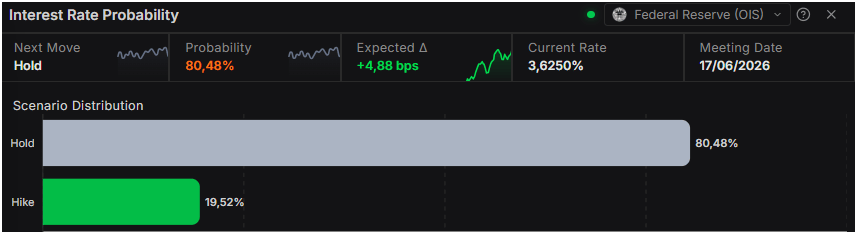
Money markets are speculating that the Fed will hold rates unchanged, with 80% odds of maintaining rates, while the odds of a rate hike are 20%, according to Prime Terminal data.
Worth noting that two major central banks tilted hawkishand blamed the Middle East conflict. The Reserve Bank of Australia (RBA) held rates unchanged, but hinted that if inflation edges higher, further tightening would be needed.
The Bank of Japan (BoJ) did its part, hiking rates by 25 basis points to 1%, but didn’t signal the path for interest rates, amid the absence of Governor Kazuo Ueda due to hospitalization.
US Treasury yields are also diving sharply. The US 10-year Treasury note yield is down nearly 5 basis points (bps) to 4.484%. This capped the Greenback advance, as measured by the US Dollar Index (DXY). The DXY, which measures the buck’s value against a basket of six peers, loses 0.12% at 99.54.
US data showed that the ADP Employment Change 4-week average indicated that private companies hired 25.5K people, down from 29K previously, signaling a hiring slowdown.
Ahead this week, the US economic docket will also feature Retail Sales, expected to remain at 0.5% MoM in May, unchanged, and Initial Jobless Claims.
XAU/USD technical outlook: Gold advances, but stalls near $4,400
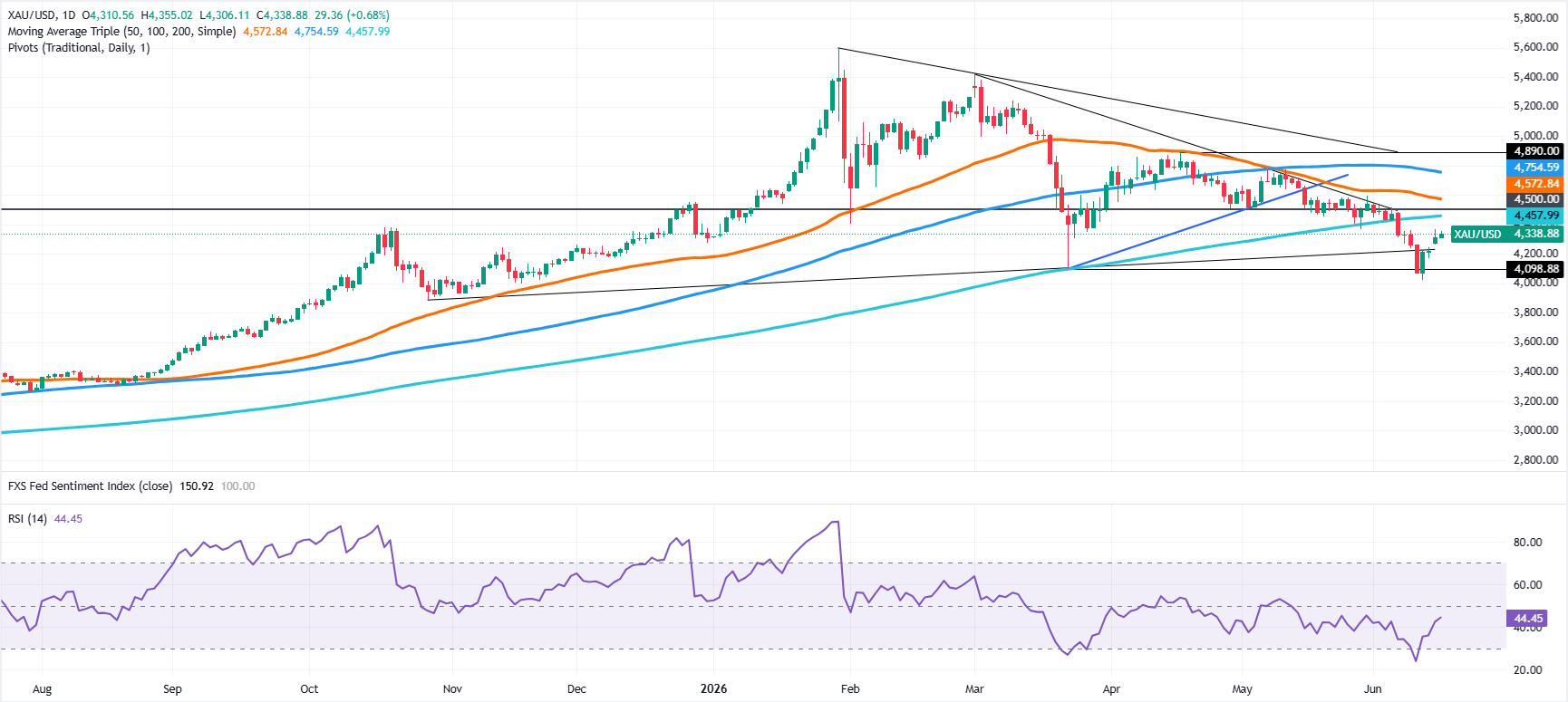
From a technical perspective, Gold seems poised to trade sideways, as it would face key overhead resistance levels. The Relative Strength Index (RSI) shows that sellers are in control, but buyers are gaining some near-term momentum. Nevertheless, the index remains below its 50 neutral level, indicating a bearish stance.
On the upside, Gold needs to clear a downward resistance trendline and the 20-day Simple Moving Average (SMA) around $4,400. Once hurdled, the next stop would be the 200-day Simple Moving Average (SMA) at $4,458 ahead of the $4,500 figure. Up next lies the 50-day SMA at $4,571
For a bearish continuation, XAU must drop below $4,300 to challenge the psychological $4,250 level. Below this, the next demand zone would be at $4,200, followed by the June 11 swing low at $4,023.
Gold FAQs
Gold has played a key role in human’s history as it has been widely used as a store of value and medium of exchange. Currently, apart from its shine and usage for jewelry, the precious metal is widely seen as a safe-haven asset, meaning that it is considered a good investment during turbulent times. Gold is also widely seen as a hedge against inflation and against depreciating currencies as it doesn’t rely on any specific issuer or government.
Central banks are the biggest Gold holders. In their aim to support their currencies in turbulent times, central banks tend to diversify their reserves and buy Gold to improve the perceived strength of the economy and the currency. High Gold reserves can be a source of trust for a country’s solvency. Central banks added 1,136 tonnes of Gold worth around $70 billion to their reserves in 2022, according to data from the World Gold Council. This is the highest yearly purchase since records began. Central banks from emerging economies such as China, India and Turkey are quickly increasing their Gold reserves.
Gold has an inverse correlation with the US Dollar and US Treasuries, which are both major reserve and safe-haven assets. When the Dollar depreciates, Gold tends to rise, enabling investors and central banks to diversify their assets in turbulent times. Gold is also inversely correlated with risk assets. A rally in the stock market tends to weaken Gold price, while sell-offs in riskier markets tend to favor the precious metal.
The price can move due to a wide range of factors. Geopolitical instability or fears of a deep recession can quickly make Gold price escalate due to its safe-haven status. As a yield-less asset, Gold tends to rise with lower interest rates, while higher cost of money usually weighs down on the yellow metal. Still, most moves depend on how the US Dollar (USD) behaves as the asset is priced in dollars (XAU/USD). A strong Dollar tends to keep the price of Gold controlled, whereas a weaker Dollar is likely to push Gold prices up.
Author

Christian Borjon Valencia
FXStreet
Markets analyst, news editor, and trading instructor with over 14 years of experience across FX, commodities, US equity indices, and global macro markets.

















