Gold bears retain control as Fed hike bets and Oil-driven inflation weigh
- Gold remains under pressure as Fed rate hike expectations weigh on the non-yielding metal.
- A softer US Dollar limits losses amid broad Japanese Yen strength.
- XAU/USD holds above the 100-day SMA, but the negative MACD keeps the near-term bias tilted lower.

Gold (XAU/USD) trades with a modest downside bias during American trading hours on Monday. A softer US Dollar (USD) limits the decline and helps the metal recover part of its earlier losses. At the time of writing, XAU/USD trades around $4,414, down 0.35% on the day, after touching an intraday low of $4,381. Trading activity is likely to stay subdued, with US markets closed for the Labor Day holiday.
The Greenback faces selling pressure as broad Japanese Yen (JPY) strength outweighs support from hawkish Federal Reserve (Fed) expectations and geopolitical tensions. USD/JPY trades near 154.40, down around 3.30% since the start of the month and revisiting levels last seen in February.
The US Dollar Index (DXY), which tracks the Greenback’s value against a basket of six major currencies, trades around 98.87, down nearly 0.30% on the day, hovering near two-week lows.
However, Gold may struggle to attract strong follow-through buying as Fed rate hike concerns dominate sentiment following the blockbuster US employment report. Higher Oil prices also keep energy-driven inflation risks in focus as tensions between the United States and Iran continue to simmer.
Data released on Friday showed US Nonfarm Payrolls rose by 162K in August, well above the market forecast of 56K, while the Unemployment Rate held steady at 4.1%.
Tensions rose over the weekend after the US military said it struck three Iranian crude Oil tankers on Saturday in response to Iran firing ballistic missiles at two US Navy ships. The Financial Times also reported that Saudi Aramco’s Jazan refinery was hit by a fresh strike on Monday.
The US-Iran conflict provides little support to Gold as markets focus on its inflationary impact through higher energy prices. West Texas Intermediate (WTI) trades near $91 per barrel, close to its highest level since July.
Elevated Oil prices add to inflation risks around the globe, strengthening the case for keeping interest rates higher for longer at a time when bond yields in major economies are already near multi-year highs. This increases the opportunity cost of holding non-yielding Gold.
Looking ahead, Gold is likely to remain sensitive to Fed rate expectations and developments in the Middle East. According to the CME FedWatch Tool, markets price in around a 58% chance of a rate hike at the September 15-16 meeting.
Later this week, the US Producer Price Index (PPI) is due on Thursday, followed by the Consumer Price Index (CPI) on Friday. Hotter inflation readings would reinforce Fed rate hike expectations, while softer figures could offer Gold some relief.
Technical analysis: Sellers retain control below the 200-day SMA
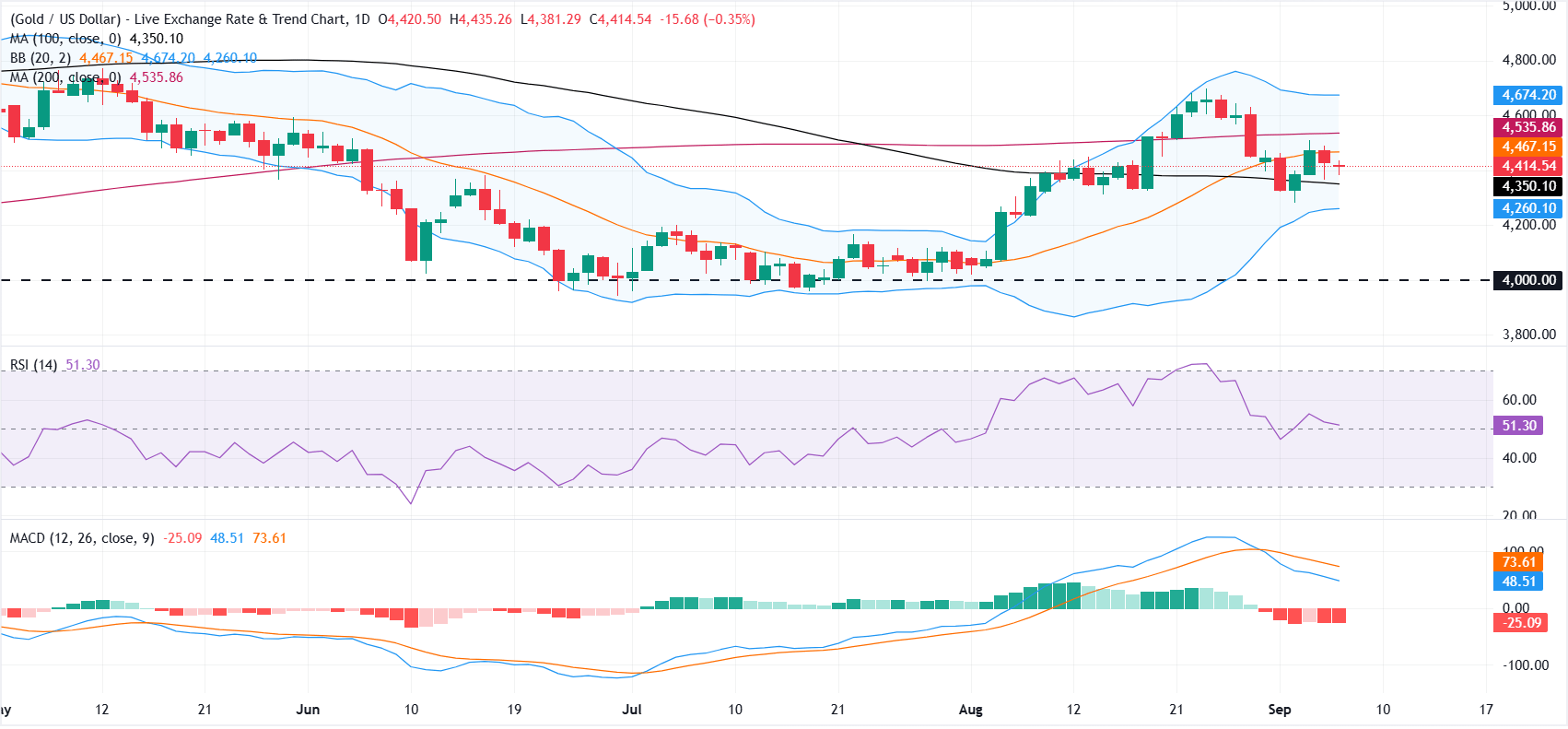
XAU/USD holds below the Bollinger mid-line near $4,466 on the daily chart and the 200-day Simple Moving Average (SMA) at $4,536, keeping the near-term bias bearish.
Price still holds above the 100-day SMA at about $4,350 and the lower Bollinger Band around $4,259, suggesting downside pressure is present but not yet disorderly. The Relative Strength Index (RSI) on the daily chart is flat around 50 and a negative Moving Average Convergence Divergence (MACD) reading with red histogram bars hints that momentum lacks clear bullish follow-through.
On the downside, initial support is seen at the 100-day SMA around $4,350, followed by the lower Bollinger band close to $4,259 before a more significant horizontal floor at $4,000. On the topside, buyers would need to lift XAU/USD back above the Bollinger mid-line near $4,466 to ease immediate selling pressure, with the 200-day SMA around $4,535 acting as a stronger cap ahead of the upper Bollinger band near $4,674.
(The technical analysis of this story was written with the help of an AI tool. Know more.)
Gold FAQs
Gold has played a key role in human’s history as it has been widely used as a store of value and medium of exchange. Currently, apart from its shine and usage for jewelry, the precious metal is widely seen as a safe-haven asset, meaning that it is considered a good investment during turbulent times. Gold is also widely seen as a hedge against inflation and against depreciating currencies as it doesn’t rely on any specific issuer or government.
Central banks are the biggest Gold holders. In their aim to support their currencies in turbulent times, central banks tend to diversify their reserves and buy Gold to improve the perceived strength of the economy and the currency. High Gold reserves can be a source of trust for a country’s solvency. Central banks added 1,136 tonnes of Gold worth around $70 billion to their reserves in 2022, according to data from the World Gold Council. This is the highest yearly purchase since records began. Central banks from emerging economies such as China, India and Turkey are quickly increasing their Gold reserves.
Gold has an inverse correlation with the US Dollar and US Treasuries, which are both major reserve and safe-haven assets. When the Dollar depreciates, Gold tends to rise, enabling investors and central banks to diversify their assets in turbulent times. Gold is also inversely correlated with risk assets. A rally in the stock market tends to weaken Gold price, while sell-offs in riskier markets tend to favor the precious metal.
The price can move due to a wide range of factors. Geopolitical instability or fears of a deep recession can quickly make Gold price escalate due to its safe-haven status. As a yield-less asset, Gold tends to rise with lower interest rates, while higher cost of money usually weighs down on the yellow metal. Still, most moves depend on how the US Dollar (USD) behaves as the asset is priced in dollars (XAU/USD). A strong Dollar tends to keep the price of Gold controlled, whereas a weaker Dollar is likely to push Gold prices up.
Author

Vishal Chaturvedi
FXStreet
I am a macro-focused research analyst with over four years of experience covering forex and commodities market. I enjoy breaking down complex economic trends and turning them into clear, actionable insights that help traders stay ahead of the curve.
















