EUR/USD Price Forecast: Remains sticky to 20-day EMA
- EUR/USD trades broadly sideways to near 1.1625 amid an extended weekend in the US.
- Investors keenly await the ECB’s policy decision and the US CPI data.
- The ECB is expected to hike policy rates on Thursday.

The Euro (EUR) is marginally higher to near 1.1625 against the US Dollar (USD) during the European trading session on Monday. The major currency pair trades broadly sideways amid an extended weekend in the United States (US) due to Labor Day.
This week, the major trigger for the major currency pair will be the European Central Bank’s (ECB) monetary policy announcement on Thursday and the release of the United States (US) Consumer Price Index (CPI) data on Friday.
Euro focus turns to ECB
According to Deutsche Bank, the upcoming ECB policy decision on Thursday will be “the key event” for European markets. The bank’s European economists “expect a 25bp rate increase, taking the deposit rate to 2.50%,” and they note that investors will be closely watching “any guidance regarding the likelihood of further tightening” beyond this week’s move.
On the US Dollar front, investors will pay close attention to the US CPI data to get fresh cues regarding the Federal Reserve’s (Fed) monetary policy outlook.
Meanwhile, upbeat US Nonfarm Payrolls (NFP) data has prompted Fed’s interest rate hike expectations.
Strategists at BNY highlight that last week’s upside surprise in U.S. labour data, with "nonfarm payrolls (NFP) at 162,000 vs. the expected 55,000," pushed "market-implied odds of a September Fed hike back up to around 60% from 50%," underscoring "how much rate expectations remain tethered to the data backdrop.
EUR/USD Technical Analysis
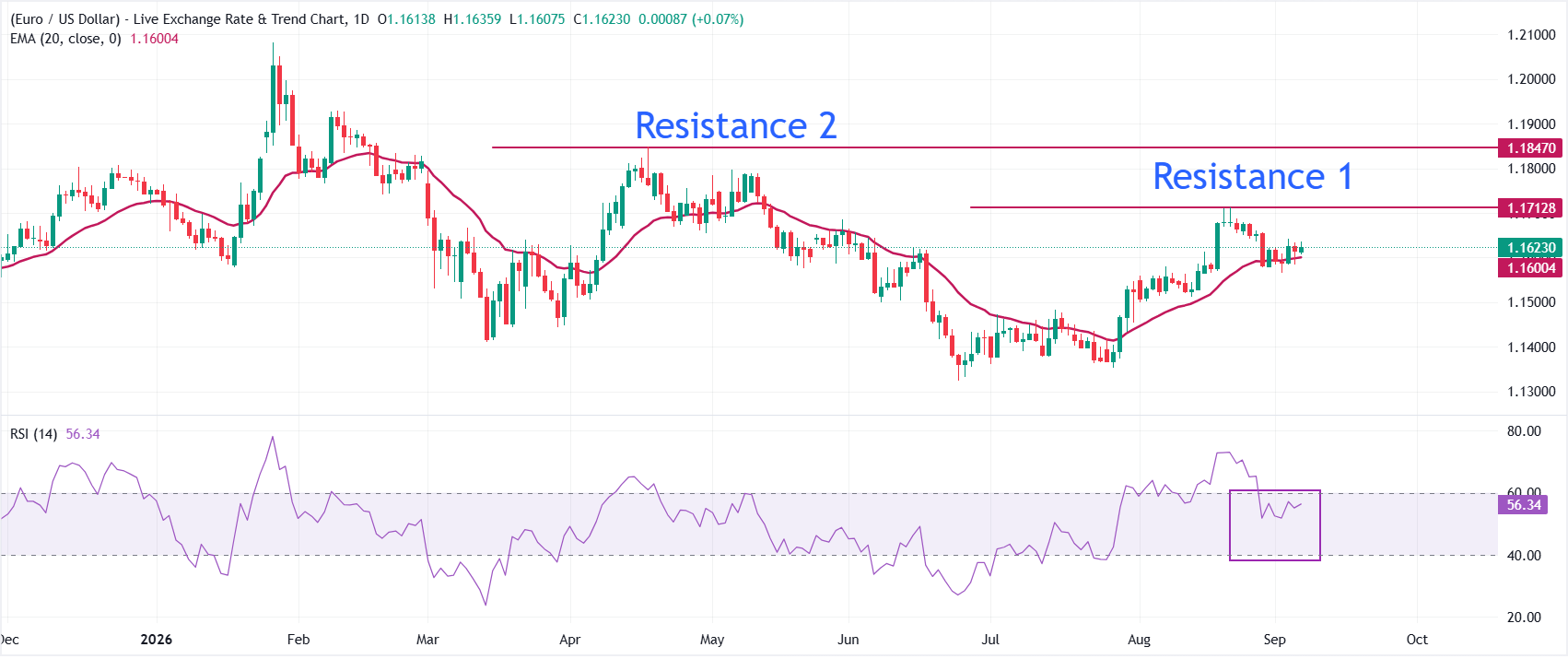
In the daily chart, EUR/USD trades at 1.1623, keeping a modest bullish tone as it holds above the 20-day Exponential Moving Average (EMA) at 1.1600.
The pair consolidates after its recent advance, and the Relative Strength Index (RSI) around 56 suggests constructive but not overextended upside momentum.
On the downside, immediate support emerges at the 20-day EMA near 1.1600, with a break below this level likely to weaken the current upward bias and open the door to a deeper pullback towards the psychological level of 1.1500. Looking up, the August high at 1.1713 is the immediate resistance level, followed by the April high at 1.1849.
(The technical analysis of this story was written with the help of an AI tool. Know more.)
Economic Indicator
ECB Main Refinancing Operations Rate
One of the three key interest rates set by the European Central Bank (ECB), the main refinancing operations rate is the interest rate the ECB charges to banks for one-week long loans. It is announced by the European Central Bank at its eight scheduled annual meetings. If the ECB expects inflation to rise, it will increase its interest rates to bring it back down to its 2% target. This tends to be bullish for the Euro (EUR), since it attracts more foreign capital inflows. Likewise, if the ECB sees inflation falling it may cut the main refinancing operations rate to encourage banks to borrow and lend more, in the hope of driving economic growth. This tends to weaken the Euro as it reduces its attractiveness as a place for investors to park capital.
Read more.Next release: Thu Sep 10, 2026 12:15
Frequency: Irregular
Consensus: 2.65%
Previous: 2.4%
Source: European Central Bank
Author

Sagar Dua
FXStreet
Sagar Dua is associated with the financial markets from his college days. Along with pursuing post-graduation in Commerce in 2014, he started his markets training with chart analysis.