GBP/USD holds near 1.3160 as traders wait for NFP and UK CPI
- GBP/USD steady as traders assess US labor data and brace for Thursday’s Nonfarm Payrolls report.
- Fed cut odds rise to 55% as market jitters build ahead of key NVIDIA AI-sector earnings.
- UK CPI and November 26 Autumn Budget in focus, with markets pricing 83% odds of December BoE cut.

The Pound Sterling is steady on Tuesday as traders shift worried about the economic outlook in the US and market participants eyeing crucial NVIDIA earnings for Q3, keeping US equity markets in the red. The GBP/USD trades at 1.3156 virtually unchanged.
Sterling trades steady despite softer US data and rising Fed cut expectations, with UK inflation and Autumn Budget in focus
The US Department of Labor revealed that Initial Jobless Claims for the week ended October 18 were 232K, while continuing claims rose to 1.957 million. GBP/USDs was muted on its release with traders eyeing Nonfarm Payrolls data on Thursday.
Expectations that the Federal Reserve would cut rates at the December meeting stand at 55%, higher than last week’s below 50% chances, according to Prime Market Terminal data.
Alongside this, traders are awaiting British inflation figures, which could potentially impact the Bank of England’s path on interest rates. Money markets are expecting a rate cut with odds standing at 83%.
Recently BoE Chief Economist Huw Pill said measures related to inflation had not slowed as much as he would expect in the past. He said that “I think policymakers should be cautious about over-interpreting the latest news in data, because there is a lot of noise in the data flow, and partly because of some of the challenges our colleagues in the Office for National Statistics have faced.”
Traders are also awaiting the release of the Autumn Budget in November 26. Chancellor Rachel Reeves is expected to raise tens of billions of pounds to meet her fiscal goals, according to analysts.
GBP/USD Price Forecast: Technical outlook
The GBP/USD daily chart shows the pair consolidating after forming back-to-back doji’s below the 20-day Simple Moving Average (SMA) at 1.3185, acting as key resistance. A breach of the latter clears the path to 1.3200 and higher prices. On the flipside, further downside is seen.
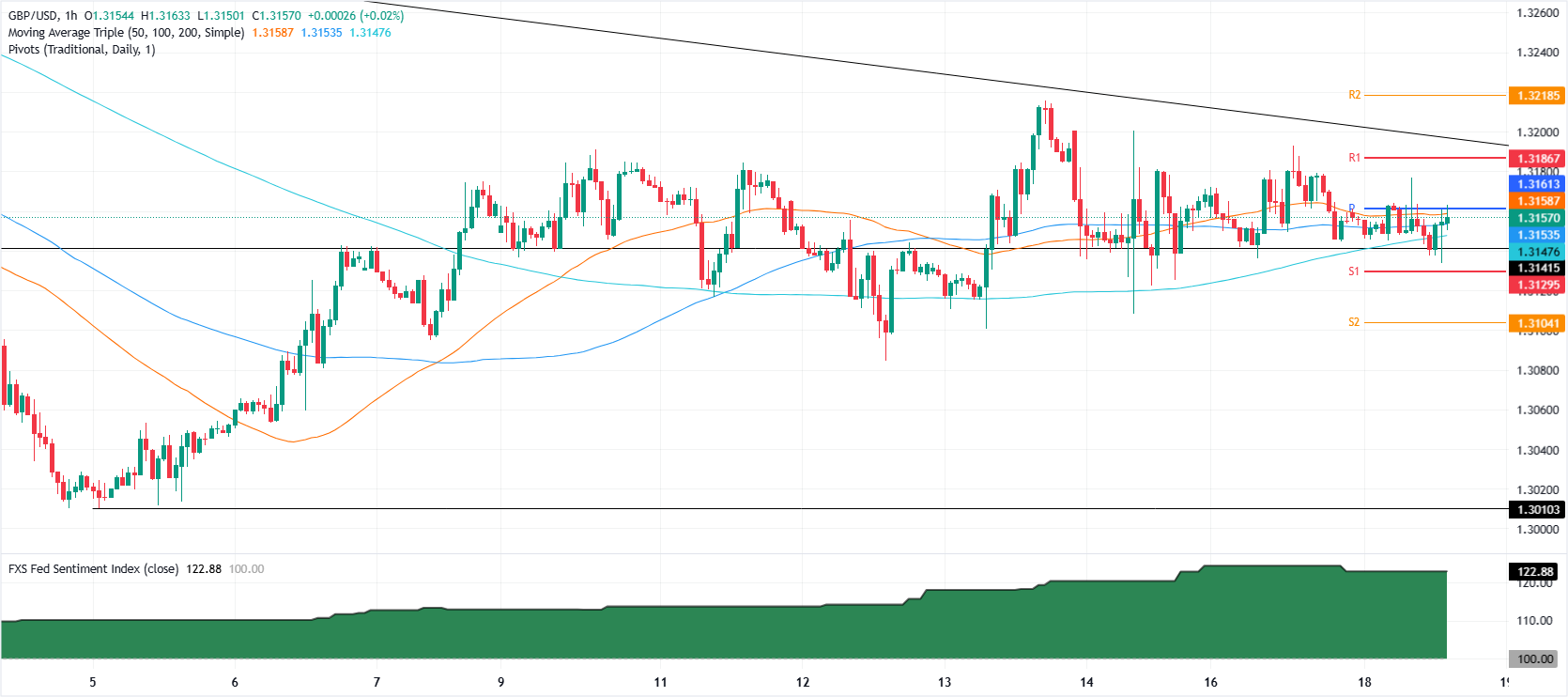
Short-term, the GBP/USD hourly chart shows the pair is subdued, with the 20-, 50-, 100- and 200-SMAs trapped within the 1.3141-1.3158 range, an indication of traders' indecision.
Pound Sterling FAQs
The Pound Sterling (GBP) is the oldest currency in the world (886 AD) and the official currency of the United Kingdom. It is the fourth most traded unit for foreign exchange (FX) in the world, accounting for 12% of all transactions, averaging $630 billion a day, according to 2022 data. Its key trading pairs are GBP/USD, also known as ‘Cable’, which accounts for 11% of FX, GBP/JPY, or the ‘Dragon’ as it is known by traders (3%), and EUR/GBP (2%). The Pound Sterling is issued by the Bank of England (BoE).
The single most important factor influencing the value of the Pound Sterling is monetary policy decided by the Bank of England. The BoE bases its decisions on whether it has achieved its primary goal of “price stability” – a steady inflation rate of around 2%. Its primary tool for achieving this is the adjustment of interest rates. When inflation is too high, the BoE will try to rein it in by raising interest rates, making it more expensive for people and businesses to access credit. This is generally positive for GBP, as higher interest rates make the UK a more attractive place for global investors to park their money. When inflation falls too low it is a sign economic growth is slowing. In this scenario, the BoE will consider lowering interest rates to cheapen credit so businesses will borrow more to invest in growth-generating projects.
Data releases gauge the health of the economy and can impact the value of the Pound Sterling. Indicators such as GDP, Manufacturing and Services PMIs, and employment can all influence the direction of the GBP. A strong economy is good for Sterling. Not only does it attract more foreign investment but it may encourage the BoE to put up interest rates, which will directly strengthen GBP. Otherwise, if economic data is weak, the Pound Sterling is likely to fall.
Another significant data release for the Pound Sterling is the Trade Balance. This indicator measures the difference between what a country earns from its exports and what it spends on imports over a given period. If a country produces highly sought-after exports, its currency will benefit purely from the extra demand created from foreign buyers seeking to purchase these goods. Therefore, a positive net Trade Balance strengthens a currency and vice versa for a negative balance.
Author

Christian Borjon Valencia
FXStreet
Markets analyst, news editor, and trading instructor with over 14 years of experience across FX, commodities, US equity indices, and global macro markets.














