|

GBP/USD falls to new four-day lows on a soft US jobs report as the US Dollar climbs

  • GBP/USD tumbled on an initial reaction to the headline.
  • US Nonfarm Payrolls for March came below estimates, but the US Dollar rallied.
  • Average Hourly Earnings came a tick lower, while the Unemployment Rate was unchanged.

GBP/USD tumbles on a worse-than-expected US Nonfarm Payrolls report, with the US economy adding fewer jobs than analysts’ consensus. However, the initial reaction favored the US Dollar (USD). At the time of writing, the GBP/USD trades volatile around the 1.2450-1.2370 range, below its opening price.

US Nonfarm Payrolls below estimates, but the greenback rises

Delving into March’s Nonfarm Payrolls data, the US Bureau of Labor Statistics (BLS) revealed the creation of fewer than 240K employments estimated, increased by 236, and trailed February’s 311K. Average Hourly Earnings, estimated at 4.3%, came at 4.2%, and the Unemployment Rate was at 3.5%YoY, below the expected 3.6%.

GBP/USD 1-Hour Chart Reaction
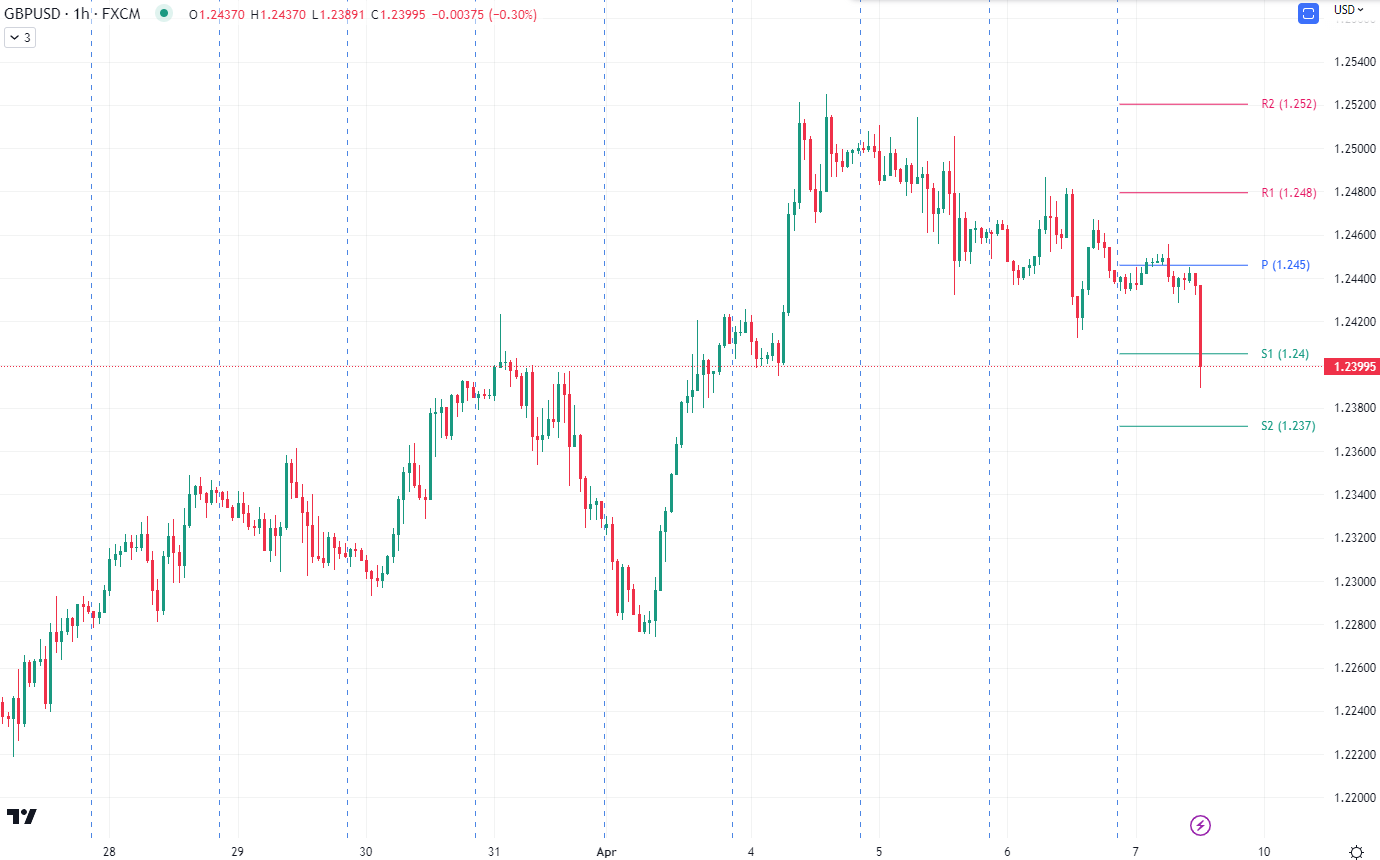
GBP/USD Hourly chart

The GBP/USD printed a new four-day low, at 1.2389, in a perception that the report was soft, but not as probably estimated to be a scenario that could weaken the USD. The GBP/USD tumbled below the S1 daily pivot, at 1.2405, with traders eyeing the S2 daily pivot at 1.2370.

GBP/USD

Overview
Today last price1.2429
Today Daily Change-0.0011
Today Daily Change %-0.09
Today daily open1.244
 
Trends
Daily SMA201.2274
Daily SMA501.2155
Daily SMA1001.2154
Daily SMA2001.1901
 
Levels
Previous Daily High1.2487
Previous Daily Low1.2413
Previous Weekly High1.2424
Previous Weekly Low1.2219
Previous Monthly High1.2424
Previous Monthly Low1.1803
Daily Fibonacci 38.2%1.2441
Daily Fibonacci 61.8%1.2459
Daily Pivot Point S11.2406
Daily Pivot Point S21.2372
Daily Pivot Point S31.2332
Daily Pivot Point R11.248
Daily Pivot Point R21.2521
Daily Pivot Point R31.2554

Author

Christian Borjon Valencia

Markets analyst, news editor, and trading instructor with over 14 years of experience across FX, commodities, US equity indices, and global macro markets.


More from Christian Borjon Valencia
Share:

Editor's Picks

AUD/USD bounces off multi-month low, nears 0.6900

AUD/USD edges higher toward 0.6900 in the Asian session on Wednesday, recovering some of the previous day’s losses to its lowest level since March as the US Dollar stalls the hot US CPI-inspired rally amid hopes of a US-Iran peace deal. Meanwhile, hawkish comments from FOMC members have almost confirmed another December rate hike, which favors USD bulls and should cap the Aussie.

USD/JPY remains capped below 159.00 amid looming intervention risks

USD/JPY struggles to build on the previous day’s strong gains to a near one-month top as intervention risk supports the Japanese Yen while hopes of a US-Iran peace deal cap the safe-haven US Dollar. That keeps the pair's upside limited below 159.00, for now.

Gold struggles near $4,050 as Fed rate-hike bets intensify

Gold (XAU/USD) trades with modest gains on Wednesday after falling 2.67% the previous day, in the aftermath of hotter-than-expected US consumer inflation data and hawkish remarks from Federal Reserve (Fed) officials that fueled expectations of a more aggressive interest rate-hike path.

Crypto Today: Bitcoin, Ethereum and XRP struggle to find footing amid spot ETF outflows

Cryptocurrency prices are broadly consolidating near key lower support levels on Wednesday, led by Bitcoin, hovering around $74,000. Ethereum sits above $2,000 while its upside remains structurally capped. Ripple, meanwhile, holds delicately above $1.00.

Ten questions for China in 2027

2026 has been a year of slowing growth and increasing divergence within China's economy. We saw the gap between external and domestic demand, as well as between the new economy and the old economy, widen significantly. Here, we look ahead to the key questions facing China in 2027.

What the US CPI headline doesn’t tell you about inflation

Brent crude has fallen about a third since mid-October on hopes the Iran war is ending, but diesel, freight and fertiliser costs haven't followed. Those costs reach US consumer prices in stages through 2027 and could keep inflation high after gasoline gets cheaper.