GBP/JPY Price Forecast: Bulls eye 211.10 as bearish trend persists
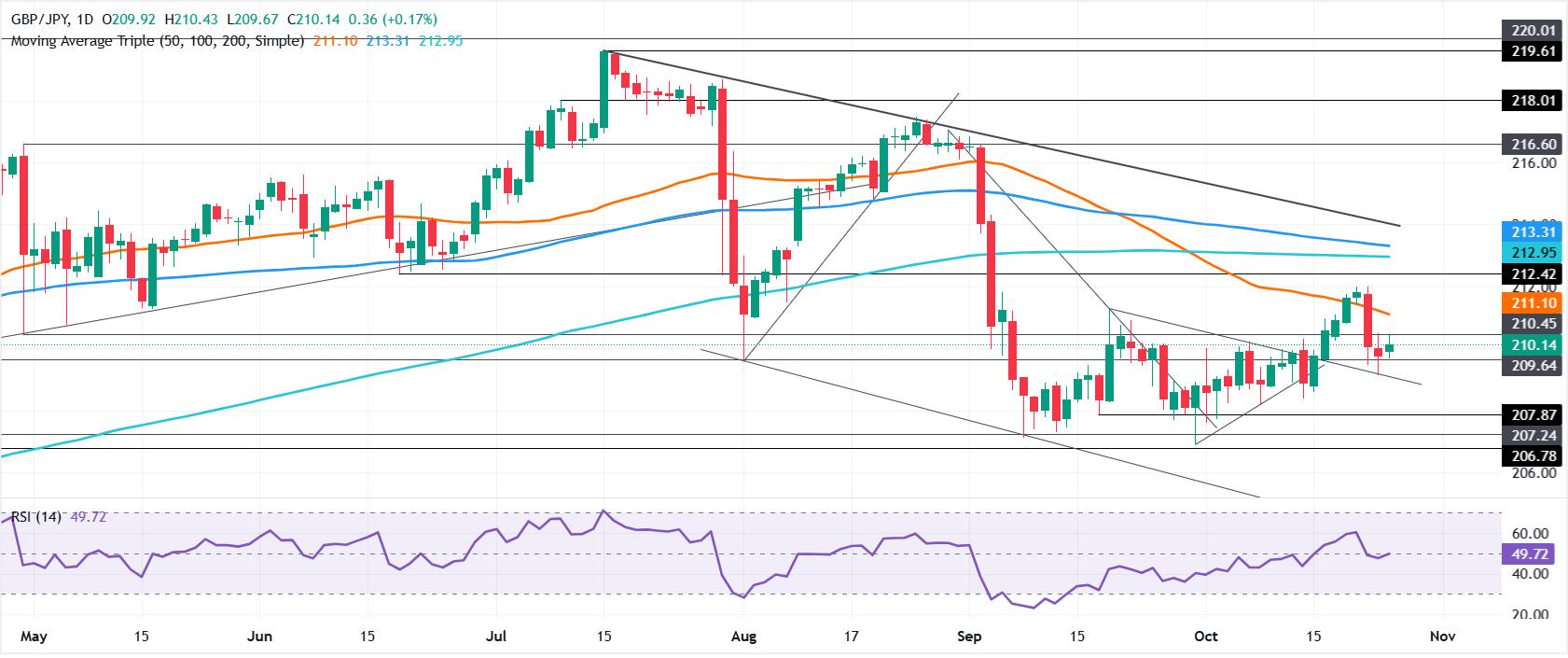
- GBP/JPY recovers from 209.13 as buyers defend former trendline resistance.
- RSI approaches bullish territory, signaling strengthening short-term buying momentum.
- A break above 211.10 exposes 212.00 and 200-day SMA at 212.95.

GBP/JPY rises over 0.20% on Monday as market sentiment is positive amid a potential de-escalation of the Middle East conflict and US equity markets trading in the green, with Anthropic, an AI company, filing for an IPO. The cross-pair trades above 210.00, after testing six-day lows of 209.13.
GBP/JPY Price Forecast: Technical outlook
The cross-pair remains downward-biased even though it cleared a downslope resistance trendline in mid-October, pushing GBP/JPY to a one-month high of 211.99 before retracing to current levels near the psychological 210.00 mark.
The market structure of lower highs and lower lows remains intact unless buyers push GBP/JPY back above the August 25 high of 217.48.
Momentum suggests further upside, as the Relative Strength Index (RSI) is trending higher and is about to turn bullish.
If GBP/JPY rises above 211.00, a move to the 50-day Simple Moving Average (SMA) at 211.10 is on the cards. Above, the next stop is 212.00, followed by the 200-day SMA at 212.95.
On the flip side, if GBP/JPY drops below the October 23 low of 209.13, this opens the path to challenge 209.00. Once cleared, the next support is a resistance-turned-support trendline at 209.00, ahead of a potential extension of losses to the September 30 low of 206.89.
GBP/JPY Price Chart – Daily
Pound Sterling FAQs
The Pound Sterling (GBP) is the oldest currency in the world (886 AD) and the official currency of the United Kingdom. It is the fourth most traded unit for foreign exchange (FX) in the world, accounting for 12% of all transactions, averaging $630 billion a day, according to 2022 data. Its key trading pairs are GBP/USD, also known as ‘Cable’, which accounts for 11% of FX, GBP/JPY, or the ‘Dragon’ as it is known by traders (3%), and EUR/GBP (2%). The Pound Sterling is issued by the Bank of England (BoE).
The single most important factor influencing the value of the Pound Sterling is monetary policy decided by the Bank of England. The BoE bases its decisions on whether it has achieved its primary goal of “price stability” – a steady inflation rate of around 2%. Its primary tool for achieving this is the adjustment of interest rates. When inflation is too high, the BoE will try to rein it in by raising interest rates, making it more expensive for people and businesses to access credit. This is generally positive for GBP, as higher interest rates make the UK a more attractive place for global investors to park their money. When inflation falls too low it is a sign economic growth is slowing. In this scenario, the BoE will consider lowering interest rates to cheapen credit so businesses will borrow more to invest in growth-generating projects.
Data releases gauge the health of the economy and can impact the value of the Pound Sterling. Indicators such as GDP, Manufacturing and Services PMIs, and employment can all influence the direction of the GBP. A strong economy is good for Sterling. Not only does it attract more foreign investment but it may encourage the BoE to put up interest rates, which will directly strengthen GBP. Otherwise, if economic data is weak, the Pound Sterling is likely to fall.
Another significant data release for the Pound Sterling is the Trade Balance. This indicator measures the difference between what a country earns from its exports and what it spends on imports over a given period. If a country produces highly sought-after exports, its currency will benefit purely from the extra demand created from foreign buyers seeking to purchase these goods. Therefore, a positive net Trade Balance strengthens a currency and vice versa for a negative balance.
Author

Christian Borjon Valencia
FXStreet
Markets analyst, news editor, and trading instructor with over 14 years of experience across FX, commodities, US equity indices, and global macro markets.