Euro recovers early losses against Canadian Dollar, BoC policy eyed
- The Euro turns positive after recovering early losses against the Canadian Dollar.
- Signs of easing fears of a prolonged US-Iran war have strengthened the Euro.
- Investors await BoC’s monetary policy announcement scheduled for Wednesday.

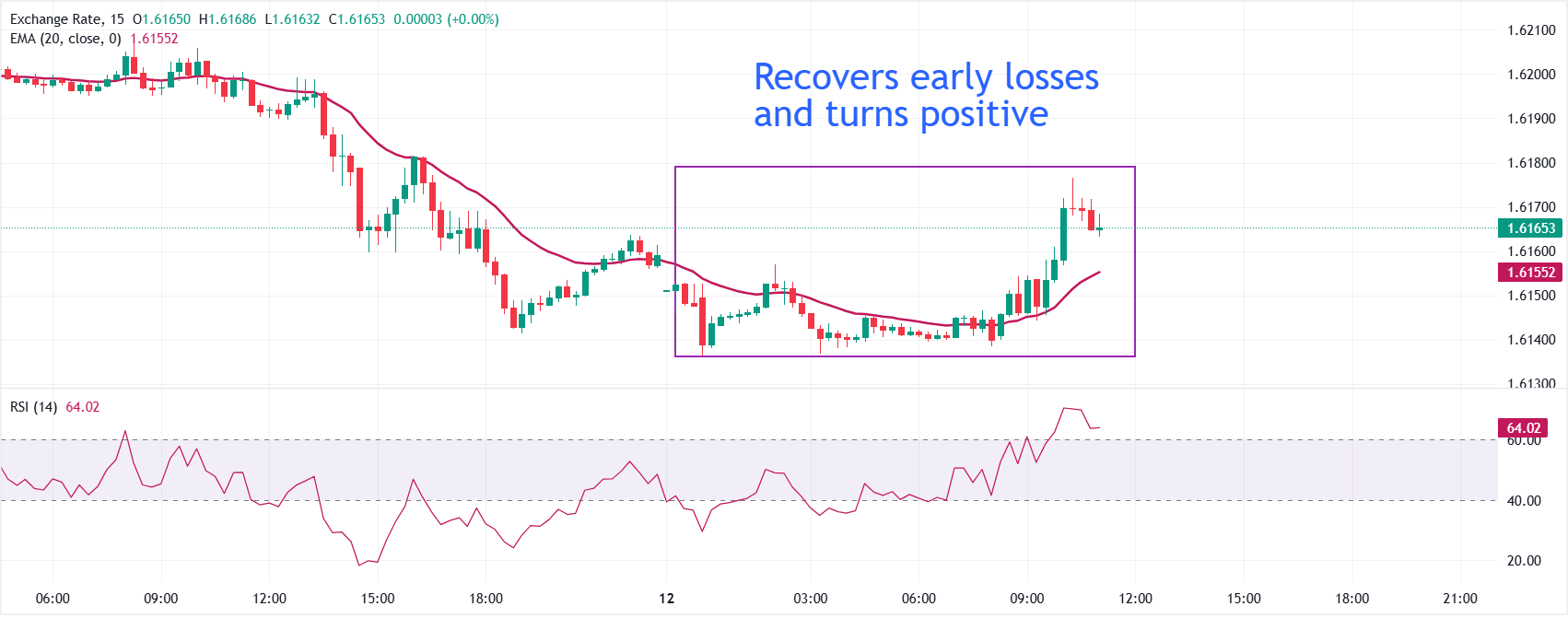
The Euro (EUR) claws back its early losses and turns slightly positive at around 1.6170 against the Canadian Dollar (CAD) during the European trading session on Monday. The cross bounces back as the Euro strengthens amid hopes that the ongoing aggression in the Middle East won’t be prolonged.
A spokesperson from the Iranian Foreign Ministry has confirmed that efforts from Qatar, Oman, and Pakistan to mediate tensions with the United States (US) continue.
The impact of easing fears of a prolonged US-Iran war is also visible on oil prices and the US Dollar. At press time, the WTI Oil price trades 2.13% higher to near $73 but has given back a majority of its gains after surging to near $75.00. The US Dollar Index (DXY), which gauges the Greenback’s value against six major currencies, turns upside down to near 100.80.
The Canadian Dollar has also given back a majority of its early gains, with oil prices easing significant gains.
Going forward, investors will focus on the Bank of Canada’s (BoC) monetary policy announcement on Wednesday, in which the central bank is expected to leave interest rates unchanged at 2.25%. Investors will pay close attention to comments regarding inflation and the economic outlook.
In the Eurozone, investors await fresh cues regarding whether the European Central Bank (ECB) will deliver one more interest rate hike this year.
Economic Indicator
BoC Interest Rate Decision
The Bank of Canada (BoC) announces its interest rate decision at the end of its eight scheduled meetings per year. If the BoC believes inflation will be above target (hawkish), it will raise interest rates in order to bring it down. This is bullish for the CAD since higher interest rates attract greater inflows of foreign capital. Likewise, if the BoC sees inflation falling below target (dovish) it will lower interest rates in order to give the Canadian economy a boost in the hope inflation will rise back up. This is bearish for CAD since it detracts from foreign capital flowing into the country.
Read more.Next release: Wed Jul 15, 2026 13:45
Frequency: Irregular
Consensus: 2.25%
Previous: 2.25%
Source: Bank of Canada
Author

Sagar Dua
FXStreet
Sagar Dua is associated with the financial markets from his college days. Along with pursuing post-graduation in Commerce in 2014, he started his markets training with chart analysis.
















