Euro edges down, while US NFP takes centre stage
- The Euro trades slightly lower at around 1.1545 against the US Dollar.
- Investors keenly await the US NFP data for July.
- Weak US ADP Employment Change data has set a negative tone for the US NFP data.

The Euro (EUR) trades marginally lower at around 1.1545 against the US Dollar (USD) during the European trading session on Friday. The major currency pair edges down as the US Dollar ticks up, while investors shift their focus to the United States (US) Nonfarm Payrolls (NFP) data release on Friday.
At press time, the US Dollar Index (DXY), which gauges the Greenback’s value against six major currencies, trades marginally higher to near 99.73. However, it is still close to its two-day low of 99.63.
Investors will closely track the US NFP data as it will influence market expectations for the Federal Reserve’s (Fed) monetary policy outlook.
The US NFP report is expected to show that the economy created 80K fresh jobs in July, higher than 57K in June. The Unemployment Rate is seen remaining steady at 4.2%. Average Hourly Earnings, a key measure of wage growth, are expected to have grown steadily at 0.3% and 3.5%, monthly and yearly, respectively.
Though estimates from the FXStreet economic calendar indicate stronger NFP figures than previous ones, weaker-than-expected ADP Employment Change data for July has established a cautious backdrop for official employment.
On Wednesday, ADP reported that the private sector hired 44K new workers, lower than estimates of 70K and the prior release of 98K.
Meanwhile, the Euro trades broadly calm as investors seek fresh cues regarding the European Central Bank’s (ECB) monetary policy outlook.
EUR/USD technical analysis
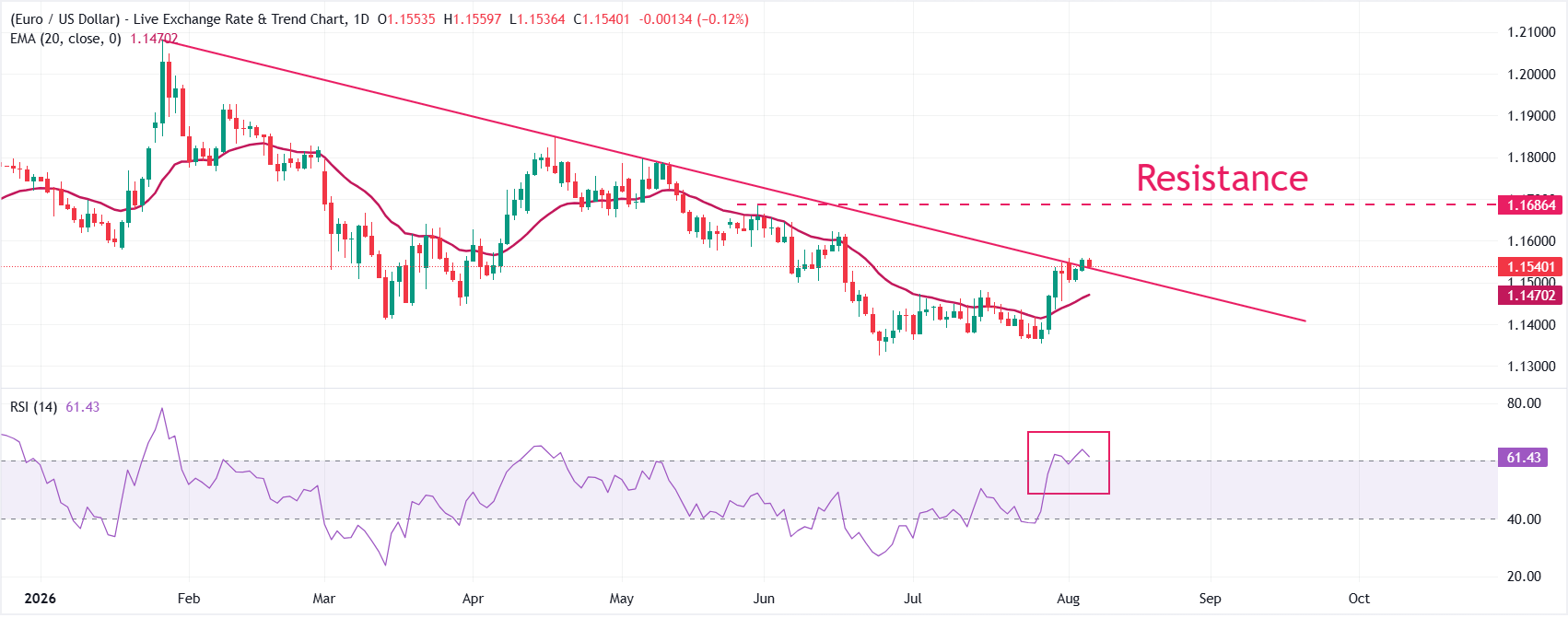
In the daily chart, EUR/USD trades at 1.1540. The pair is holding above the 20-day exponential moving average (EMA) at 1.1470, but wobbles near the downtrend resistance line at around 1.1537, which together suggests a bullish near-term bias. The Relative Strength Index (14) at 61.37 stays in positive territory but below overbought conditions, hinting that upside momentum remains constructive without yet looking stretched.
On the downside, initial support is seen at the 20-day EMA at 1.1470. Looking up, the pair might attempt to extend the advance towards the May 29 high at 1.1686 if it manages to stabilize above the downward-sloping trendline at around 1.1537.
(The technical analysis of this story was written with the help of an AI tool. Know more.)
Economic Indicator
ADP Employment Change
The ADP Employment Change is a gauge of employment in the private sector released by the largest payroll processor in the US, Automatic Data Processing Inc. It measures the change in the number of people privately employed in the US. Generally speaking, a rise in the indicator has positive implications for consumer spending and is stimulative of economic growth. So a high reading is traditionally seen as bullish for the US Dollar (USD), while a low reading is seen as bearish.
Read more.Next release: Wed Sep 02, 2026 12:15
Frequency: Monthly
Consensus: -
Previous: 44K
Source: ADP Research Institute
Traders often consider employment figures from ADP, America’s largest payrolls provider, report as the harbinger of the Bureau of Labor Statistics release on Nonfarm Payrolls (usually published two days later), because of the correlation between the two. The overlaying of both series is quite high, but on individual months, the discrepancy can be substantial. Another reason FX traders follow this report is the same as with the NFP – a persistent vigorous growth in employment figures increases inflationary pressures, and with it, the likelihood that the Fed will raise interest rates. Actual figures beating consensus tend to be USD bullish.
Author

Sagar Dua
FXStreet
Sagar Dua is associated with the financial markets from his college days. Along with pursuing post-graduation in Commerce in 2014, he started his markets training with chart analysis.