Gold extends recovery amid post-election volatility, US jobs data in focus
- Gold builds on Wednesday's sharp rally as traders assess the implications of a Democratic-controlled Congress.
- Hawkish Fed expectations remain a key headwind for the non-yielding metal.
- XAU/USD shows improving bullish momentum, with the 21-day SMA offering immediate support.

Gold (XAU/USD) extends gains on Thursday, moving further away from the year-to-date low of $3,870 touched last week. The metal attracts buyers as the US midterm election results fuel volatility across financial markets. At the time of writing, XAU/USD trades around $4,130, near two-week highs.
The precious metal surged 3.64% on Wednesday, while West Texas Intermediate (WTI) tumbled 8% as traders speculated that a Democratic sweep of Congress could restrict funding for Trump’s military campaign against Iran and increase pressure to end the war, now in its ninth month.
Moreover, the prospect of divided government eases concerns about the fiscal outlook, as passing new tax cuts or spending packages could become more difficult. This supports Treasury buying and pushes yields lower, weighing on the US Dollar (USD). The slide in Oil prices also offers some relief from inflation concerns, and together these developments drive renewed demand for Gold.
However, selling pressure on the US Dollar, Treasury yields and Oil prices abates on Thursday following the previous day’s rout, which should keep further upside in Gold in check.
In the meantime, a hawkish Federal Reserve (Fed) outlook remains a key hurdle for bullion. Oil prices are still well above pre-war levels, keeping inflation risks alive. With the Fed committed to bringing inflation back to its 2% target, traders expect interest rates to remain elevated for longer and anticipate a December rate hike, with the CME FedWatch Tool putting the odds at around 79%.
Higher borrowing costs weigh on the non-yielding metal by increasing the opportunity cost of holding it.
Attention now turns to US employment data, which could shape expectations for the Fed’s policy path. Initial Jobless Claims are due later on Thursday, followed by the Nonfarm Payrolls (NFP) report on Friday.
Technical analysis: Bulls eye 50-day and 100-day SMAs near $4,200
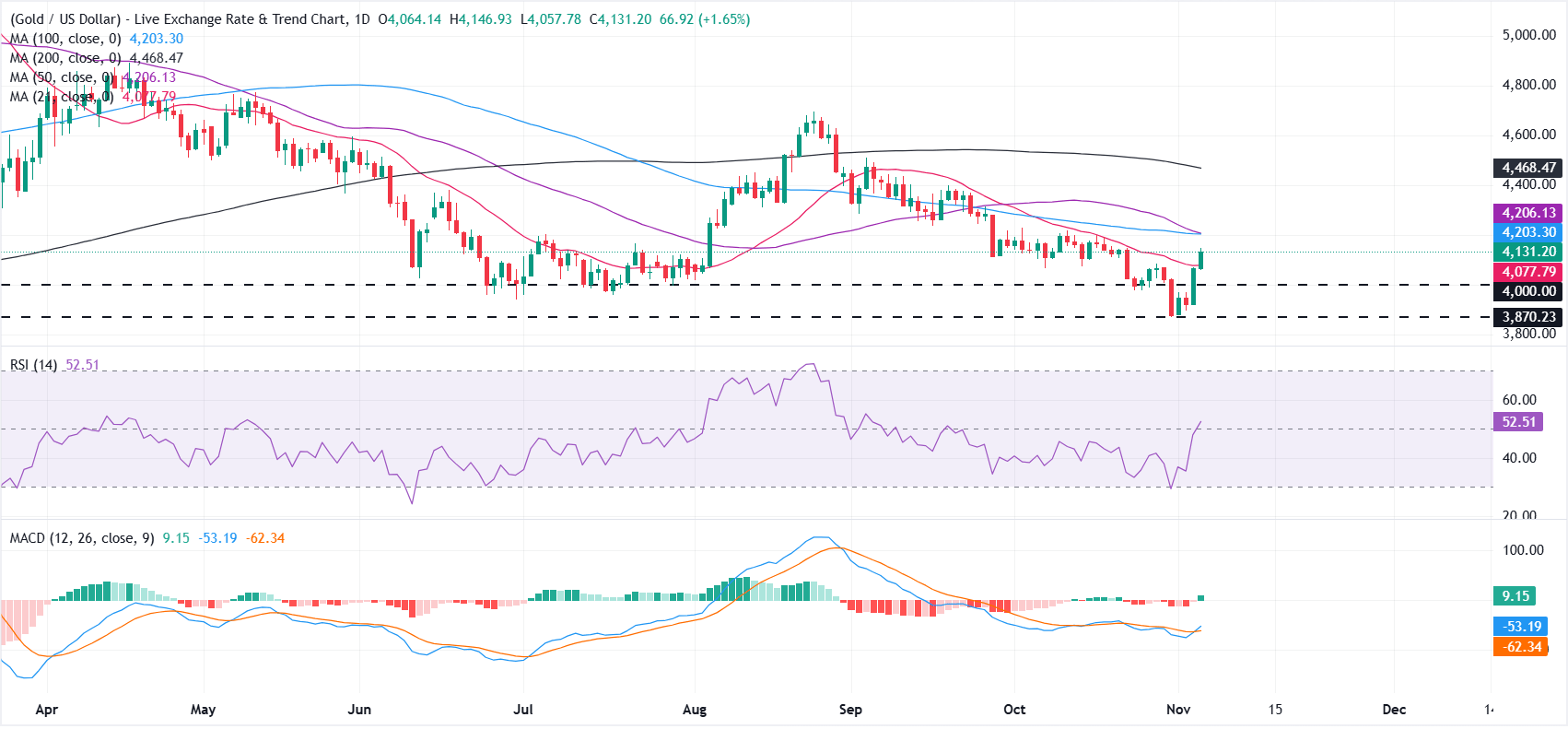
On the daily chart, XAU/USD maintains a capped bias as spot holds below the medium- and long-term moving averages. The 21-day simple moving average (SMA) at $4,077 now underpins the recovery as immediate support, but price remains below the 50-day, 100-day and 200-day SMAs.
Momentum has improved, with the Relative Strength Index near 52 and the Moving Average Convergence Divergence (MACD) turning positive, which hints at rebuilding bullish pressure but does not yet overturn the structurally bearish setup.
On the downside, initial support is seen at the 21-day SMA around $4,077, followed by the psychological $4,000 level and the year-to-date low of $3,870.
On the upside, immediate resistance is seen at the closely aligned 100-day and 50-day SMAs at $4,203 and $4,206, respectively. While a more substantial barrier emerges at the 200-day SMA near $4,468. Only a clear daily close above these clustered moving averages would start to ease the prevailing bearish bias.
(The technical analysis of this story was written with the help of an AI tool. Know more.)
Gold FAQs
Gold has played a key role in human’s history as it has been widely used as a store of value and medium of exchange. Currently, apart from its shine and usage for jewelry, the precious metal is widely seen as a safe-haven asset, meaning that it is considered a good investment during turbulent times. Gold is also widely seen as a hedge against inflation and against depreciating currencies as it doesn’t rely on any specific issuer or government.
Central banks are the biggest Gold holders. In their aim to support their currencies in turbulent times, central banks tend to diversify their reserves and buy Gold to improve the perceived strength of the economy and the currency. High Gold reserves can be a source of trust for a country’s solvency. Central banks added 1,136 tonnes of Gold worth around $70 billion to their reserves in 2022, according to data from the World Gold Council. This is the highest yearly purchase since records began. Central banks from emerging economies such as China, India and Turkey are quickly increasing their Gold reserves.
Gold has an inverse correlation with the US Dollar and US Treasuries, which are both major reserve and safe-haven assets. When the Dollar depreciates, Gold tends to rise, enabling investors and central banks to diversify their assets in turbulent times. Gold is also inversely correlated with risk assets. A rally in the stock market tends to weaken Gold price, while sell-offs in riskier markets tend to favor the precious metal.
The price can move due to a wide range of factors. Geopolitical instability or fears of a deep recession can quickly make Gold price escalate due to its safe-haven status. As a yield-less asset, Gold tends to rise with lower interest rates, while higher cost of money usually weighs down on the yellow metal. Still, most moves depend on how the US Dollar (USD) behaves as the asset is priced in dollars (XAU/USD). A strong Dollar tends to keep the price of Gold controlled, whereas a weaker Dollar is likely to push Gold prices up.
Author

Vishal Chaturvedi
FXStreet
I am a macro-focused research analyst with over four years of experience covering forex and commodities market. I enjoy breaking down complex economic trends and turning them into clear, actionable insights that help traders stay ahead of the curve.