EUR/USD wobbles below 1.0600 on USD strength as traders eye Fed minutes
- US Dollar remains bid even though data showed Manufacturing PMI continues to decelerate.
- The Euro extends its losses spurred by Germany’s inflation edging down.
- The US Dollar Index recovered and reached fresh two-week highs, albeit US Treasury yields dropped.
- EUR/USD Price Analysis: Neutral biased, likely to find direction on fundamental news.

The Euro (EUR) plunges against the US Dollar (USD) during the North American session after hitting a daily high of 1.0683, but it has trimmed some of its earlier losses after reaching a six-week low at around 1.0519. Data released in the United States (US) and the Euro area (EU) showed factory activity weakening on both sides of the pond, though the US Dollar is emerging with the upper hand. Hence, the EUR/USD is trading at 1.0558 below its opening price by 0.99%.
US PMI stayed in recessionary reading, ignored by the USD bulls
Wall Street has extended its losses portraying a dampened sentiment. S&P Global revealed that Manufacturing PMI for December in the US was unchanged at 46.2, remaining in contractionary territory. Although data was negative for the US Dollar, the EUR/USD continued to remain in negative territory.
Siân Jones, Senior Economist at S&P Global Market Intelligence, said, “The manufacturing sector posted a weak performance as 2022 was brought to a close, as output and new orders contracted at sharper rates. Demand for goods dwindled as domestic orders and export sales dropped. Muted demand conditions also led to downward adjustments of stock holdings.”
Germany’s inflation slowed, weakening the Euro
In the Eurozone, its economic calendar witnessed the release of mixed S&P Global Manufacturing PMIs for December, which traders mainly ignored. On Tuesday, inflation in Germany for December, as measured by the Consumer Price Index (CPI), decelerated to 8.6% YoY vs. November’s 10% figure and beneath 9% estimates. Concerning the monthly reading, CPI dropped 0.8%.
Meanwhile, the Harmonised Index of Consumer Prices (HICP), the European Central Bank’s (ECB) preferred gauge of inflation, edged lower to 9.6% YoY, from 11.3%, compared to analysts’ estimate of 10.7%.
US Dollar remains strong, albeit US Treasury yields dropped
Elsewhere, the US Dollar Index (DXY), which measures the US Dollar value against a basket of six currencies, climbs close to 1%, at 104.522, and is weighing on the EUR/USD’s fall. Contrarily, the US 10-year Treasury bond yield remains down in the day, trimming its earlier losses, slightly down four bps, at 3.792%, stalling the US Dollar rally.
Ahead of the week, the US economic calendar will feature the ISM Manufacturing PMI for December alongside the US Federal Reserve (Fed) last meeting minutes. On the EU side, the docket will feature S&P Global Services and Composite PMIs for December.
EUR/USD Technical Analysis
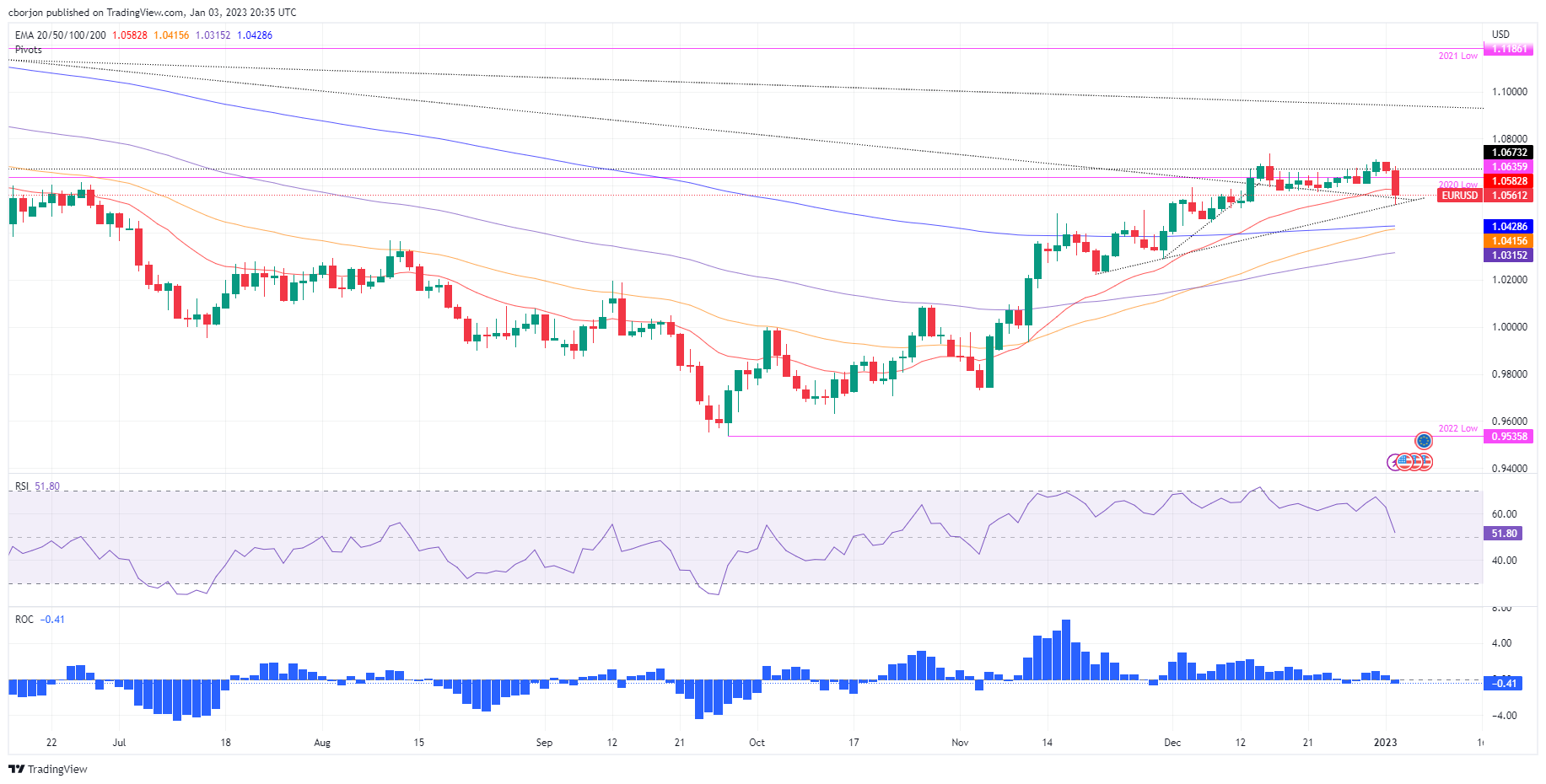
From a daily chart perspective, the EUR/USD pair shifted to a neutral biased after dropping below the 20-day Exponential Moving Average (EMA) at 1.0582. However, the intersection of two trendlines, nearby Tuesday’s daily low of 1.0519, capped the Euro’s fall, which recovered to the 1.0550s area. Nevertheless, surpassing the 20-day EMA would be difficult, and with fundamental news lurking on Wednesday’s docket, the EUR/USD might seesaw in the near term.
The EUR/USD key resistance levels are 1.0600, followed by the 2020 yearly low of 1.0636 and 1.0700. On the flip side, the EUR/USD first support would be 1.0519, followed by the 1.0500 mark. Break below will expose the 200-day EMA at 1.0428.
Author

Christian Borjon Valencia
FXStreet
Markets analyst, news editor, and trading instructor with over 14 years of experience across FX, commodities, US equity indices, and global macro markets.