|

EUR/USD Price Analysis: Retraces the recent gains near 1.0550 ahead of ZEW Survey

  • EUR/USD trades lower ahead of the ZEW Economic Sentiment Survey.
  • MACD indicated a shift in momentum towards a bullish trend.
  • 21-day EMA appears as the barrier, followed by the 1.0600 psychological level.

EUR/USD pulls back from the recent gains, trading lower around 1.0550 psychological level during the Asian session on Tuesday. Investors anticipate the release of the ZEW Economic Sentiment Survey for October, with expectations pointing toward an improvement from -8.9 to -8.0.

Additionally, the European Central Bank (ECB) President Christine Lagarde has informed euro-area finance ministers that the ECB is closely monitoring energy prices and the conflict between Israel and Hamas as potential sources of inflation risks.

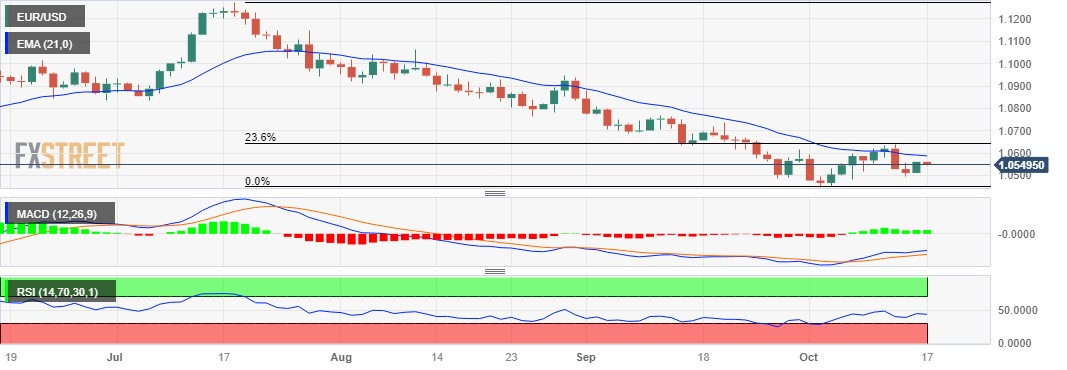
The 21-day Exponential Moving Average (EMA) at 1.0587 emerges as the immediate resistance. A break above the latter could support the EUR/USD pair to explore the region near the 1.0600 major level, followed by the 23.6% Fibonacci retracement at the 1.0643 level.

On the flip side, the weekly low at 1.0508 could act as immediate support lined up with the 1.0500 psychological level.

The Moving Average Convergence Divergence (MACD) line lies below the centerline indicating that the short-term average is beneath the long-term average. However, a noteworthy development is observed as the line diverges above the signal line, signaling a potential shift in momentum toward a bullish trend.

However, the EUR/USD pair maintains a prevailing bearish momentum, underscoring a weaker bias. This is evidenced by the 14-day Relative Strength Index (RSI) holding below the 50 level.

EUR/USD: Daily Chart
EUR/USD: additional important levels

Overview
Today last price1.055
Today Daily Change-0.0011
Today Daily Change %-0.10
Today daily open1.0561
 
Trends
Daily SMA201.0571
Daily SMA501.0721
Daily SMA1001.0832
Daily SMA2001.0824
 
Levels
Previous Daily High1.0563
Previous Daily Low1.0511
Previous Weekly High1.064
Previous Weekly Low1.0496
Previous Monthly High1.0882
Previous Monthly Low1.0488
Daily Fibonacci 38.2%1.0543
Daily Fibonacci 61.8%1.0531
Daily Pivot Point S11.0527
Daily Pivot Point S21.0493
Daily Pivot Point S31.0475
Daily Pivot Point R11.0579
Daily Pivot Point R21.0597
Daily Pivot Point R31.063

Author

Akhtar Faruqui

Akhtar Faruqui is a Forex Analyst based in New Delhi, India. With a keen eye for market trends and a passion for dissecting complex financial dynamics, he is dedicated to delivering accurate and insightful Forex news and analysis.


More from Akhtar Faruqui
Share:

Editor's Picks

AUD/USD bulls regain control above 0.6950 amid USD retreat

AUD/USD regains traction and extends the previous day's bounce from the weekly low, aiming for 0.7000 in Asia on Friday. The overnight pullback in US bond yields keeps the US Dollar below an 18-month high, which in turn offers some support to the pair. Meanwhile, hawkish RBA expectations also keep the major underpinned.

USD/JPY holds gains near 158.00 after Japan's weak Household Spending data

USD/JPY clings to gains around 158.00 after data showed on Friday that Japan's Household Spending fell for the ninth straight month, undermining the Japanese Yen. Meanwhile, the US Dollar remains depressed as the overnight fall in US bond yields counters a hawkish Fed and geopolitical uncertainties, could cap any downside in the pair.

Gold remains range-bound below $4,200

Gold has given up some ground after an initial bullish attempt to reach weekly highs, returning to below the $4,200 mark per troy ounce on Friday. The US Dollar’s strong upside momentum, combined with rising US Treasury yields across the curve, seems to keep further gains in the yellow metal under scrutiny.

Has Bitcoin really escaped the macro forces it was built to fight?
Over 17 years ago, Satoshi Nakamoto designed Bitcoin (BTC) on the back of a global financial crisis as an alternative to the global monetary system outside the control of central banks, governments and traditional intermediaries. This raises a key question: has Bitcoin really become independent of the macroeconomic forces it was built to challenge?
The Euro is not the sick man of Europe. France's bond market is
EUR/USD remains under pressure, near the 17-month low of 1.1161 reached on Monday. The pair has lost more than 7% since its yearly peak, as concerns over France's public finances increasingly weigh on the single currency. But behind the weakness of the Euro (EUR), the problem does not necessarily lie with the European economy as a whole.
Has Bitcoin really escaped the macro forces it was built to fight?
Over 17 years ago, Satoshi Nakamoto designed Bitcoin (BTC) on the back of a global financial crisis as an alternative to the global monetary system outside the control of central banks, governments and traditional intermediaries. This raises a key question: has Bitcoin really become independent of the macroeconomic forces it was built to challenge?














