|

EUR/USD Price Analysis: Edges toward 1.0830 as bullish momentum builds post-Europe

  • EUR/USD was seen trading near the 1.0830 zone on Friday after the European session, moving closer to the top of its daily range.
  • Despite mixed oscillator signals, short- and long-term moving averages support the pair’s ongoing bullish momentum.
  • Support is seen around 1.0790–1.0810, while resistance stands near 1.0845; MACD flashes a sell, but trend bias remains bullish.

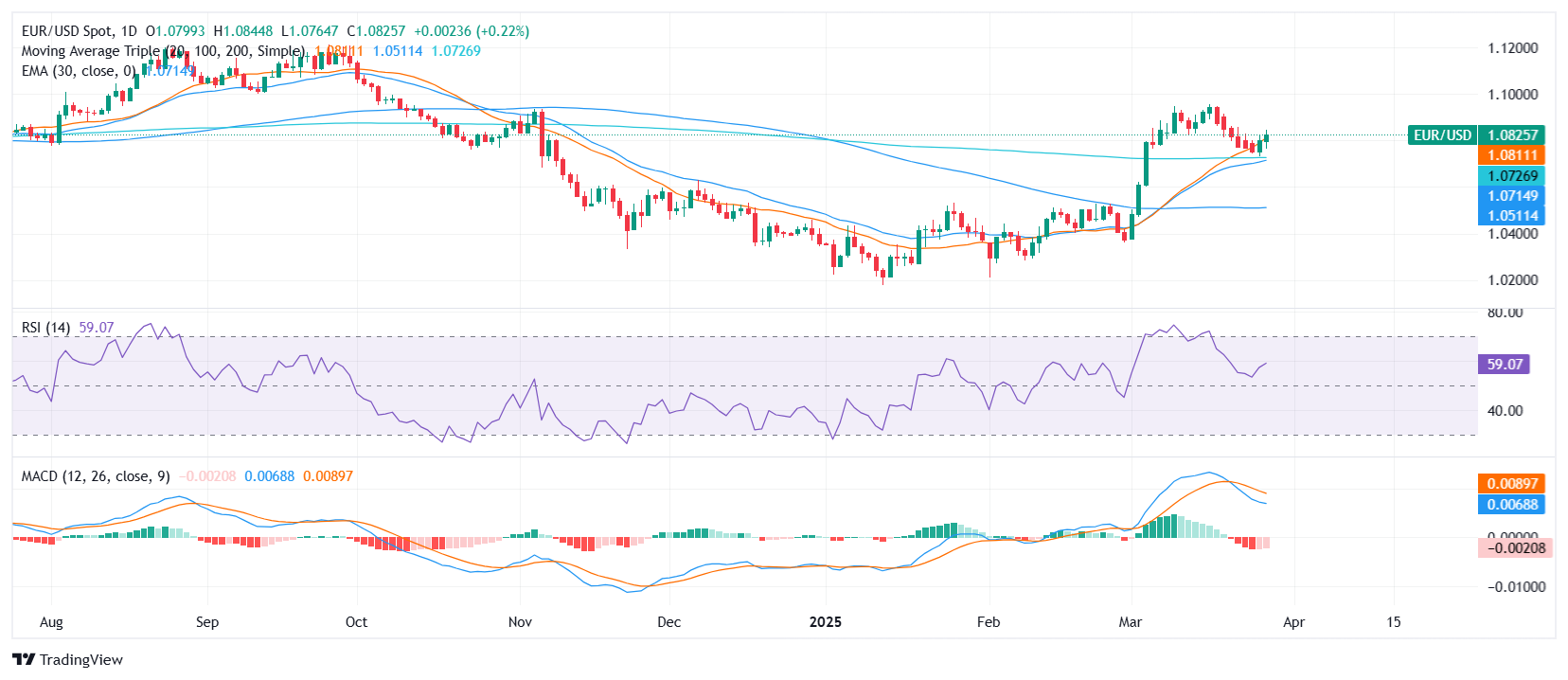
EUR/USD extended its upward trajectory on Friday, moving near the 1.0830 region after the European session and toward the upper end of the day’s trading range. The pair has gained traction, reflecting investor appetite for the euro despite mixed short-term signals. Technicals reveal an ongoing bullish backdrop, underpinned by supportive moving averages, though caution remains as oscillators flash neutral-to-negative cues.

Momentum indicators are mixed. The short-term Relative Strength Index is neutral at 5.91, and when combined with the Stochastic indicator, it confirms a lack of clear directional drive. The Moving Average Convergence Divergence (MACD) flashes a sell signal, while the longer-term RSI (14) sits at around 57. The Bull Bear Power also remains marginally negative, suggesting slight hesitation despite recent gains.

However, the moving averages paint a more optimistic picture. The 20-day Simple Moving Average (SMA) at 1.0791, the 100-day at 1.0518, and the 200-day at 1.0729 all signal buy conditions, reinforcing the prevailing bullish structure. Additional support from the 30-day Exponential Moving Average (1.0709) and SMA (1.0682) further strengthens this view.

On the downside, support levels are located at 1.0810, 1.0791, and 1.0785. Resistance is found near 1.0845, a key area that, if breached, could open the door for an extended move higher. While bullish conditions persist, traders may need to navigate choppy signals from oscillators as the pair consolidates gains.

EUR/USD daily chart
Author

Patricio Martín

Patricio is an economist from Argentina passionate about global finance and understanding the daily movements of the markets.


More from Patricio Martín
Share:

Editor's Picks

GBP/USD: Gains remain capped below 1.3200 ahead of US PCE

GBP/USD clings to minor recovery gains, but remains below 1.3200 in the European session on Thursday. However, the potential upside for the pair appear limited amid UK political instability and rising expectations of US interest rate hikes this year. Traders await the US May PCE inflation data on Thursday for a clear direction.

EUR/USD defends 1.1350 as eyes turn to US PCE inflation

EUR/USD trades better bid above 1.1350 in European trading on Thursday. A pause in the US Dollar rally is helping the pair stay afloat. Markets look to the key US Personal Consumption Expenditures report for fresh trading impetus.

Gold consolidates around $4,000 ahead of US PCE data

Gold enters a bearish consolidation phase during the first half of the European session, and currently trades around the $4,000 psychological mark. The commodity sticks to its bearish bias for the third straight day, and remains close to the lowest level since November 2025, touched on Wednesday, as traders await the crucial US inflation data.

Bitcoin tests $60,000 as whales sell off – Aave and Jupiter show resilience

The broader cryptocurrency market remains under intense selling pressure, with Bitcoin back at $60,000 for the third time this year. On-chain data shows selling pressure from large-wallet investors, commonly referred to as whales, while total liquidations hit nearly $1 billion in 24 hours.

Bitcoin nears make-or-break level ahead of US PCE data

Bitcoin recovers slightly, trading at $61,700 after reaching a new yearly low of $59,103 and a 21-month low the previous day. This bearish price action is supported by the ongoing institutional sell-off, which recorded an outflow of over $469 million on Wednesday.

Regime change: Inside Kevin Warsh's first move to make the Fed unreadable on purpose

The rate did not move. That was the least interesting thing about Kevin Warsh's first meeting in charge of the Fed. The FOMC held its benchmark at 3.50%-3.75% for the fourth straight meeting, exactly as priced, and then the new chair used his first press conference to dismantle the machinery the market has leaned on for a decade.