Euro steadies at five-week highs near 1.1700 amid market optimism
- EUR/USD extends its recovery from the 1.1500 area to levels near 1.1700.
- A two-week ceasefire in Iran boosted risk appetite and sent the US Dollar tumbling on Wednesday.
- Later in the day, the focus will shift to the minutes of the latest Fed meeting.

The announcement of a two-week ceasefire in Iran triggered a relief rally during Wednesday’s Asian trading session, sending the safe-haven US Dollar (USD) tumbling against its main peers. The EUR/USD pair extended its rally from 1.1500 and has remained steady around the 1.1700 area during most of the European trading session.
Investors have celebrated a last-minute agreement between Washington and Tehran to cease the hostilities for two weeks and temporarily reopen the Strait of Hormuz. US President Donald Trump had threatened to kill an entire civilisation if the authorities of the Islamic Republic failed to open the critical gateway before Tuesday at 8 PM Easter Time (00:00 GMT on Wednesday).
On the macroeconomic front, German Factory Orders bounced up 0.9% in February, following a 11.1% decline in January, but short of the market expectations of a 2% increase. Somewhat later, producer prices contracted, and Retail Sales dropped in line with the market consensus. These, however, are figures predating the Iran war, and their relevance right now is minimal.
In the US, the main focus will be on the minutes of the Federal Reserve (Fed) March meeting and speeches by Fed officials Mary Daly and Christopher Waller, which might contribute to shedding some light on the path of the central bank’s monetary policy. These comments, however, will be contrasted by Friday's Consumer Prices Index (CPI) release, which will reflect the inflationary impact of Iran's war.
Technical Analysis: Bulls aiming for 1.1700 and higher
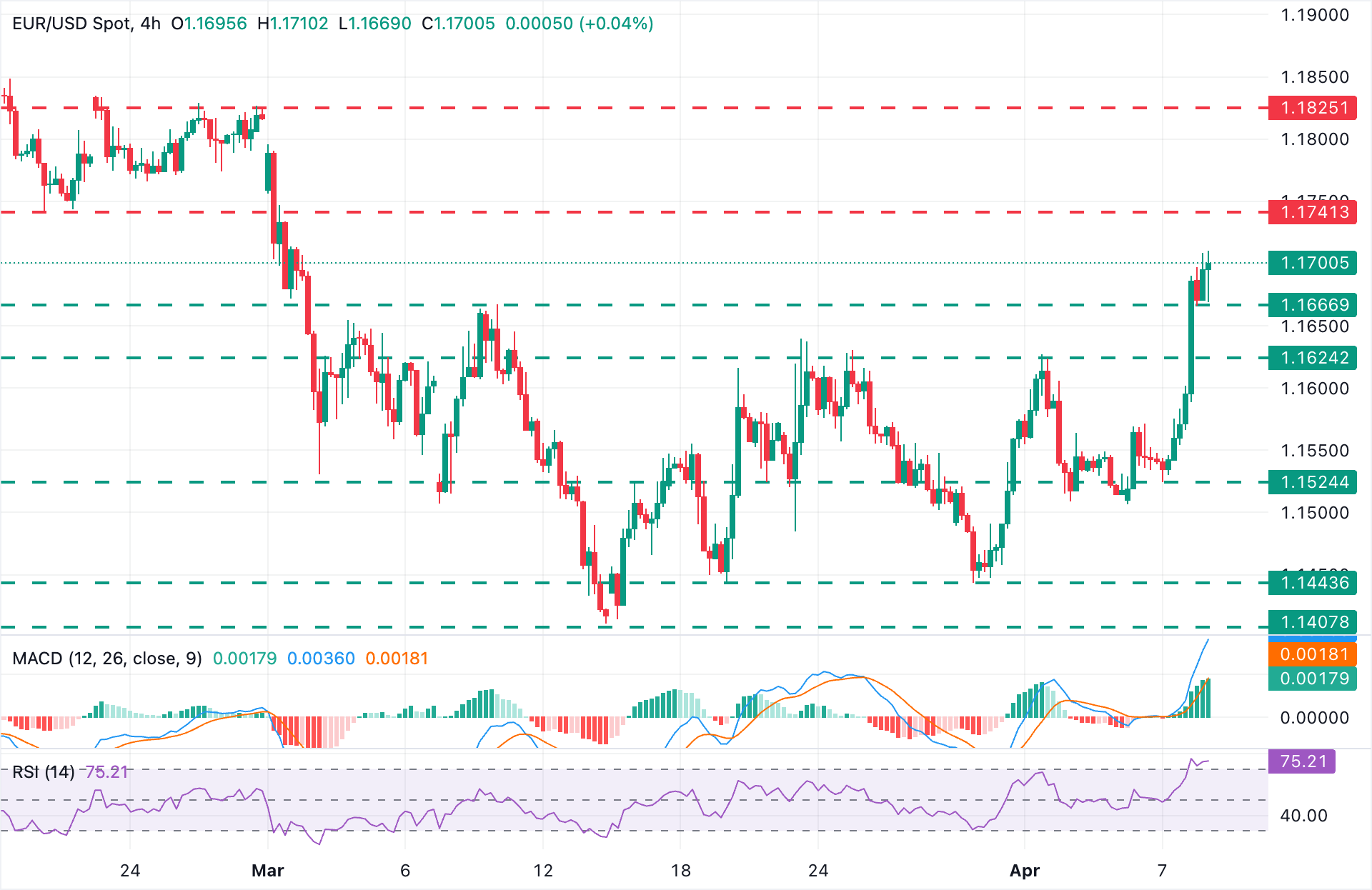
EUR/USD maintains a strong bullish near-term bias. The Relative Strength Index (RSI) has reached overbought levels, but downside attempts are finding buyers so far, while the Moving Average Convergence Divergence (MACD) line has accelerated beyond the signal, and the expanding histogram reinforces building buying pressure.
Bulls remain capped a few pips above 1.1700, yet price action stands comfortably above the previous range top, at 1.1670. Further up, the next targets might be the February 19 and 20 lows, in the 1.1740 area, and the February 26 and 27 highs, around 1.1825.
On the downside, a bearish reaction below March 10 highs near 1.1670 would target the 1.1630-1.1640 area (March 23, 25, and April 1 highs). A reversal to Tuesday's lows at 1.1525 seems off the cards right now.
(The technical analysis of this story was written with the help of an AI tool.)
Economic Indicator
FOMC Minutes
FOMC stands for The Federal Open Market Committee that organizes 8 meetings in a year and reviews economic and financial conditions, determines the appropriate stance of monetary policy and assesses the risks to its long-run goals of price stability and sustainable economic growth. FOMC Minutes are released by the Board of Governors of the Federal Reserve and are a clear guide to the future US interest rate policy.
Next release: Wed Apr 08, 2026 18:00
Frequency: Irregular
Consensus: -
Previous: -
Source: Federal Reserve
Minutes of the Federal Open Market Committee (FOMC) is usually published three weeks after the day of the policy decision. Investors look for clues regarding the policy outlook in this publication alongside the vote split. A bullish tone is likely to provide a boost to the greenback while a dovish stance is seen as USD-negative. It needs to be noted that the market reaction to FOMC Minutes could be delayed as news outlets don’t have access to the publication before the release, unlike the FOMC’s Policy Statement.
Author

Guillermo Alcala
FXStreet
Graduated in Communication Sciences at the Universidad del Pais Vasco and Universiteit van Amsterdam, Guillermo has been working as financial news editor and copywriter in diverse Forex-related firms, like FXStreet and Kantox.
















